Thank you for visiting SNEWPapers!
Sign up free
Martinsburg Gazette
Martinsburg, Berkeley County, West Virginia
What is this article about?
Heated debate in the US House of Representatives over Democratic presidential nominee James K. Polk's opposition to protectionism and support for free trade and Texas annexation. Speakers including Payne, Hardin, Douglass, and Schenck clash on tariffs, political inconsistencies, and naval punishment.
Merged-components note: Merged adjacent columns containing the same congressional debate on the Civil and Diplomatic Bill.
Clipping
OCR Quality
Full Text
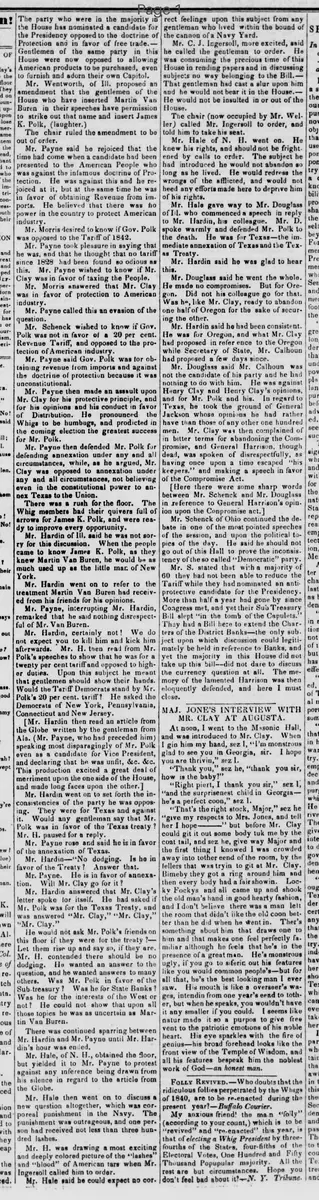
Mr. Wentworth, of Ill. proposed an amendment that the gentlemen of the House who have inserted Martin Van Buren in their speeches have permission to strike out that name and insert James K. Polk, (laughter.)
The chair ruled the amendment to be out of order.
Mr. Payne said he rejoiced that the time had come when a candidate had been presented to the American People who was against the infamous doctrine of Protection. He was against this and he rejoiced at it, but at the same time he was in favor of obtaining Revenue from imports. He believed that there was no power in the country to protect American industry.
Mr. Morris desired to know if Gov. Polk was opposed to the Tariff of 1842.
Mr. Payne took pleasure in saying that he was, and that he thought that no tariff since 1828 had been found so odious as this. Mr. Payne wished to know if Mr. Clay was in favor of taxing the People.
Mr. Morris answered that Mr. Clay was in favor of protection to American industry.
Mr. Payne called this an evasion of the question.
Mr. Schenck wished to know if Gov. Polk was not in favor of a 20 per cent. Revenue Tariff, and opposed to the protection of American industry.
Mr. Payne said Gov. Polk was for obtaining revenue from imports and against the doctrine of protection because it was unconstitutional.
Mr. Payne then made an assault upon Mr. Clay for his protective principle, and for his opinions and his conduct in favor of Distribution. He pronounced the Whigs to be humbugs, and predicted in the coming election the greatest success for Mr. Polk.
Mr. Payne then defended Mr. Polk for defending annexation under any and all circumstances, while, as he argued, Mr. Clay was opposed to annexation under any and all circumstances, not believing even in the constitutional power to annex Texas to the Union.
There was a rush for the floor. The Whig members had their quivers full of arrows for James K. Polk, and were ready to improve every opportunity.
Mr. Hardin of Ill. said he was not sorry for this discussion. When the people came to know James K. Polk, as they knew Martin Van Buren, he would be as much used up as the little man of New York.
Mr. Hardin went on to refer to the treatment Martin Van Buren had received from his friends for his opinions.
Mr. Payne, interrupting Mr. Hardin, remarked that he said nothing disrespectful of Mr. Van Buren.
Mr. Hardin, certainly not! We do not expect you to kill him and kick him afterwards. Mr. H. then read from Mr. Polk's speeches to show that he was for a twenty per cent tariff and opposed to higher duties. Upon this subject he meant that gentlemen should show their hands. Would the Tariff Democrats stand by Mr. Polk's 20 per cent. tariff? He asked the Democrats of New York, Pennsylvania, Connecticut and New Jersey.
[Mr. Hardin then read an article from the Globe written by the gentleman from Ala. (Mr. Payne, who had preceded him) speaking most disparagingly of Mr. Polk even as a candidate for Vice President, and declaring that he was unfit, &c. &c. This production excited a great deal of merriment upon the one side of the House, and made long faces upon the other.]
Mr. Hardin went on to set forth the inconsistencies of the party he was opposing.
They were for Texas and against it.
Would any gentleman say that Mr. Polk was in favor of the Texas treaty?
Mr. H. paused for a reply.
Mr. Payne rose and said he is in favor of the annexation of Texas.
Mr. Hardin "No dodging. Is he in favor of the Treaty? Answer that."
Mr. Payne. He is in favor of annexation. Will Mr. Clay go for it?
Mr. Hardin answered that Mr. Clay's letter spoke for itself. He had asked if Mr. Polk was for the Texas Treaty, and was answered "Mr. Clay," "Mr. Clay," "Mr. Clay."
He would not ask Mr. Polk's friends on this floor if they were for the treaty?—Let them rise up and say so, if they are.
Mr. H. contended there should be no dodging. He wanted an answer to the question, and he wanted answers to many others. Was Mr. Polk in favor of the Sub-treasury? Was he for State Banks? Was he for the interests of the West or not? He could not show that upon all those topics he was as uncertain as Martin Van Buren.
There was continued sparring between Mr. Hardin and Mr. Payne until Mr. Hardin's hour was ended.
Mr. Hale, of N. H., obtained the floor but yielded it to Mr. Payne to protest against any inference being drawn from his silence in regard to the article from the Globe.
Mr. Hale then went on to discuss a new question altogether, which was corporal punishment in the Navy. The punishment was outrageous, and one person had received not less than three hundred lashes.
Mr. H. was drawing a most exciting and deeply colored picture of the "lashes" and "blood" of American tars when Mr. Ingersoll called him to order.
Mr. Hale said he could expect no correct feelings upon this subject from any gentleman who lived within the bound of the Cannon of a Navy Yard.
Mr. C. J. Ingersoll, more excited, said he called the gentleman to order. He was consuming the precious time of this House in reading papers and in discussing subjects no way belonging to the Bill.—That gentleman had cast a slur upon him and he would not bear it in the House.—He would not be insulted in or out of the House.
The chair (now occupied by Mr. Weller) called Mr. Ingersoll to order, and told him to take his seat.
Mr. Hale of N. H. went on. He knew his rights, and should not be frightened by calls to order. The subject he had introduced he would not abandon so long as he lived. He would redress the wrongs of the afflicted, and would not heed any efforts made here to deprive him of his rights.
Mr. Hale gave way to Mr. Douglass of Ill. who commenced a speech in reply to Mr. Hardin, his colleague. Mr. D. spoke warmly and defended Mr. Polk to the death. He was for Texas—the immediate annexation of Texas and the Texas Treaty.
Mr. Hardin said he was glad to hear this.
Mr. Douglass said he went the whole. He made no compromises. But for Oregon. Did not his colleague go for that. Was he, like Mr. Clay, ready to abandon one half of Oregon for the sake of securing the other.
Mr. Hardin said he had been consistent. He was for Oregon, and what Mr. Clay had proposed in reference to the Oregon while Secretary of State, Mr. Calhoun had proposed a few days since.
Mr. Douglass said Mr. Calhoun was not the candidate of his party and he had nothing to do with him. He was against Henry Clay and Henry Clay's opinions, and for Mr. Polk and his. In regard to Texas, he took the ground of General Jackson whose opinions he had rather have than those of any other one hundred men. Mr. Clay was then complained of in bitter terms for abandoning the Compromise, and General Harrison, though dead, was spoken of disrespectfully, as having once upon a time escaped "his keepers," and making a speech in favor of the Compromise Act.
Here there were some sharp words between Mr. Schenck and Mr. Douglass in reference to General Harrison's opinion upon the Compromise act.
Mr. Schenck of Ohio continued the debate in one of the most pointed speeches of the session, and upon the political topics of the day. He said he should not go out of this Hall to prove the inconsistency of the so called "Democratic" party.
Mr. S. stated that with a majority of 60 they had not been able to reduce the Tariff while they had nominated an anti-protective candidate for the Presidency. More than half a year had gone by since Congress met, and yet their Sub Treasury Bill slept "in the tomb of the Capulets."
They had a Bill here to extend the Charters of the District Banks—the only subject upon which discussion could legitimately be held in reference to Banks, and yet the majority in this House did not take up this bill—did not dare to discuss the currency question at all. The memory of the lamented Harrison was then eloquently defended, and here I must close.
What sub-type of article is it?
What themes does it cover?
What keywords are associated?
What entities or persons were involved?
Where did it happen?
Story Details
Key Persons
Location
Us House Of Representatives
Story Details
Debate on Democratic nomination of Polk opposing protectionism, favoring revenue tariffs and Texas annexation; Whigs attack inconsistencies; digressions on naval punishment and Oregon.