Thank you for visiting SNEWPapers!
Sign up free
Story
January 2, 1852
The Republic
Washington, District Of Columbia
What is this article about?
Editorial in The Republic defends President Fillmore's honest and cordial response to Kossuth against The Union's criticism, highlighting the Union's ambiguous stance on intervention in Hungarian affairs and reaffirming the Compromise of 1850 as a final settlement.
Clipping
OCR Quality
95%
Excellent
Full Text
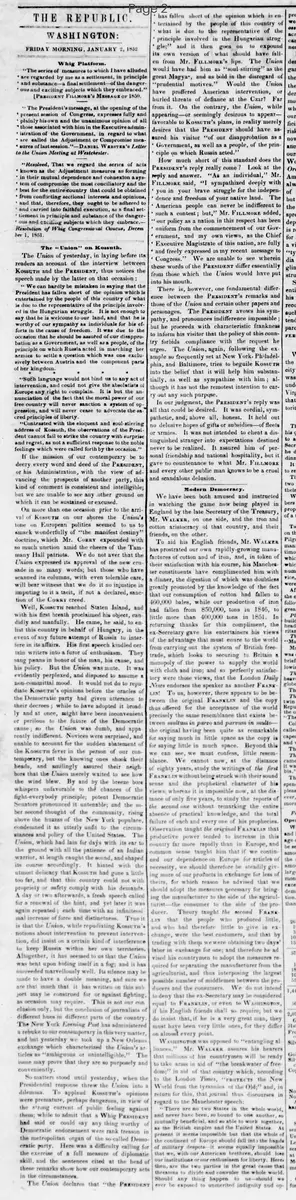
THE REPUBLIC.
WASHINGTON:
Friday Morning, January 2, 1852.
This Platform,
"The series of measures to which I have alluded are regarded by me as a settlement, in principle and substance—a final settlement of the dangerous and exciting subjects which they embraced."
[President Fillmore's Message of 1850.]
"The President's message, at the opening of the present session of Congress, expresses fully and plainly his own and the unanimous opinion of all those associated with him in the Executive administration of the Government, in regard to what are called the Adjustment or Compromise measures of last session."—Daniel Webster's Letter to the Union Meeting at Westchester.
"Resolved, That we regard the series of acts known as the Adjustment measures as forming, in their mutual dependence and connexion, a system of compromise the most conciliatory and the best for the entire country that could be obtained from conflicting sectional interests and opinions, and that, therefore, they ought to be adhered to and carried into faithful execution, as a final settlement in principle and substance of the dangerous and exciting subjects which they embrace."
Resolution of Whig Congressional Caucus, December 1, 1851.
The "Union" on Kossuth.
The Union of yesterday, in laying before its readers an account of the interview between Kossuth and the President, thus notices the speech made by the latter on that occasion:
"We can hardly be mistaken in saying that the President has fallen short of the opinion which is entertained by the people of this country of what is due to the representative of the principle involved in the Hungarian struggle. It is not enough to say that he is welcome to our land, and that he is worthy of our sympathy as individuals for his efforts in the cause of freedom. It was due to the occasion that he should be assured of our disapprobation as a Government, as well as a people, of the principle on which Russia acted in marching her armies to settle a question which was one exclusively between Austria and the component part of her kingdom.
"Such language would not bind us to any act of intervention, and could not give the absolutists of Europe any right to complain. It is but the annunciation of the fact that the moral power of our free country will never sanction a system of oppression, and will never cease to advocate the sacred principles of liberty.
"Contrasted with the eloquent and soul-stirring address of Kossuth, the observations of the President cannot fail to strike the country with surprise and regret, as not a sufficient response to the noble feelings which were called forth by the occasion."
If the mission of our contemporary be to decry every word and deed of the President, or his Administration, with the view of advancing the prospects of another party, this kind of comment is consistent and intelligible; but we are unable to see any other ground on which it can be sustained or excused.
On more than one occasion prior to the arrival of Kossuth on our shores the Union's tone on European politics seemed to us to smack wonderfully of "the manifest destiny" doctrine, which Mr. Corry expounded with so much unction amid the cheers of the Tammany Hall patriots. We do not aver that the Union expressed its approval of the new crusade in so many words; but those who have scanned its columns, with even tolerable care, will bear witness that we do it no injustice in imputing to it a tacit, if not a declared, sanction of the Corry creed.
Well, Kossuth reached Staten Island, and with his first breath proclaimed his object, candidly and manfully. He came, he said, to enlist this country in behalf of Hungary, in the event of any future attempt of Russia to interfere in its affairs. His first speech kindled certain writers into a furor of enthusiasm. They sang paeans in honor of the man, his cause, and his policy. But the Union was mute. It was evidently perplexed, and disposed to assume a non-committal mood. It would not do to repudiate Kossuth's opinions before the oracles of the Democratic party had given utterance to their decrees; while to have adopted it broadly and at once, might have been inconvenient or perilous to the future of the Democratic cause; so the Union was dumb, and apparently indifferent. Novices were surprised, and unable to account for the sudden abatement of the Kossuth fever in the person of our contemporary, but the knowing ones shook their heads, and smilingly assured their neighbors that the Union merely waited to see how the wind blew. By and by the breeze bore whispers unfavorable to the chances of the fight-everybody principle; potent Democratic Senators pronounced it untenable; and the sober second thought of the community, rising above the huzzas of the New York populace, condemned it as utterly unfit to the circumstances and policy of the United States. The Union, which had lain for days with its ear to the ground with all the patience of an Indian warrior, at length caught the sound, and shaped its course accordingly. It hinted with the utmost delicacy that Kossuth had gone a little too far, and that this country could not with propriety or safety comply with his demands. A day or two afterwards, a fresh speech called for a renewal of the hint, and yet later it was again repeated; each time with an infinitesimal increase of force and distinctness. True it is that the Union, while repudiating Kossuth's notions about intervention to prevent intervention, did insist on a certain kind of interference to keep Russia within her own territories. Altogether, it has seemed to us that the Union was bent upon hiding itself in a fog; and it has succeeded marvellously well. Its silence may be made to have a double meaning, and sure we are that much that it has written on this subject may be construed for or against fighting, as occasion may require. This is not our conclusion only, but the conclusion of journalists of different hues in different parts of the country. The New York Evening Post has administered a rebuke to our contemporary in this very matter, and but yesterday we took up a New Orleans exchange which characterized the Union's articles as "ambiguous or unintelligible." The issue may prove that they are so purposely and conveniently.
So matters stood until yesterday, when the Presidential response threw the Union into a dilemma. To applaud Kossuth's opinions were premature, perhaps dangerous, in view of the strong current of public feeling against them; while to admit that a Whig President had said or could say anything worthy of Democratic endorsement were rank treason in the metropolitan organ of the so-called Democratic party. Here was a difficulty calling for the exercise of a full measure of diplomatic skill, and the sentences cited at the head of these remarks show how our contemporary acts in the circumstances.
The Union declares that "the President has fallen short of the opinion which is entertained by the people of this country of what is due to the representative of the principle involved in the Hungarian struggle;" and it then goes on to expound its own version of what should have fallen from Mr. Fillmore's lips. The Union would have had him as "soul-stirring" as the great Magyar, and as bold in the disregard of "prudential motives." Would the Union have proffered American intervention, or hurled threats of defiance at the Czar? Far from it. On the contrary, the Union, while appearing—or seemingly desirous to appear—favorable to Kossuth's plans, in reality merely desires that the President should have assured his visitor "of our disapprobation as a Government, as well as a people, of the principle on which Russia acted."
How much short of this standard does the President's reply really come? Look at the reply and answer. "As an individual," Mr. Fillmore said, "I sympathized deeply with you in your brave struggle for the independence and freedom of your native land. The American people can never be indifferent to such a contest; but," Mr. Fillmore added, "our policy as a nation in this respect has been uniform from the commencement of our Government, and my own views, as the Chief Executive Magistrate of this nation, are fully and freely expressed in my recent message to Congress." We are unable to see wherein these words of the President differ essentially from those which the Union would have put into his mouth.
There is, however, one fundamental difference between the President's remarks and those of the Union and certain other papers and personages. The President avows his sympathy, and pronounces indifference impossible; but he proceeds with characteristic frankness to inform his visitor that the policy of this country forbids compliance with the request he urges. The Union, again, following the example so frequently set at New York, Philadelphia, and Baltimore, tries to beguile Kossuth into the belief that it will help him substantially, as well as sympathize with him; although it has not the remotest intention to carry out any such purpose.
In our judgment, the President's reply was all that could be desired. It was cordial, sympathetic, and, above all, honest. It held out no delusive hopes of gifts or subsidies—of fleets or armies. It was not intended to cheat a distinguished stranger into expectations destined never to be realized. It assured him of personal friendship and national hospitality, but it gave no countenance to what Mr. Fillmore and every other public man knows to be a cruel and scandalous delusion.
WASHINGTON:
Friday Morning, January 2, 1852.
This Platform,
"The series of measures to which I have alluded are regarded by me as a settlement, in principle and substance—a final settlement of the dangerous and exciting subjects which they embraced."
[President Fillmore's Message of 1850.]
"The President's message, at the opening of the present session of Congress, expresses fully and plainly his own and the unanimous opinion of all those associated with him in the Executive administration of the Government, in regard to what are called the Adjustment or Compromise measures of last session."—Daniel Webster's Letter to the Union Meeting at Westchester.
"Resolved, That we regard the series of acts known as the Adjustment measures as forming, in their mutual dependence and connexion, a system of compromise the most conciliatory and the best for the entire country that could be obtained from conflicting sectional interests and opinions, and that, therefore, they ought to be adhered to and carried into faithful execution, as a final settlement in principle and substance of the dangerous and exciting subjects which they embrace."
Resolution of Whig Congressional Caucus, December 1, 1851.
The "Union" on Kossuth.
The Union of yesterday, in laying before its readers an account of the interview between Kossuth and the President, thus notices the speech made by the latter on that occasion:
"We can hardly be mistaken in saying that the President has fallen short of the opinion which is entertained by the people of this country of what is due to the representative of the principle involved in the Hungarian struggle. It is not enough to say that he is welcome to our land, and that he is worthy of our sympathy as individuals for his efforts in the cause of freedom. It was due to the occasion that he should be assured of our disapprobation as a Government, as well as a people, of the principle on which Russia acted in marching her armies to settle a question which was one exclusively between Austria and the component part of her kingdom.
"Such language would not bind us to any act of intervention, and could not give the absolutists of Europe any right to complain. It is but the annunciation of the fact that the moral power of our free country will never sanction a system of oppression, and will never cease to advocate the sacred principles of liberty.
"Contrasted with the eloquent and soul-stirring address of Kossuth, the observations of the President cannot fail to strike the country with surprise and regret, as not a sufficient response to the noble feelings which were called forth by the occasion."
If the mission of our contemporary be to decry every word and deed of the President, or his Administration, with the view of advancing the prospects of another party, this kind of comment is consistent and intelligible; but we are unable to see any other ground on which it can be sustained or excused.
On more than one occasion prior to the arrival of Kossuth on our shores the Union's tone on European politics seemed to us to smack wonderfully of "the manifest destiny" doctrine, which Mr. Corry expounded with so much unction amid the cheers of the Tammany Hall patriots. We do not aver that the Union expressed its approval of the new crusade in so many words; but those who have scanned its columns, with even tolerable care, will bear witness that we do it no injustice in imputing to it a tacit, if not a declared, sanction of the Corry creed.
Well, Kossuth reached Staten Island, and with his first breath proclaimed his object, candidly and manfully. He came, he said, to enlist this country in behalf of Hungary, in the event of any future attempt of Russia to interfere in its affairs. His first speech kindled certain writers into a furor of enthusiasm. They sang paeans in honor of the man, his cause, and his policy. But the Union was mute. It was evidently perplexed, and disposed to assume a non-committal mood. It would not do to repudiate Kossuth's opinions before the oracles of the Democratic party had given utterance to their decrees; while to have adopted it broadly and at once, might have been inconvenient or perilous to the future of the Democratic cause; so the Union was dumb, and apparently indifferent. Novices were surprised, and unable to account for the sudden abatement of the Kossuth fever in the person of our contemporary, but the knowing ones shook their heads, and smilingly assured their neighbors that the Union merely waited to see how the wind blew. By and by the breeze bore whispers unfavorable to the chances of the fight-everybody principle; potent Democratic Senators pronounced it untenable; and the sober second thought of the community, rising above the huzzas of the New York populace, condemned it as utterly unfit to the circumstances and policy of the United States. The Union, which had lain for days with its ear to the ground with all the patience of an Indian warrior, at length caught the sound, and shaped its course accordingly. It hinted with the utmost delicacy that Kossuth had gone a little too far, and that this country could not with propriety or safety comply with his demands. A day or two afterwards, a fresh speech called for a renewal of the hint, and yet later it was again repeated; each time with an infinitesimal increase of force and distinctness. True it is that the Union, while repudiating Kossuth's notions about intervention to prevent intervention, did insist on a certain kind of interference to keep Russia within her own territories. Altogether, it has seemed to us that the Union was bent upon hiding itself in a fog; and it has succeeded marvellously well. Its silence may be made to have a double meaning, and sure we are that much that it has written on this subject may be construed for or against fighting, as occasion may require. This is not our conclusion only, but the conclusion of journalists of different hues in different parts of the country. The New York Evening Post has administered a rebuke to our contemporary in this very matter, and but yesterday we took up a New Orleans exchange which characterized the Union's articles as "ambiguous or unintelligible." The issue may prove that they are so purposely and conveniently.
So matters stood until yesterday, when the Presidential response threw the Union into a dilemma. To applaud Kossuth's opinions were premature, perhaps dangerous, in view of the strong current of public feeling against them; while to admit that a Whig President had said or could say anything worthy of Democratic endorsement were rank treason in the metropolitan organ of the so-called Democratic party. Here was a difficulty calling for the exercise of a full measure of diplomatic skill, and the sentences cited at the head of these remarks show how our contemporary acts in the circumstances.
The Union declares that "the President has fallen short of the opinion which is entertained by the people of this country of what is due to the representative of the principle involved in the Hungarian struggle;" and it then goes on to expound its own version of what should have fallen from Mr. Fillmore's lips. The Union would have had him as "soul-stirring" as the great Magyar, and as bold in the disregard of "prudential motives." Would the Union have proffered American intervention, or hurled threats of defiance at the Czar? Far from it. On the contrary, the Union, while appearing—or seemingly desirous to appear—favorable to Kossuth's plans, in reality merely desires that the President should have assured his visitor "of our disapprobation as a Government, as well as a people, of the principle on which Russia acted."
How much short of this standard does the President's reply really come? Look at the reply and answer. "As an individual," Mr. Fillmore said, "I sympathized deeply with you in your brave struggle for the independence and freedom of your native land. The American people can never be indifferent to such a contest; but," Mr. Fillmore added, "our policy as a nation in this respect has been uniform from the commencement of our Government, and my own views, as the Chief Executive Magistrate of this nation, are fully and freely expressed in my recent message to Congress." We are unable to see wherein these words of the President differ essentially from those which the Union would have put into his mouth.
There is, however, one fundamental difference between the President's remarks and those of the Union and certain other papers and personages. The President avows his sympathy, and pronounces indifference impossible; but he proceeds with characteristic frankness to inform his visitor that the policy of this country forbids compliance with the request he urges. The Union, again, following the example so frequently set at New York, Philadelphia, and Baltimore, tries to beguile Kossuth into the belief that it will help him substantially, as well as sympathize with him; although it has not the remotest intention to carry out any such purpose.
In our judgment, the President's reply was all that could be desired. It was cordial, sympathetic, and, above all, honest. It held out no delusive hopes of gifts or subsidies—of fleets or armies. It was not intended to cheat a distinguished stranger into expectations destined never to be realized. It assured him of personal friendship and national hospitality, but it gave no countenance to what Mr. Fillmore and every other public man knows to be a cruel and scandalous delusion.
What sub-type of article is it?
Historical Event
What themes does it cover?
Justice
Moral Virtue
What keywords are associated?
Kossuth Visit
Fillmore Response
Compromise Measures
Union Criticism
Hungarian Struggle
Non Intervention
Political Ambiguity
What entities or persons were involved?
President Fillmore
Kossuth
Daniel Webster
Mr. Corry
Where did it happen?
Washington
Story Details
Key Persons
President Fillmore
Kossuth
Daniel Webster
Mr. Corry
Location
Washington
Event Date
1852 01 02
Story Details
The Republic critiques The Union's ambiguous and critical response to President Fillmore's interview with Kossuth, defending the President's honest sympathy without promises of intervention, while reaffirming the Compromise of 1850 as a final settlement.