Thank you for visiting SNEWPapers!
Sign up free
Fowle's New Hampshire Gazette And General Advertiser
Portsmouth, Rockingham County, New Hampshire
What is this article about?
A narrative recounts a fictional conversation between an American loyalist and King George III after the Revolutionary War, where the loyalist advises settling refugees in Nova Scotia to establish new British colonies that would compete with and harm American trade, especially New England's fisheries, lumber, and shipbuilding. The author warns of dire economic consequences if refugee return laws are not repealed.
Clipping
OCR Quality
Full Text
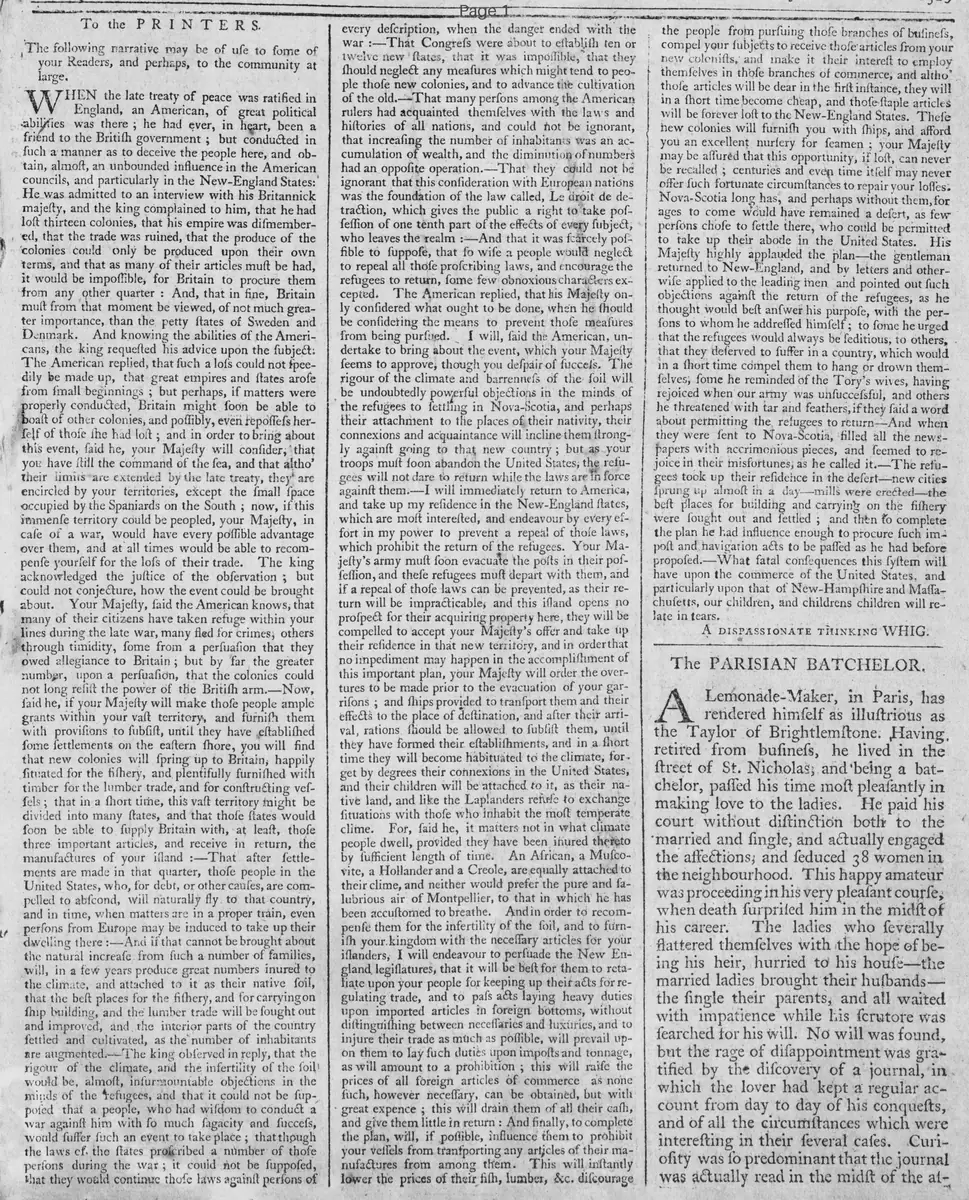
The following narrative may be of use to some of your Readers, and perhaps, to the community at large.
When the late treaty of peace was ratified in England, an American, of great political abilities was there; he had ever, in heart, been a friend to the British government; but conducted in such a manner as to deceive the people here, and obtain, almost, an unbounded influence in the American councils, and particularly in the New-England States:
He was admitted to an interview with his Britannick majesty, and the king complained to him, that he had lost thirteen colonies, that his empire was dismembered, that the trade was ruined, that the produce of the colonies could only be procured upon their own terms, and that as many of their articles must be had, it would be impossible, for Britain to procure them from any other quarter: And, that in fine, Britain must from that moment be viewed, of not much greater importance, than the petty states of Sweden and Denmark. And knowing the abilities of the Americans, the king requested his advice upon the subject:
The American replied, that such a loss could not speedily be made up, that great empires and states arose from small beginnings; but perhaps, if matters were properly conducted, Britain might soon be able to boast of other colonies, and possibly, even repossess herself of those she had lost; and in order to bring about this event, said he, your Majesty will consider; that you have still the command of the sea, and that altho' their limits are extended by the late treaty, they are encircled by your territories, except the small space occupied by the Spaniards on the South; now, if this immense territory could be peopled, your Majesty, in case of a war, would have every possible advantage over them, and at all times would be able to recompense yourself for the loss of their trade. The king acknowledged the justice of the observation; but could not conjecture, how the event could be brought about. Your Majesty, said the American knows, that many of their citizens have taken refuge within your lines during the late war, many fled for crimes, others through timidity, some from a persuasion that they owed allegiance to Britain; but by far the greater number, upon a persuasion, that the colonies could not long resist the power of the British arm.--Now, said he, if your Majesty will make those people ample grants within your vast territory, and furnish them with provisions to subsist, until they have established some settlements on the eastern shore, you will find that new colonies will spring up to Britain; happily situated for the fishery, and plentifully furnished with timber for the lumber trade, and for constructing vessels; that in a short time, this vast territory might be divided into many states, and that those states would soon be able to supply Britain with, at least, those three important articles, and receive in return, the manufactures of your island:--That after settlements are made in that quarter, those people in the United States, who, for debt, or other causes, are compelled to abscond, will naturally fly to that country, and in time, when matters are in a proper train, even persons from Europe may be induced to take up their dwelling there:--And if that cannot be brought about the natural increase from such a number of families, will, in a few years produce great numbers inured to the climate, and attached to it as their native soil, that the best places for the fishery, and for carrying on ship building, and the lumber trade will be sought out and improved, and the interior parts of the country settled and cultivated as the number of inhabitants are augmented.- The king observed in reply, that the rigour of the climate, and the infertility of the soil would be, almost, insurmountable objections in the minds of the refugees, and that it could not be supposed that a people, who had wisdom to conduct a war against him with so much sagacity and success, would suffer such an event to take place; that though the laws of the states proscribed a number of those persons during the war; it could not be supposed, that they would continue those laws against persons of every description, when the danger ended with the war:--That Congress were about to establish ten or twelve new states, that it was impossible, that they should neglect any measures which might tend to people those new colonies, and to advance the cultivation of the old.- That many persons among the American rulers had acquainted themselves with the laws and histories of all nations, and could not be ignorant, that increasing the number of inhabitants was an accumulation of wealth, and the diminution of numbers had an opposite operation.--That they could not be ignorant that this consideration with European nations was the foundation of the law called, Le droit d'extraction, which gives the public a right to take possession of one tenth part of the effects of every subject, who leaves the realm:--And that it was scarcely possible to suppose, that so wise a people would neglect to repeal all those proscribing laws, and encourage the refugees to return, some few obnoxious characters excepted. The American replied, that his Majesty only considered what ought to be done, when he should be considering the means to prevent those measures from being pursued. I will, said the American. undertake to bring about the event, which your Majesty seems to approve, though you despair of success. The rigour of the climate and barrenness of the soil will be undoubtedly powerful objections in the minds of the refugees to settling in Nova-Scotia, and perhaps their attachment to the places of their nativity, their connexions and acquaintance will incline them strongly against going to that new country; but as your troops must soon abandon the United States; the refugees will not dare to return while the laws are in force against them.---I will immediately return to America, and take up my residence in the New-England states, which are most interested, and endeavour by every effort in my power to prevent a repeal of those laws, which prohibit the return of the refugees. Your Majesty's army must soon evacuate the posts in their possession, and these refugees must depart with them, and if a repeal of those laws can be prevented, as their return will be impracticable, and this island opens no prospect for their acquiring property here, they will be compelled to accept your Majesty's offer and take up their residence in that new territory, and in order that no impediment may happen in the accomplishment of this important plan, your Majesty will order the overtures to be made prior to the evacuation of your garrisons; and ships provided to transport them and their effects to the place of destination. and after their arrival, rations should be allowed to subsist them, until they have formed their establishments, and in a short time they will become habituated to the climate, forget by degrees their connexions in the United States, and their children will be attached to it, as their native land, and like the Laplanders refuse to exchange situations with those who inhabit the most temperate clime. For, said he, it matters not in what climate people dwell, provided they have been inured thereto by sufficient length of time. An African, a Muscovite, a Hollander and a Creole, are equally attached to their clime, and neither would prefer the pure and salubrious air of Montpellier, to that in which he has been accustomed to breathe. And in order to recompense them for the infertility of the soil. and to furnish your kingdom with the necessary articles for your islanders. I will endeavour to persuade the New England legislatures, that it will be best for them to retaliate upon your people for keeping up their acts for regulating trade, and to pass acts laying heavy duties upon imported articles in foreign bottoms, without distinguishing between necessaries and luxuries, and to injure their trade as much as possible, will prevail upon them to lay such duties upon imports and tonnage, as will amount to a prohibition; this will raise the prices of all foreign articles of commerce as none such, however necessary, can be obtained, but with great expense; this will drain them of all their cash, and give them little in return: And finally, to complete the plan, will, if possible, influence them to prohibit your vessels from transporting any articles of their manufactures from among them. This will instantly lower the prices of their fish, lumber, &c. discourage the people from pursuing those branches of business, compel your subjects to receive those articles from your new colonies, and make it their interest to employ themselves in those branches of commerce, and altho those articles will be dear in the first instance, they will in a short time become cheap, and those staple articles will be forever lost to the New-England States. These new colonies will furnish you with ships, and afford you an excellent nursery for seamen; your Majesty may be assured that this opportunity, if lost, can never be recalled; centuries and even time itself may never offer such fortunate circumstances to repair your losses. Nova-Scotia long has, and perhaps without them, for ages to come would have remained a desert, as few persons chose to settle there, who could be permitted to take up their abode in the United States. His Majesty highly applauded the plan--the gentleman returned to New-England, and by letters and otherwise applied to the leading men and pointed out such objections against the return of the refugees, as he thought would best answer his purpose, with the persons to whom he addressed himself; to some he urged that the refugees would always be seditious, to others, that they deserved to suffer in a country, which would in a short time compel them to hang or drown themselves; some he reminded of the Tory's wives, having rejoiced when our army was unsuccessful, and others he threatened with tar and feathers, if they said a word about permitting the refugees to return--And when they were sent to Nova-Scotia, filled all the newspapers with acrimonious pieces, and seemed to rejoice in their misfortunes, as he called it.-The refugees took up their residence in the desert new cities sprung up almost in a day--mills were erected-the best places for building and carrying on the fishery were sought out and settled; and then to complete the plan he had influence enough to procure such import and navigation acts to be passed as he had before proposed.--What fatal consequences this system will have upon the commerce of the United States. and particularly upon that of New-Hampshire and Massachusetts, our children, and children's children will relate in tears.
A DISPASSIONATE THINKING WHIG.
What sub-type of article is it?
What themes does it cover?
What keywords are associated?
What entities or persons were involved?
Letter to Editor Details
Author
A Dispassionate Thinking Whig.
Recipient
To The Printers.
Main Argument
preventing the return of loyalist refugees by maintaining proscription laws will force them to settle in nova scotia, establishing new british colonies that will supply britain with fish, lumber, and ships, thereby ruining new england's commerce through retaliatory trade acts influenced by a duplicitous american advisor.
Notable Details