Thank you for visiting SNEWPapers!
Sign up free
Poem
September 8, 1827
The Ladies' Garland
Harpers Ferry, Jefferson County, West Virginia
What is this article about?
Excerpt from 'The Nightingale,' a conversation poem written in April 1798, describing a serene night scene and reflecting on the nightingale's song as joyful and full of love, critiquing the notion of its melancholy and poets who misinterpret nature.
Clipping
OCR Quality
95%
Excellent
Full Text
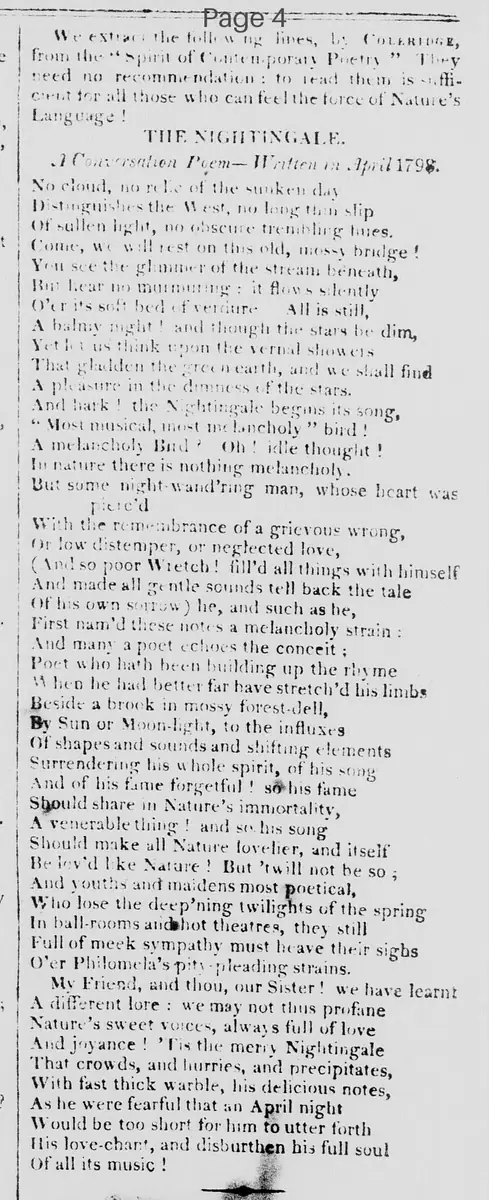
We extract the following lines, by our correspondent, from the "Spirit of Contemporary Poetry." They need no recommendation: to read them is sufficient for all those who can feel the force of Nature's Language!
THE NIGHTINGALE.
A Conversation Poem--Written in April 1798.
No cloud, no gleam of the sunken day
Distinguishes the West, no long thin slip
Of sullen light, no obscure trembling hues.
Come, we will rest on this old, mossy bridge!
You see the glimmer of the stream beneath,
But hear no murmuring: it flows silently,
O'er its soft bed of verdure. All is still,
A balmy night! and though the stars be dim,
Yet let us think upon the vernal showers
That gladden the green earth, and we shall find
A pleasure in the dimness of the stars.
And hark! the Nightingale begins its song,
"Most musical, most melancholy" bird!
A melancholy Bird? Oh! idle thought!
In nature there is nothing melancholy.
But some night-wandering man, whose heart was pierced
with the remembrance of a grievous wrong
Or slow distemper, or neglected love,
(And so, poor wretch! filled all things with himself,
And made all gentle sounds tell back the tale
Of his own sorrow) he, and such as he,
First named these notes a melancholy strain:
And many a poet echoes the conceit;
Poet who hath been building up the rhyme
When he had better far have stretched his limbs
Beside a brook in mossy forest-dell,
By Sun or Moon-light, to the influxes
Of shapes and sounds and shifting elements
Surrendering his whole spirit, of his song
And of his fame forgetful! so his fame
Should share in Nature's immortality,
A venerable thing! and so his song
Should make all Nature lovelier, and itself
Be loved like Nature! But 'twill not be so;
And youths and maidens most poetical,
Who lose the deepening twilights of the spring
In ball-rooms and hot theatres, they still
Full of meek sympathy must heave their sighs
O'er Philomela's pity-pleading strains.
My Friend, and thou, our Sister! we have learnt
A different lore: we may not thus profane
Nature's sweet voices, always full of love
And joyance! 'Tis the merry Nightingale
That crowds, and hurries, and precipitates
With fast thick warble, his delicious notes,
As he were fearful, that an April night
Would be too short for him to utter forth
His love-charm, and disburden his full soul
Of all its music!
And of his fame forgetful! so his fame
THE NIGHTINGALE.
A Conversation Poem--Written in April 1798.
No cloud, no gleam of the sunken day
Distinguishes the West, no long thin slip
Of sullen light, no obscure trembling hues.
Come, we will rest on this old, mossy bridge!
You see the glimmer of the stream beneath,
But hear no murmuring: it flows silently,
O'er its soft bed of verdure. All is still,
A balmy night! and though the stars be dim,
Yet let us think upon the vernal showers
That gladden the green earth, and we shall find
A pleasure in the dimness of the stars.
And hark! the Nightingale begins its song,
"Most musical, most melancholy" bird!
A melancholy Bird? Oh! idle thought!
In nature there is nothing melancholy.
But some night-wandering man, whose heart was pierced
with the remembrance of a grievous wrong
Or slow distemper, or neglected love,
(And so, poor wretch! filled all things with himself,
And made all gentle sounds tell back the tale
Of his own sorrow) he, and such as he,
First named these notes a melancholy strain:
And many a poet echoes the conceit;
Poet who hath been building up the rhyme
When he had better far have stretched his limbs
Beside a brook in mossy forest-dell,
By Sun or Moon-light, to the influxes
Of shapes and sounds and shifting elements
Surrendering his whole spirit, of his song
And of his fame forgetful! so his fame
Should share in Nature's immortality,
A venerable thing! and so his song
Should make all Nature lovelier, and itself
Be loved like Nature! But 'twill not be so;
And youths and maidens most poetical,
Who lose the deepening twilights of the spring
In ball-rooms and hot theatres, they still
Full of meek sympathy must heave their sighs
O'er Philomela's pity-pleading strains.
My Friend, and thou, our Sister! we have learnt
A different lore: we may not thus profane
Nature's sweet voices, always full of love
And joyance! 'Tis the merry Nightingale
That crowds, and hurries, and precipitates
With fast thick warble, his delicious notes,
As he were fearful, that an April night
Would be too short for him to utter forth
His love-charm, and disburden his full soul
Of all its music!
And of his fame forgetful! so his fame
What sub-type of article is it?
Ode
Pastoral
What themes does it cover?
Nature Seasons
Moral Virtue
Satire Society
What keywords are associated?
Nightingale
Nature
Melancholy
Poetry
April 1798
Conversation Poem
Joyance
Poem Details
Title
The Nightingale.
Subject
A Conversation Poem Written In April 1798.
Form / Style
Blank Verse Conversation Poem
Key Lines
"Most Musical, Most Melancholy" Bird!
In Nature There Is Nothing Melancholy.
'Tis The Merry Nightingale
That Crowds, And Hurries, And Precipitates
With Fast Thick Warble, His Delicious Notes,