Thank you for visiting SNEWPapers!
Sign up free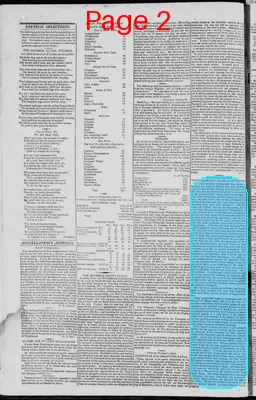
Domestic News
February 1, 1822
American Watchman
Wilmington, New Castle County, Delaware
What is this article about?
Editorial from Democratic Press encourages U.S. farmers, especially in Pennsylvania, to grow more wool, hemp, flax, and potatoes to reduce imports, boost manufacturing, and increase national prosperity, citing shortages and trade data.
Clipping
OCR Quality
95%
Excellent
Full Text
From the Democratic Press.
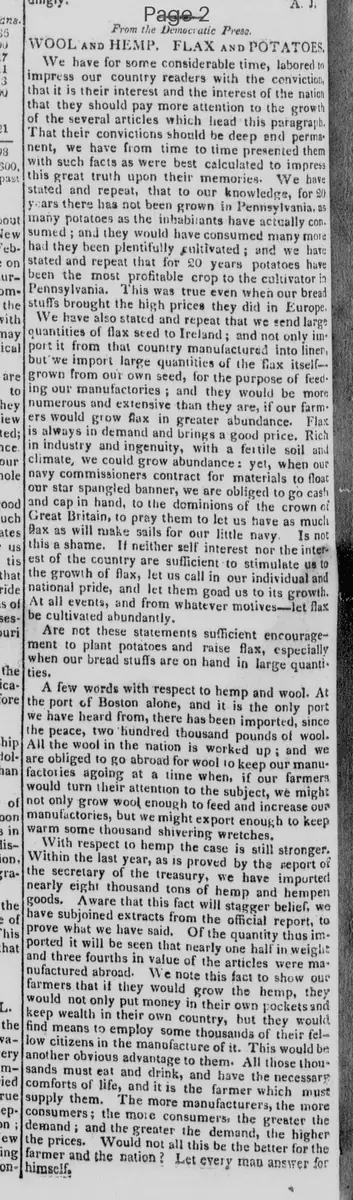
WOOL AND HEMP. FLAX AND POTATOES.
We have for some considerable time, labored to impress our country readers with the conviction, that it is their interest and the interest of the nation that they should pay more attention to the growth of the several articles which head this paragraph. That their convictions should be deep and permanent, we have from time to time presented them with such facts as were best calculated to impress this great truth upon their memories. We have stated and repeat, that to our knowledge, for 20 years there has not been grown in Pennsylvania, as many potatoes as the inhabitants have actually consumed; and they would have consumed many more had they been plentifully cultivated; and we have stated and repeat that for 20 years potatoes have been the most profitable crop to the cultivator in Pennsylvania. This was true even when our breadstuffs brought the high prices they did in Europe. We have also stated and repeat that we send large quantities of flax seed to Ireland; and not only import it from that country manufactured into linen, but we import large quantities of the flax itself—grown from our own seed, for the purpose of feeding our manufactories; and they would be more numerous and extensive than they are, if our farmers would grow flax in greater abundance. Flax is always in demand and brings a good price. Rich in industry and ingenuity, with a fertile soil and climate, we could grow abundance: yet, when our navy commissioners contract for materials to float our star spangled banner, we are obliged to go cap in hand, to the dominions of the crown of Great Britain, to pray them to let us have as much flax as will make sails for our little navy. Is not this a shame. If neither self interest nor the interest of the country are sufficient to stimulate us to the growth of flax, let us call in our individual and national pride, and let them goad us to its growth. At all events, and from whatever motives let flax be cultivated abundantly.
Are not these statements sufficient encouragement to plant potatoes and raise flax, especially when our bread stuffs are on hand in large quantities.
A few words with respect to hemp and wool. At the port of Boston alone, and it is the only port we have heard from, there has been imported, since the peace, two hundred thousand pounds of wool. All the wool in the nation is worked up : and we are obliged to go abroad for wool to keep our manufactories agoing at a time when, if our farmers would turn their attention to the subject, we might not only grow wool enough to feed and increase our manufactories, but we might export enough to keep warm some thousand shivering wretches.
With respect to hemp the case is still stronger. Within the last year, as is proved by the report of the secretary of the treasury, we have imported nearly eight thousand tons of hemp and hempen goods. Aware that this fact will stagger belief, we have subjoined extracts from the official report, to prove what we have said. Of the quantity thus imported it will be seen that nearly one half in weight and three fourths in value of the articles were manufactured abroad. We note this fact to show our farmers that if they would grow the hemp, they would not only put money in their own pockets and keep wealth in their own country, but they would find means to employ some thousands of their fellow citizens in the manufacture of it. This would be another obvious advantage to them. All those thousands must eat and drink, and have the necessary comforts of life, and it is the farmer which must supply them. The more manufacturers, the more consumers; the more consumers, the greater the demand; and the greater the demand, the higher the prices. Would not all this be the better for the farmer and the nation? Let every man answer for himself.
WOOL AND HEMP. FLAX AND POTATOES.
We have for some considerable time, labored to impress our country readers with the conviction, that it is their interest and the interest of the nation that they should pay more attention to the growth of the several articles which head this paragraph. That their convictions should be deep and permanent, we have from time to time presented them with such facts as were best calculated to impress this great truth upon their memories. We have stated and repeat, that to our knowledge, for 20 years there has not been grown in Pennsylvania, as many potatoes as the inhabitants have actually consumed; and they would have consumed many more had they been plentifully cultivated; and we have stated and repeat that for 20 years potatoes have been the most profitable crop to the cultivator in Pennsylvania. This was true even when our breadstuffs brought the high prices they did in Europe. We have also stated and repeat that we send large quantities of flax seed to Ireland; and not only import it from that country manufactured into linen, but we import large quantities of the flax itself—grown from our own seed, for the purpose of feeding our manufactories; and they would be more numerous and extensive than they are, if our farmers would grow flax in greater abundance. Flax is always in demand and brings a good price. Rich in industry and ingenuity, with a fertile soil and climate, we could grow abundance: yet, when our navy commissioners contract for materials to float our star spangled banner, we are obliged to go cap in hand, to the dominions of the crown of Great Britain, to pray them to let us have as much flax as will make sails for our little navy. Is not this a shame. If neither self interest nor the interest of the country are sufficient to stimulate us to the growth of flax, let us call in our individual and national pride, and let them goad us to its growth. At all events, and from whatever motives let flax be cultivated abundantly.
Are not these statements sufficient encouragement to plant potatoes and raise flax, especially when our bread stuffs are on hand in large quantities.
A few words with respect to hemp and wool. At the port of Boston alone, and it is the only port we have heard from, there has been imported, since the peace, two hundred thousand pounds of wool. All the wool in the nation is worked up : and we are obliged to go abroad for wool to keep our manufactories agoing at a time when, if our farmers would turn their attention to the subject, we might not only grow wool enough to feed and increase our manufactories, but we might export enough to keep warm some thousand shivering wretches.
With respect to hemp the case is still stronger. Within the last year, as is proved by the report of the secretary of the treasury, we have imported nearly eight thousand tons of hemp and hempen goods. Aware that this fact will stagger belief, we have subjoined extracts from the official report, to prove what we have said. Of the quantity thus imported it will be seen that nearly one half in weight and three fourths in value of the articles were manufactured abroad. We note this fact to show our farmers that if they would grow the hemp, they would not only put money in their own pockets and keep wealth in their own country, but they would find means to employ some thousands of their fellow citizens in the manufacture of it. This would be another obvious advantage to them. All those thousands must eat and drink, and have the necessary comforts of life, and it is the farmer which must supply them. The more manufacturers, the more consumers; the more consumers, the greater the demand; and the greater the demand, the higher the prices. Would not all this be the better for the farmer and the nation? Let every man answer for himself.
What sub-type of article is it?
Agriculture
Economic
What keywords are associated?
Wool Cultivation
Hemp Production
Flax Growth
Potato Farming
Agricultural Imports
Manufacturing Encouragement
Where did it happen?
Pennsylvania
Domestic News Details
Primary Location
Pennsylvania
Event Details
Editorial urging farmers to cultivate wool, hemp, flax, and potatoes for national interest and profit, highlighting shortages in Pennsylvania and imports from abroad, with facts on consumption, prices, and trade.