Thank you for visiting SNEWPapers!
Sign up free
Editorial
October 7, 1842
The Illinois Free Trader And Lasalle County Commercial Advertiser
Ottawa, La Salle County County, Illinois
What is this article about?
This editorial reflects on the profound moral, political, and social transformations over the past two centuries, contrasting Native American wilderness life with modern American comforts and global progress toward enlightenment and freedom, predicting further advancements.
Clipping
OCR Quality
95%
Excellent
Full Text
TWO HUNDRED YEARS.
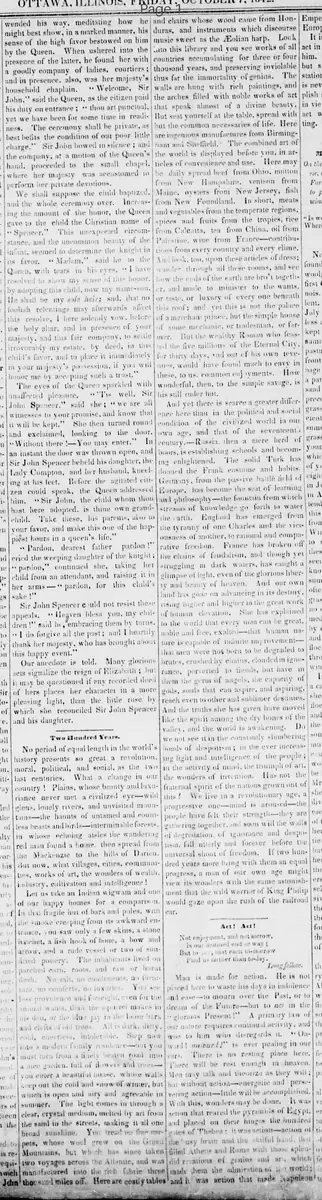
No period of equal length in the world's history presents so great a revolution, moral, political, and social, as the two last centuries. What a change in our country! Plains, whose beauty and luxuriance never met a civilized eye—wild glens, lonely rivers, and unvisited mountains—the haunts of untamed and countless beasts and birds—interminable forests, in whose echoing aisles the wandering red man found a home, then spread from the Mackenzie to the hills of Darien. But now, what villages, cities, communities, works of art, the wonders of wealth, industry, cultivation and intelligence!
Let us take an Indian wigwam and one of our happy homes for a comparison. In that fragile hut of bark and poles, with the smoke creeping from its awkward entrance, you saw only a few skins, a stone hatchet, a fish hook of bone, a bow and arrow, and a rude vessel or two of sundried pottery. The inhabitants lived on parched corn, roots, and raw or burnt flesh. No salt, no condiments, no furniture, no comforts, no luxuries. You see less providence and foresight, even for the passing wants, than the squirrel makes in his den, or the blue jay by the loose bark and chinks of old trees. All is dark, dirty, cold, cheerless, intolerable. Step now into a modern family residence—but you must turn from a finely beaten road into a nice garden, full of flowers and trees—you enter a beautiful house, whose walls keep out the cold and snow of winter, but which is open and airy and agreeable in summer. The light comes in through a clear, crystal medium, melted by art from the sand in the streets, making it all one broad sunshine. You tread on fine carpets, whose wool grew on the Green Mountains, but which has since taken two voyages across the Atlantic, and was manufactured into the rich fabric three thousand miles off. Here are costly tables and chairs whose wood came from Honduras, and instruments which discourse music sweet as the Eolian harp. Look into this library and you see works of all countries accumulating for three or four thousand years, and preserving inviolable thus far the immortality of genius. The walls are hung with rich paintings, and the arches filled with noble works of art that speak almost of a divine beauty.
But seat yourself at the table, spread with but the common necessaries of life. Here are ingenious manufactures from Birmingham and Sheffield. The combined art of the world is displayed before you, in articles of convenience and use. Here may be daily spread beef from Ohio, mutton from New Hampshire, venison from Maine, oysters from New Jersey, fish from Newfoundland. In short, meats and vegetables from the temperate regions, spices and fruits from the tropics, rice from Calcutta, tea from China, oil from Palestine, wine from France—contributions from every country and every clime. And look, too, upon these articles of dress; wander through all these rooms, and see how the ends of the earth are brought together, and made to minister to the wants, or taste, or luxury of every one beneath this roof: and yet this is not the palace of a merchant prince, but the simple house of some mechanic, or tradesman, or farmer. But the wealthy Roman who feasted the five millions of the Eternal City, for thirty days, and out of his own revenues, would have found much to envy in these, to us, common enjoyments. How wonderful, then, to the simple savage, is his still ruder hut.
And yet there is scarce a greater difference here than in the political and social condition of the civilized world in our own age, and that of the seventeenth century. Russia, then a mere herd of boors, is establishing schools and becoming enlightened. The stolid Turk has donned the Frank costume and habits. Germany, from the passive battle field of Europe, has become the seat of learning and philosophy—the fountain from which streams of knowledge go forth to water the earth. England has emerged from the tyranny of one Charles and the viciousness of another, to rational and comparative freedom. France has broken off the chains of feudalism, and though yet struggling in dark waters, has caught a glimpse of light, even of the glorious liberty and beauty of heaven. And our own land has gone on advancing in its destiny, rising higher and higher in the great work of human elevation. She has explained to the world that every man can be great, noble and free, exalted—that human nature is capable of infinite improvement—that men were not born to be degraded to brutes, crushed by chains, clouded in ignorance, perverted to fiends, but have in them the germ of angels, the capacity of gods, souls that can aspire, and aspiring, reach even to other and sublimer destinies. And the truths she has given have moved like the spirit among the dry bones of the valley, and the world is awakening. Do we not see it in the constantly slumbering bonds of despotism; in the ever increasing light and intelligence of the people; in the activity of mind, the triumph of art, the wonders of invention. Has not the fraternal spirit of the nations grown out of this? We live in a revolutionary age, a progressive one—and its aroused—the people have felt their strength—they are gathering together, and soon will the walls of degradation, of ignorance and despotism, fall utterly and forever before the universal shout of freedom. If two hundred years more bring with them an equal progress, a man of our own age might view its wonders with the same astonishment that the wild warrior of King Philip would gaze upon the rush of the railroad car.
No period of equal length in the world's history presents so great a revolution, moral, political, and social, as the two last centuries. What a change in our country! Plains, whose beauty and luxuriance never met a civilized eye—wild glens, lonely rivers, and unvisited mountains—the haunts of untamed and countless beasts and birds—interminable forests, in whose echoing aisles the wandering red man found a home, then spread from the Mackenzie to the hills of Darien. But now, what villages, cities, communities, works of art, the wonders of wealth, industry, cultivation and intelligence!
Let us take an Indian wigwam and one of our happy homes for a comparison. In that fragile hut of bark and poles, with the smoke creeping from its awkward entrance, you saw only a few skins, a stone hatchet, a fish hook of bone, a bow and arrow, and a rude vessel or two of sundried pottery. The inhabitants lived on parched corn, roots, and raw or burnt flesh. No salt, no condiments, no furniture, no comforts, no luxuries. You see less providence and foresight, even for the passing wants, than the squirrel makes in his den, or the blue jay by the loose bark and chinks of old trees. All is dark, dirty, cold, cheerless, intolerable. Step now into a modern family residence—but you must turn from a finely beaten road into a nice garden, full of flowers and trees—you enter a beautiful house, whose walls keep out the cold and snow of winter, but which is open and airy and agreeable in summer. The light comes in through a clear, crystal medium, melted by art from the sand in the streets, making it all one broad sunshine. You tread on fine carpets, whose wool grew on the Green Mountains, but which has since taken two voyages across the Atlantic, and was manufactured into the rich fabric three thousand miles off. Here are costly tables and chairs whose wood came from Honduras, and instruments which discourse music sweet as the Eolian harp. Look into this library and you see works of all countries accumulating for three or four thousand years, and preserving inviolable thus far the immortality of genius. The walls are hung with rich paintings, and the arches filled with noble works of art that speak almost of a divine beauty.
But seat yourself at the table, spread with but the common necessaries of life. Here are ingenious manufactures from Birmingham and Sheffield. The combined art of the world is displayed before you, in articles of convenience and use. Here may be daily spread beef from Ohio, mutton from New Hampshire, venison from Maine, oysters from New Jersey, fish from Newfoundland. In short, meats and vegetables from the temperate regions, spices and fruits from the tropics, rice from Calcutta, tea from China, oil from Palestine, wine from France—contributions from every country and every clime. And look, too, upon these articles of dress; wander through all these rooms, and see how the ends of the earth are brought together, and made to minister to the wants, or taste, or luxury of every one beneath this roof: and yet this is not the palace of a merchant prince, but the simple house of some mechanic, or tradesman, or farmer. But the wealthy Roman who feasted the five millions of the Eternal City, for thirty days, and out of his own revenues, would have found much to envy in these, to us, common enjoyments. How wonderful, then, to the simple savage, is his still ruder hut.
And yet there is scarce a greater difference here than in the political and social condition of the civilized world in our own age, and that of the seventeenth century. Russia, then a mere herd of boors, is establishing schools and becoming enlightened. The stolid Turk has donned the Frank costume and habits. Germany, from the passive battle field of Europe, has become the seat of learning and philosophy—the fountain from which streams of knowledge go forth to water the earth. England has emerged from the tyranny of one Charles and the viciousness of another, to rational and comparative freedom. France has broken off the chains of feudalism, and though yet struggling in dark waters, has caught a glimpse of light, even of the glorious liberty and beauty of heaven. And our own land has gone on advancing in its destiny, rising higher and higher in the great work of human elevation. She has explained to the world that every man can be great, noble and free, exalted—that human nature is capable of infinite improvement—that men were not born to be degraded to brutes, crushed by chains, clouded in ignorance, perverted to fiends, but have in them the germ of angels, the capacity of gods, souls that can aspire, and aspiring, reach even to other and sublimer destinies. And the truths she has given have moved like the spirit among the dry bones of the valley, and the world is awakening. Do we not see it in the constantly slumbering bonds of despotism; in the ever increasing light and intelligence of the people; in the activity of mind, the triumph of art, the wonders of invention. Has not the fraternal spirit of the nations grown out of this? We live in a revolutionary age, a progressive one—and its aroused—the people have felt their strength—they are gathering together, and soon will the walls of degradation, of ignorance and despotism, fall utterly and forever before the universal shout of freedom. If two hundred years more bring with them an equal progress, a man of our own age might view its wonders with the same astonishment that the wild warrior of King Philip would gaze upon the rush of the railroad car.
What sub-type of article is it?
Social Reform
Moral Or Religious
What keywords are associated?
Historical Progress
Social Revolution
Human Elevation
Civilization Advancement
Moral Transformation
Political Freedom
Global Enlightenment
What entities or persons were involved?
Native Americans
Russia
Turkey
Germany
England
France
America
King Philip
Editorial Details
Primary Topic
Two Centuries Of Moral, Political, And Social Progress
Stance / Tone
Optimistic Celebration Of Human Advancement And Enlightenment
Key Figures
Native Americans
Russia
Turkey
Germany
England
France
America
King Philip
Key Arguments
Profound Changes In Living Conditions From Native American Huts To Modern Homes
Global Contributions To Everyday Comforts In America
Political Transformations In Europe From Tyranny To Freedom
America's Role In Demonstrating Human Potential For Greatness And Liberty
World Awakening To Progress, Invention, And Fraternal Spirit
Prediction Of Further Revolutionary Advancements