Thank you for visiting SNEWPapers!
Sign up free
The New York Herald
New York, New York County, New York
What is this article about?
Trial proceedings in Jersey City, NJ, for Spencer accused of murdering his wife on July 15. Defense appeals for acquittal; Attorney General counters insanity defense, stresses jealousy motive, reviews sanity evidence, and invokes legal precedents amid crowded courtroom.
Clipping
OCR Quality
Full Text
Jersey City:
COURT OF OYER AND TERMINER, HUDSON CO., N. J.
Before Chief Justice Hornblower, and Judges John Tonnelle, junr, James M'Donnell, John Grifth, John G. Speer, C. Van Winkle, and Geo. C. DeKay.
SIXTEENTH DAY.
The Court room was as usual crowded to excess with the "gentler sex," who have evinced the liveliest interest during this trial, and daily filled the galleries and the inner bar. During the time of recess, the galleries remained almost filled with the fair occupants, and many of them partook of a comfortable dejeuner in the galleries, talking over the facts connected with the trial.
The Defence concluded a long appeal to the jury, about 12½ o'clock, and commented very fully upon the facts brought out upon the trial, concluding by calling upon the jury not to be led away by prejudice, or a too zealous anxiety, but to weigh well the entire facts and circumstances of the case—feeling a deep confidence in their determination to acquit the prisoner. The Court here took a
RECESS
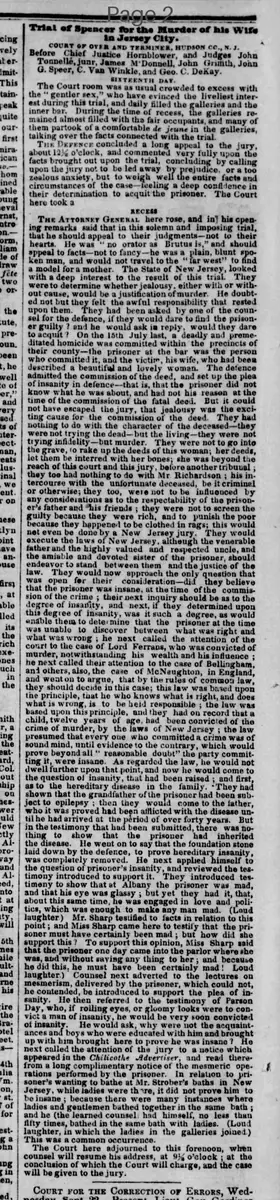
The Attorney General here rose, and in his opening remarks said that in this solemn and imposing trial, that he should appeal to their judgments—not to their hearts. He was "no orator as Brutus is." and should appeal to facts—not to fancy—he was a plain, blunt spoken man, and would not travel to the "far west" to find a model for a mother. The State of New Jersey, looked with a deep interest to the result of this trial. They were to determine whether jealousy, either with or without cause, would be a justification of murder. He doubted not but they felt the awful responsibility that rested upon them. They had been asked by one of the counsel for the defence, if they would dare to find the prisoner guilty? and he would ask in reply, would they dare to acquit? On the 15th July last, a deadly and premeditated homicide was committed within the precincts of their county—the prisoner at the bar was the person who committed it, and the victim, his wife, who had been described a beautiful and lovely woman. The defence admitted the commission of the deed, and set up the plea of insanity in defence—that is, that the prisoner did not know what he was about, and had not his reason at the time of the commission of the fatal deed.
But it could not have escaped the jury, that jealousy was the exciting cause for the commission of the deed. They had nothing to do with the character of the deceased they were not trying the dead—but the living—they were not trying infidelity—but murder. They were not to go into the grave, to rake up the deeds of this woman; her deeds, let them be interred with her bones; she was beyond the reach of this court and this jury, before another tribunal; they too had nothing to do with Mr Richardson; his intercourse with the unfortunate deceased, be it criminal or otherwise; they too, were not to be influenced by any considerations as to the respectability of the prisoner's father and his friends; they were not to screen the guilty because they were rich, and to punish the poor because they happened to be clothed in rags; this would not even be done by a New Jersey jury. They would execute the laws of New Jersey, although the venerable father and the highly valued and respected uncle, and the amiable and devoted sister of the prisoner, should endeavor to stand between them and the justice of the law. They would now approach the only question that was open for their consideration—did they believe that the prisoner was insane, at the time of the commission of the crime; their next inquiry should be as to the degree of insanity, and next, if they determined upon this degree of insanity, was it such a degree, as would enable them to determine that the prisoner at the time was unable to discover between what was right and what was wrong; he next called the attention of the court to the case of Lord Ferrars, who was convicted of murder, notwithstanding his wealth and his influence; he next called their attention to the case of Bellingham, and others, also, the case of McNaughton, in England, and went on to argue, that by the rules of common law, they should decide in this case; this law was based upon the principle, that he who knows what is right, and does what is wrong, is to be held responsible; the law was based upon this principle, and they had on record that a child, twelve years of age, had been convicted of the crime of murder, by the laws of New Jersey; the law presumed that every one who committed a crime was of sound mind, until evidence to the contrary, which would prove beyond all "reasonable doubt" the party committing it, were insane. As regarded the law, he would not dwell further upon that point, and now he would come to the question of insanity, that had been raised; and first, as to the hereditary disease in the family. They had shown that the grandfather of the prisoner had been subject to epilepsy; then they would come to the father, who it was proved had been afflicted with the disease until he had arrived at the period of over forty years. But in the testimony that had been submitted, there was nothing to show that the prisoner had inherited the disease. He went on to say that the foundation stone laid down by the defence, to prove hereditary insanity, was completely removed. He next applied himself to the question of prisoner's insanity, and reviewed the testimony introduced to support it. They introduced testimony to show that at Albany the prisoner was mad, and that his eye was glassy; but yet they had it, that, about this same time, he was engaged in love and politics, which was enough to make any man mad. (Loud laughter.)
Mr. Sharp testified to facts in relation to this point; and Miss Sharp came here to testify that the prisoner must have certainly been mad: but how did she support this? To support this opinion, Miss Sharp said that the prisoner one day came into the parlor where she was, and without saying any thing to her; and because he did this, he must have been certainly mad! Loud laughter.)
Counsel next adverted to the lectures on mesmerism, delivered by the prisoner, which could not, he contended, be introduced to support the plea of insanity. He then referred to the testimony of Parson Day, who, if rolling eyes, or gloomy looks were to convict a man of insanity, he would be very soon convicted of insanity.
He would ask, why were not the acquaintances and boys who were educated with him and brought up with him brought here to prove he was insane? He next called the attention of the jury to a notice which appeared in the Chillicothe Advertiser, and read therefrom a long complimentary notice of the mesmeric operations performed by the prisoner. In relation to prisoner's wanting to bathe at Mr. Strobel's baths in New Jersey, while ladies were there, it did not prove him to be insane; because there were many instances where ladies and gentlemen bathed together in the same bath; and he (the learned counsel had himself, no less than fifty times, bathed in the same bath with ladies. (Loud laughter, in which the ladies in the galleries joined.)
This was a common occurrence.
The Court here adjourned to this forenoon, when counsel will resume his address, at 9 o'clock; at the conclusion of which the Court will charge, and the case will be given to the jury.
What sub-type of article is it?
What themes does it cover?
What keywords are associated?
What entities or persons were involved?
Where did it happen?
Story Details
Key Persons
Location
Jersey City, Hudson Co., N. J.
Event Date
15th July Last
Story Details
On the sixteenth day of the trial, the defense concludes its appeal urging the jury to acquit based on facts. After recess, the Attorney General opens by arguing against the insanity plea, asserting jealousy as the motive for the premeditated murder of Spencer's wife, reviewing evidence of sanity, and citing legal precedents like Lord Ferrars and McNaughton.