Thank you for visiting SNEWPapers!
Sign up free
Virginia Argus
Richmond, Virginia
What is this article about?
A purported French state paper from October 30, 1810, signed by the Duke of Cadore, blames Britain for centuries of European turmoil, religious and political upheavals, and ongoing wars. It urges continental unity to force British constitutional reform or isolation, portraying England as a source of anarchy and factionalism.
Clipping
OCR Quality
Full Text
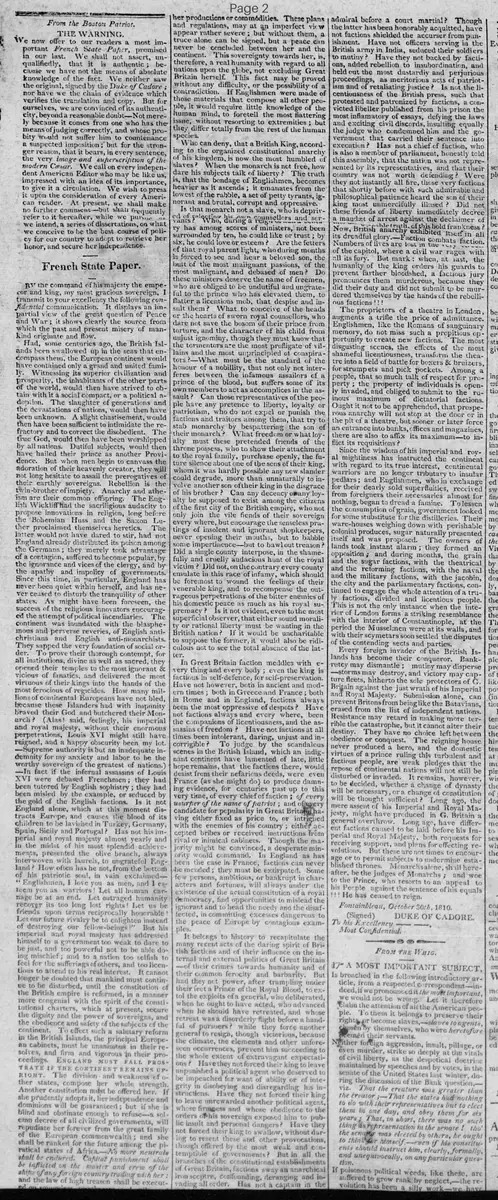
THE WARNING.
We now offer to our readers a most important French State Paper, promised in our last. We shall not assert, unqualifiedly, that it is authentic; because we have not the means of absolute knowledge of the fact. We neither saw the original, signed by the Duke of Cadore; nor have we the chain of evidence which verifies the translation and copy. But for ourselves, we are convinced of its authenticity, beyond a reasonable doubt—Not merely because it comes from one who has the means of judging correctly, and whose probity would not suffer him to countenance a suspected imposition; but for the stronger reason, that it bears, in every sentence, the very image and superscription of the modern Caesar. We call on every independent American Editor who may be like us, impressed with an idea of its importance, to give it a circulation. We wish to press it upon the consideration of every American reader. At present, we shall make no further comment—but shall frequently refer to it hereafter, while we pursue a course we intend, a series of dissertations, on what we conceive to be the best course of policy for our country to adopt to retrieve her honor, and secure her independence.
French State Paper.
By the command of his majesty the emperor and king, my most gracious sovereign, I transmit to your excellency the following confidential communication. It displays an impartial view of the great question of Peace and War; it shows clearly the source from which the past and present misery of mankind originate and flow.
Had, some centuries ago, the British Islands been swallowed up in the seas that encompass them, the European continent would have contained only a grand and united family. Witnessing its superior civilization and prosperity, the inhabitants of the other parts of the world, would then have strived to obtain with it a social compact, or a political adoption. The slaughter of generations and the devastations of nations, would then have been unknown. A slight chastisement, would then have been sufficient to intimidate the refractory and to correct the disobedient. The true God, would then have been worshipped by all nations. Dutiful subjects, would then have hailed their prince as another Providence. But when men begin to canvass the adoration of their heavenly creator, they will not long hesitate to assail the prerogatives of their earthly sovereigns. Rebellion is the twin-brother of impiety. Anarchy and atheism are their common offspring. The English Wickliff had the sacrilegious audacity to propose innovations in religion, long before the Bohemian Huss and the Saxon Luther proclaimed themselves heretics. The latter would not have dared to stir, had not England already distributed its poison among the Germans; they merely took advantage of a contagion, suffered to become popular, by the ignorance and vices of the clergy, and by the apathy and impolicy of governments.
Since this time, in particular, England has never been quiet within herself, and has never ceased to disturb the tranquility of other states. As might have been foreseen, the success of the religious innovators encouraged the attempt of political incendiaries. The continent was inundated with the blasphemous and perverse reveries, of English antichrists and English anti-monarchists. They sapped the very foundation of social order. To prove their thorough contempt, for all institutions, divine as well as sacred, they opened their temples to the most ignorant & vicious of fanatics, and delivered the most virtuous of their kings into the hands of the most ferocious of regicides. How many millions of continental Europeans have not bled, because these Islanders had with impunity braved their God and butchered their Monarch? (Alas! said, feelingly, his imperial and royal majesty, without their enormous perpetrations, Louis XVI might still have reigned, and a happy obscurity been my lot. --Supreme authority is but an inadequate indemnity for my anxiety and labor to be the worthy sovereign of the greatest of nations.) -In fact if the infernal assassins of Louis XVI were debased Frenchmen; they had been tutored by English sophistry; they had been misled by the example, or seduced by the gold of the English factions. Is it not England alone, which at this moment dis tracts Europe, and causes the blood of its children to be lavished in Turkey, Germany, Spain, Sicily and Portugal? Has not his imperial and royal majesty almost yearly and in the midst of his most splendid achievements, presented the olive branch, always interwoven with laurels, to ungrateful England? How often has he not, from the bottom of his patriotic soul, in vain exclaimed-- "Englishmen, I love you as men, and I esteem you as warriors! Let all human carnage be at an end. Let outraged humanity recover its too long lost rights! Let us be friends upon terms reciprocally honorable! Let our future rivalry be to enlighten instead of destroying our fellow-beings!" But his imperial and royal majesty has addressed himself to a government too weak to dare to be just, and too powerful not to be able doing mischief; and to a nation too selfish to feel for the sufferings of others, and too licentious to attend to his real interest. It cannot longer be doubted that mankind must continue to be disturbed, until the constitution of the British empire is reformed, in a manner more congenial with the spirit of the constitutional charters, which at present, secure the dignity and the power of sovereigns, and the obedience and safety of the subjects of the continent. To effect such a salutary reform in the British Islands, the principal European cabinets, must be unanimous in their resolves, and firm and vigorous in their proceedings. England Must FAll PROSTRATE IF THE CONTINENT REMAINS UNITED. The division and weakness of other states, compose her whole strength. Another constitution must be offered her. If she prudently adopts it, her independence and dominions will be guaranteed; but if she is blind and obstinate enough to refuse a solemn decree of all civilized governments, will repudiate her forever from the great family of the European commonwealth: and she shall be ranked for the future among the piratical states of Africa. No more neutrals shall be endured. Capital punishment shall be inflicted on the master and crew of the ships of any foreign country trading with her: her productions or commodities. These plans and regulations, may at an imperfect view appear rather severe; but without them, a truce alone can be signed, but a peace can never be concluded between her and the continent. This sovereignty towards her, is, therefore, a real humanity with regard to all nations upon the globe, not excluding Great Britain herself. This fact may be proved without any difficulty, or the possibility of a contradiction. If Englishmen were made of those materials that compose all other people, it would require little knowledge of the human mind, to foretell the most flattering issue, without resorting to extremities; but they differ totally from the rest of the human species.
Who can deny, that a British King, according to the organized constitutional anarchy of his kingdom, is now the most humbled of slaves? When the monarch is not free, how dare his subjects talk of liberty? The truth is, that the bondage of Englishmen, becomes heavier as it ascends; it emanates from the lowest of the rabble, a set of petty tyrants, ignorant and brutal, corrupt and oppressive. Is that monarch not a slave, who is deprived of selecting his own counsellors and servants? Who, during a long reign has among scores of ministers, not been surrounded by ten, he could like or trust; by six, he could love or esteem? Are the fetters of that royal parent light, who during months is forced to see and hear a beloved son, the butt of the most malignant passions, of the most malignant, and debased of men? Do these ministers deserve the name of freemen, who are obliged to be undutiful and ungrateful to the prince who has elevated them, to flatter a licentious mob, that despise and insult them? What to conceive of the heads or the hearts of sworn royal counsellors, who dare not save the bosom of their prince from torture, and the character of his child from unjust ignominy, though they must know that the tormentors are the most profligate of villains and the most unprincipled of conspirators?--What must be the standard of the honour of a nobility, that not only not interferes between the infamous assailors of a prince of the blood, but suffers some of its own members to act as accomplices in the assault? Can those representatives of the people have any pretence to liberty, loyalty or patriotism, who do not expel or punish the factions and traitors among them, that try to stab monarchy by bespattering the son of their monarch? What freedom or what loyalty must these pretended friends of the throne possess, who to show their attachment to the royal family, purchase openly, the future silence about one of the sons of their king, whom it was hardly possible any new slander could degrade, more than unnaturally to involve another son of their king in the disgrace of his brother? Can any decency or any loyalty be supposed to exist among the citizens of the first city of the British empire, who not only join the vile fiends of their sovereign every where, but encourage the senseless pratlings of insolent and ignorant shopkeepers, never opening their mouths, but to babble some impertinence -but to bawl out treason? Did a single county interpose, in the shame fully and cruelly audacious hunt of the royal victim? Did not, on the Contrary every county emulate in this race of infamy, which should be foremost to wound the feelings of their venerable king, and to recompense the outrageous perpetrations of the bitter enemies of his domestic peace as much as his royal supremacy? Is it not evident, even to the most superficial observer, that either sound morality or rational liberty must be wanting in the British nation? If it would be uncharitable to suppose the former, it would also be ridiculous not to see the total absence of the latter.
In Great Britain faction meddles with every thing and every body; even the king is factious in self-defence, for self-preservation. Have not however, both in ancient and modern times : both in Greece and France: both in Rome and in England, factions always been the most oppressive of despots? Have not factions always and every where, been the companions of licentiousness, and the assassins of freedom? Have not factions at all times been intolerant, daring, unjust and incorrigible? To judge by the scandalous scenes in the British Island, which an indignant continent have lamented of late, little hope remains, that the factions there, would desist from their nefarious deeds, were even France (as she might do) to produce damning evidence, for centuries past up to this very time, of every chief of faction; of every usurper of the name of patriot ; and of every candidate for popularity in Great Britain having either fixed as price to, or intrigued with the enemies of his country; either accepted bribes or received instructions from rival or inimical cabinets. Though the majority might be convinced, a desperate minority would command. In England as has been the case in France, factions can never be mended; they must be extirpated. Some few persons, ambitious, or bankrupt in characters and fortunes, will always under the existence of the actual constitution of a royal democracy, find opportunities to mislead the ignorant and to head the needy and the disaffected, in committing excesses dangerous to the peace of Europe by contagious examples.
It belongs to history to recapitulate the many recent acts of the daring spirit of British factions and of their influence on the internal and external politics of Great Britain -of their crimes towards humanity and of their common ferocity and barbarity. But had they not power, after trampling under their feet a Prince of the Royal Blood, to extol the exploits of a general, who deliberated, when he ought to have acted, who advanced when he should have retreated, and whose retreat was a disorderly fight before a hand ful of pursuers? while they force another general to resign, though victorious, because the climate, the elements and other unforeseen occurrences, prevent him succeeding to the whole extent of extravagant expectations? Have they not forced their king to leave unpunished a political agent who deserved to be impeached for want of ability or of integrity in disobeying and disregarding his instructions. Have they not forced their king to leave unrewarded another political agent, whose firmness and whose obedience to the orders of his sovereign exposed him to public insult and personal dangers? Have they not forced their king to swallow, without daring to resent these and other provocations, though offered by the most weak and contemptible of governments? But in all the branches of the constitutional establishments of Great Britain, factions sway an anarchical iron sceptre, confounding, deranging and invading all order. Has not a captain in the admiral before a court martial? Though the latter has been honorably acquitted, have not factions shielded the accuser from punishment. Have not officers serving in the British army in India, seduced their soldiers to mutiny? Have they not backed by factions, added rebellion to insubordination, and held out the most dastardly and perjurious proceedings, as meritorious acts of patriotism and of retaliating justice? Is not the licentiousness of the British press, such that protested and patronized by factions, a convicted libeller published from his prison the most inflammatory of essays, defying the laws and exciting civil discords, insulting equally the judge who condemned him and the government that carried their sentence into execution? Has not a chief of faction, who is also a member of parliament, honestly told this assembly, that the nation was not represented by its representatives, and that their country was not worth defending? Were they not instantly all fire, those very factions that shortly before with such admirable and philosophical patience heard the son of their king most unmercifully illused? Did not these friends of liberty immediately decree a mandate of arrest against the declaimer of onhietrutli, cf this bold frankness? Now: British anarchy exhibited itself in all its dreadful glory.-Faction combats faction. Numbers of lives are lost in the very of the capitol, where a civil war rages with all its fury. But mark: when, at last, the humanity of the king orders his guards to prevent farther bloodshed, a factious jury pronounces them murderous, because they did their duty and did not submit to be murdered themselves by the hands of the rebellious factions!!!
The proprietors of a theatre in London, augments a trifle the price of admittance. Englishmen, like the Romans of sanguinary memory, do not miss such a propitious opportunity to create new factions. The most disgusting scenes, the effects of the most shameful licentiousness, transform the theatre into a field of battle for boxers & bruisers, for strumpets and pick pockets. Among a people, that so much talk of respect for property ; the property of individuals is openly invaded, and obliged to submit to the ruinous maximum of dictatorial factions. Ought it not to be apprehended, that prosperous anarchy will not stop at the door or in the pit of a theatre, but sooner or later force an entrance into banks, offices and magazines, there are also to affix its maximum—to inflict its requisitions?
Since the wisdom of his imperial and royal mightiness has instructed the continent with regard to its true interest, continental warriors are no longer tributary to insular pedlars; and Englishmen, who in exchange for their dearly sold superfluities, received from foreigners their necessaries almost for nothing, began to dread a famine. To lessen the consumption of grain, government looked for some substitute for the distilleries. Their ware-houses weighing down with perishable colonial produces, sugar naturally presented itself and was proposed. The owners of lands took instant alarm; they formed an opposition; and during months, the grain and the sugar factions, with the theatrical and the reforming factions, with the naval and the military factions, with the jacobin, the city and the parliamentary factions, continued to engage the whole attention of a truly factious, divided and licentious people.
This is not the only instance when the interior of London forms a striking resemblance with the interior of Constantinople, at the period the Musselmen were at its walls, and with their scymetars soon settled the disputes of the contending sects and parties.
Every foreign invader of the British Islands has become their conqueror. Bankruptcy may dismantle; mutiny may disperse -storms may destroy, and victory may capture fleets, hitherto the sole protectors of G. Britain against the just wrath of his Imperial and Royal Majesty. Submission alone, can prevent Britons from being like the Batavians, erased from the list of independent nations. Resistance may retard in making more terrible the catastrophe, but it cannot alter their destiny. They have no choice left between obedience or conquest. The reigning house never produced a hero, and the domestic virtues of a prince ruling this turbulent and factious people, are weak pledges that the repose of continental nations will not still be disturbed or invaded. It remains, however, to be decided, whether a change of dynasty will be necessary, or a change of constitution will be thought sufficient? Long ago, the mere assent of his Imperial and Royal Majesty, might have produced in G. Britain a general overthrow. Long ago, have different factions caused to be laid before his Imperial and Royal Majesty, both requests for receiving support, and pleas for effecting revolutions. But these are not times to encourage or to permit subjects to undermine established thrones. Monarchs alone, shall hereafter, be the judges of Monarchs ; and woe to the Prince, who resorts to an appeal to his People against the sentence of his equals !!! He has ceased to reign.
Fontainbleau, October 30th, 1810.
(Signed)
DUKE OF CADORE.
To his Excellency -
Most Confidential.
What sub-type of article is it?
What keywords are associated?
What entities or persons were involved?
Where did it happen?
Foreign News Details
Primary Location
Fontainebleau
Event Date
1810 10 30
Key Persons
Outcome
calls for unanimous european resolve to reform british constitution or exclude britain from the european commonwealth, treating it as a piratical state with severe penalties for trading with it.
Event Details
Confidential French state paper transmitted by command of Napoleon, critiquing British historical role in religious and political disruptions, current wars in Europe, and internal factions; urges continental unity to enforce reform or isolation of Britain to achieve lasting peace.