Thank you for visiting SNEWPapers!
Sign up free
Gazette Of The United States And Daily Evening Advertiser
Philadelphia, Philadelphia County, Pennsylvania
What is this article about?
Earl of Carlisle's letter defends English ministers against Earl Fitzwilliam's criticisms on Irish Roman Catholic policy, highlighting a dispute over timely indulgences amid war, leading to Fitzwilliam's resignation and strained relations.
Clipping
OCR Quality
Full Text
A.M.
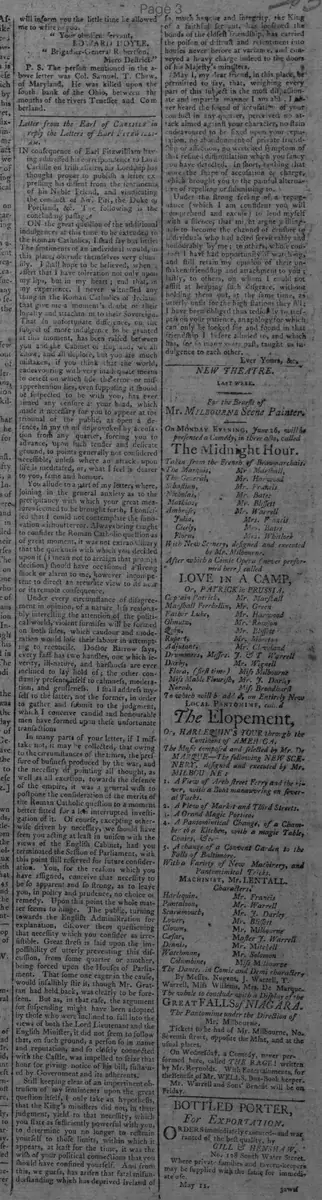
IN consequence of Earl Fitzwilliam having addressed his correspondence to Lord Carlisle on Irish affairs, his Lordship has thought proper to publish a letter expressing his dissent from the sentiments of his Noble Friend, and vindicating the conduct of Mr. Pitt, the Duke of Portland, &c. The following is the concluding paragraph
ON the great question of the additional indulgences at this time to be extended to the Roman Catholics, I shall say but little: The sentiments of an individual would, in this place, obtrude themselves very clumsily. I shall hope to be believed, when I assert that I have toleration not only upon my lips, but in my heart ; and that, in my experience, I never witnessed any thing in the Roman Catholics of Ireland that gave me a moment's doubt of their loyalty and attachment to their Sovereign. That unfortunate difference, on the subject of more indulgence to be granted at this moment, has been raised between you and the Cabinet of England, we all know, and all deplore, but you are much mistaken, if you think that the world, endeavouring with very inadequate means to detect on which side the error or misapprehension lies, even supposing it should be suspected to be with you, has ever aimed any censure at your head, which made it necessary for you to appear at the tribunal of the public, as open a defence, in my mind unprovoked by accusation from any quarter, forcing you to advance, upon such tender and delicate ground, to points generally not considered accessible, unless where an attack upon life is meditated, or, what I feel is dearer to you, fame and honour.
You allude to a part of my letter, where, joining in the general anxiety as to the precipitancy with which your great measures seemed to be brought forth, I confessed that I could not contemplate the innovation without terror. Always being taught to consider the Roman Catholic question as of great moment, it was not extraordinary that the quickness with which you decided upon it (I mean not to arraign that prompt decision) should have occasioned a strong shock or alarm to me, however incompetent to direct an accurate view to its near or its remote consequence.
Under every circumstance of disagreement in opinion, of a nature less reasonably interesting the attention of the political world, violent armies will be formed on both sides, which candour and moderation would lose their labour in attempting to reconcile. Doctor Barrow says, every fact has two handles, one which severity, ill-nature, and harshness are ever inclined to lay hold of; the other constantly presents itself to calmness, moderation, and gentleness. I shall address myself to the latter, not the former, in order to gather and submit to the judgment, which I conceive candid and honourable men have formed upon these unfortunate transactions
In many parts of your letter, if I mistake not, it may be collected, that owing to the circumstances of the times, the pressure of business produced by the war, and the necessity of pointing all thought, as well as all exertion, towards the defence of the empire, it was a general wish to postpone the consideration of the merits of the Roman Catholic question to a moment better fitted for a less interrupted investigation of it. Of course, excepting otherwise driven by necessity, we should have seen you acting at least in union with the views of the English Cabinet, had you terminated the Session of Parliament, with this point still reserved for future consideration. You, for the reasons which you have assigned, conceive that necessity to be so apparent and so strong, as to leave you, in policy and prudence, no choice of remedy. Upon this point the whole matter seems to hinge. The public, turning towards the English Administration for explanation, discover them questioning that necessity which you consider as irresistible. Great stress is laid upon the impossibility of utterly preventing this discussion, from some quarter or another, being forced upon the Houses of Parliament. That some one eager in the cause, would infallibly stir it, though Mr. Grattan had held back, was clearly to be foreseen. But as, in that case, the argument for suspending might have been adopted by those who were inclined to fall into the views of both the Lord Lieutenant and the English Minister, it did not seem to follow that, on such ground, a person so in name and reputation, and so closely connected with the Castle, was impelled to seize that hour for giving notice of his bill, sustained by Government and its adherents.
Still keeping clear of an impertinent obtrusion of my sentiments upon the great question itself, I only take an hypothesis, that the King's ministers did not, in their judgment, yield to that necessity, which you state as sufficiently powerful with you, to determine you no longer to restrain yourself to those limits, within which it appears, at least for the time, it was the wish of your political connections that you should have confined yourself. And from this, we guess, has arisen that fatal misunderstanding which has deprived Ireland of so much honour and integrity, the King of a faithful servant, has loosened the bonds of the closest friendship, has carried the poison of distrust and resentment into houses never before at variance, and conveyed a heavy charge indeed to the doors of his Majesty's ministers.
May I, my dear friend, in this place, be permitted to say, that, weighing every part of this subject in the most dispassionate and impartial manner I am able, I never heard the sound of accusation of your conduct in any quarter, perceived no attack aimed against your character, no stain endeavoured to be fixed upon your reputation, no abandonment of private friendship or affection, no wretched symptom of that refined dissimulation which you fancy you have detected.. In short, nothing that wore the shape of accusation or charge, which brought you to the painful alternative of repelling or submitting to.
Under the strong feeling of a repugnance (which I am confident you will comprehend and excuse) I did lend myself with a silence, that might argue a willingness to become the channel of censure to individuals who had acted serviceably and honourably by me; to others, whose conduct I have had opportunity of watching, and still retain my opinion of their unshaken friendship and attachment to you ; lastly, to others, on whom I could not sit by heaping such disgrace, without holding them out, at the same time, as utterly unfit for the high stations they fill; I have been obliged thus tediously to trespass on your patience, an apology for which can only be looked for and found in that friendship I before alluded to, and which has, for so many years past, taught us indulgence to each other,
Ever Yours, &ca
What sub-type of article is it?
What keywords are associated?
What entities or persons were involved?
Where did it happen?
Foreign News Details
Primary Location
Ireland
Key Persons
Outcome
disagreement over roman catholic indulgences led to fatal misunderstanding, depriving ireland of honour and integrity, the king of a faithful servant, loosening bonds of friendship, and introducing distrust and resentment.
Event Details
Earl of Carlisle publishes a letter dissenting from Earl Fitzwilliam's sentiments on Irish affairs, vindicating Mr. Pitt and the Duke of Portland. He expresses toleration for Roman Catholics, deplores the difference with the English Cabinet, and argues against the precipitancy of granting additional indulgences amid war pressures. The dispute hinges on the necessity of addressing the Roman Catholic question immediately, leading to Fitzwilliam's actions against Cabinet wishes, resulting in his apparent resignation and broader political fallout.