Thank you for visiting SNEWPapers!
Sign up free
The New Hampshire Gazette
Portsmouth, Rockingham County, New Hampshire
What is this article about?
General Taylor forwards Colonel Beatty's report on the successful defense of Craney Island against a British attack on June 22, 1813. American forces, aided by naval support, repelled the enemy with no losses, while inflicting heavy casualties and capturing a barge and prisoners.
Clipping
OCR Quality
Full Text
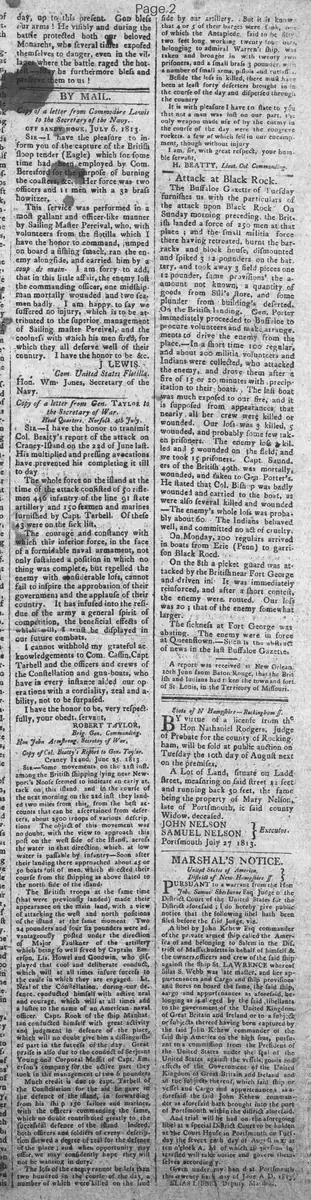
Head Quarters, Norfolk, 4th July.
Sir—I have the honor to transmit Col. Beatty's report of the attack on Craney-Island on the 22d of June last. His multiplied and pressing avocations have prevented his completing it till to day.
The whole force on the island at the time of the attack consisted of 20 riflemen 446 infantry of the line 91 state artillery and 150 seamen and marines furnished by Capt. Tarbell. Of these 43 were on the sick list.
The courage and constancy with which this inferior force, in the face of a formidable naval armament, not only sustained a position in which nothing was complete, but repelled the enemy with considerable loss, cannot fail to inspire the approbation of their government and the applause of their country. It has infused into the residue of the army a general spirit of competition, the beneficial effects of which will, I trust be displayed in our future combats.
I cannot withhold my grateful acknowledgements to Com. Cassin, Capt. Tarbell and the officers and crews of the Constellation and gun-boats, who have in every instance aided our operations with a cordiality, zeal and ability, not to be surpassed.
I have the honor to be, very respectfully, your obdt. servant,
ROBERT TAYLOR,
Brig. Gen. Commanding.
Hon. John Armstrong, Secretary of War.
Copy of Col. Beatty's Report to Gen. Taylor.
Craney Island, June 25, 1813.
Sir—Some movements on the 21st inst. among the British shipping lying near Newport's News seemed to indicate an early attack on this island, and in the course of the next morning on the 22d inst they landed two miles from this, from the best accounts that can be ascertained from deserters, about 2500 troops of various descriptions The object of this movement was no doubt, with the view to approach this post on the west side of the Island, across the water in that direction, which, at low water is passable by infantry—Soon after their landing there approached about 45 or 50 boats full of men, which directed their course from the shipping as above stated to the north side of the island—
The British troops at the same time (that were previously landed) made their appearance on the main land, with a view of attacking the west and north positions of the island at the same moment. Two 24 pounders and four six pounders were advantageously posted under the direction of Major Faulkner of the artillery which being so well served by Captain Emerson, Lts. Howell and Goodwin, who displayed that cool and deliberate conduct, which will at all times insure success to the cause in which they are engaged. Lt. Neal of the Constellation, during our defence, conducted himself with active zeal and courage, which will at all times add lustre to the name of an American naval officer. Capt. Rook of the ship Merchant conducted himself with great activity and judgment in defence of the place, which will no doubt give him a distinguished part in the success of the day. Great praise is also due to the conduct of Serjeant Young and Corporal Moffit of Capt. Emerson's company for the active part they took in the management of two 6 pounders Much credit is due to capt. Tarbell of the Constellation for the aid he gave in the defence of the island, in forwarding from his ship 150 sailors and marines, with the officers commanding the same, which no doubt contributed greatly to the successful defence of the island. Indeed, both officers and soldiers of every description shewed a degree of zeal for the defence of the place : and when opportunity may offer, we may confidently hope they will not be wanting in duty
The loss of the enemy cannot be less than two hundred in the course of the day. a number of which were killed on the island by our artillery. But it is known that 4 or 5 of their barges were sunk, one of which the Antipode, said to be fifty two feet long, working twenty four oars, belonging to admiral Warren's Ship, was taken and brought in with twenty two prisoners, and a small brass 3 pounder, with a number of small arms, pistols and cutlasses. Beside the loss in killed, there must have been at least forty deserters brought in in the course of the day and dispersed through the country
It is with pleasure I have to state to you that not a man was lost on our part, the only weapon made use of by the enemy in the course of the day were the congreve rockets. a few of which fell in our encampment, though without injury
I am, sir, with great respect, your humble servant,
H. BEATTY,
Lieut. Col. Commanding.
What sub-type of article is it?
What keywords are associated?
What entities or persons were involved?
Where did it happen?
Domestic News Details
Primary Location
Craney Island
Event Date
22d Of June 1813
Key Persons
Outcome
no american losses; enemy losses at least 200 killed, 4-5 barges sunk, one barge (antipode) captured with 22 prisoners, small brass 3-pounder, arms; at least 40 deserters.
Event Details
British forces numbering about 2500 landed two miles from Craney Island on June 22, 1813, approaching from west and north sides with 45-50 boats. American force of 20 riflemen, 446 infantry, 91 state artillery, and 150 seamen/militia, under Col. Beatty, repelled the attack using artillery including two 24-pounders and four 6-pounders. Naval support from Constellation and gunboats aided the defense. Enemy used Congreve rockets without effect.