Thank you for visiting SNEWPapers!
Sign up free
The National Intelligencer And Washington Advertiser
Washington, District Of Columbia
What is this article about?
On October 27, 1803, the U.S. House of Representatives debated a Senate bill authorizing President Jefferson to take possession of the Louisiana territories ceded by France. Key contention focused on the constitutionality of Section 2, which delegated extensive military, civil, and judicial powers to the executive until Congress established temporary governance.
Merged-components note: This is a single logical story: congressional debate on the Louisiana Treaty, continued across pages 1 and 2, with sequential reading order and direct text flow ending in '(To be continued.)'.
Clippings
1 of 2
OCR Quality
Full Text
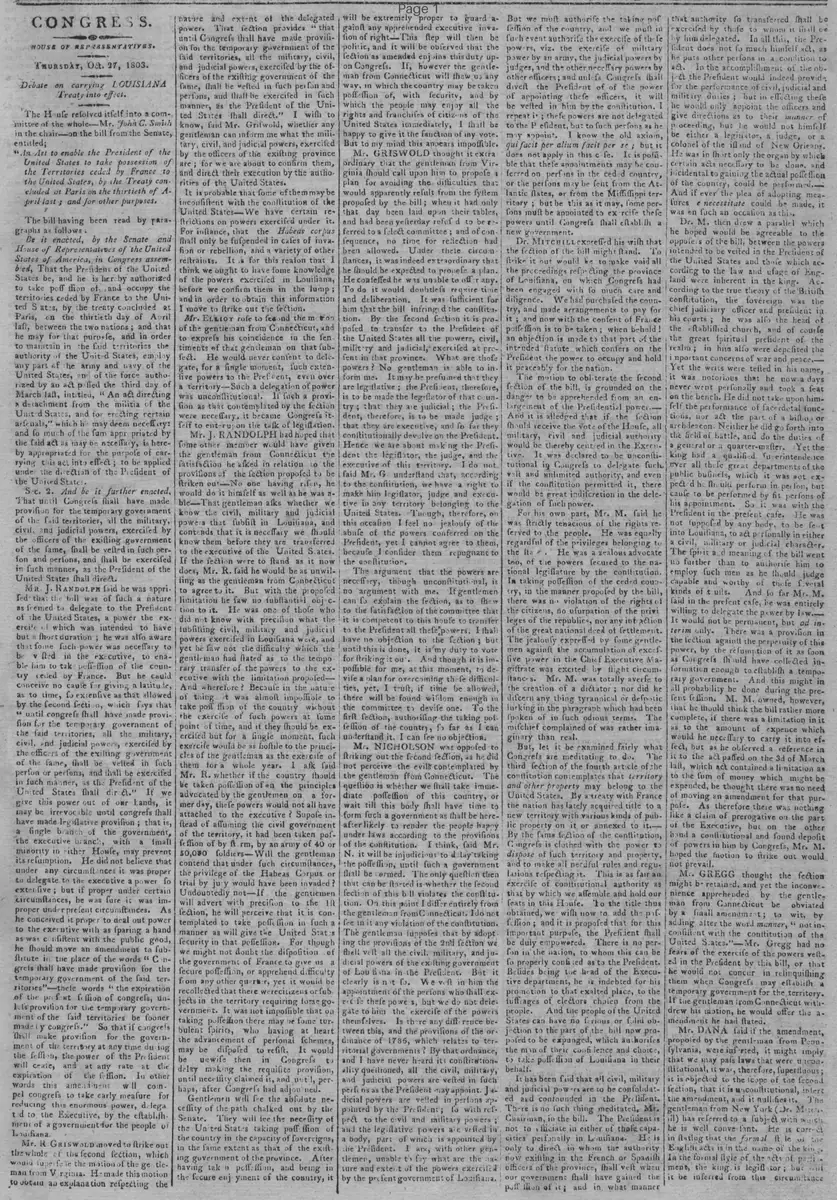
HOUSE OF REPRESENTATIVES.
THURSDAY, Oct. 27, 1803.
Debate on carrying LOUISIANA Treaty into effect.
The House resolved itself into a committee of the whole—Mr. John C. Smith in the chair—on the bill from the Senate, entitled:
"An Act to enable the President of the United States to take possession of the Territories ceded by France to the United States, by the Treaty concluded at Paris on the thirtieth of April last; and for other purposes."
The bill having been read by paragraphs as follows:
Be it enacted by the Senate and House of Representatives of the United States of America in Congress assembled, That the President of the United States be, and he is hereby authorized to take possession of, and occupy the territories ceded by France to the United States, by the treaty concluded at Paris, on the thirtieth day of April last, between the two nations: and that he may for that purpose, and in order to maintain in the said territories the authority of the United States, employ any part of the army and navy of the United States, and of the force authorized by an act passed the third day of March last, entitled, "An act directing a detachment from the militia of the United States, and for erecting certain arsenals," which he may deem necessary: and so much of the sum appropriated by the said act as may be necessary, is hereby appropriated for the purpose of carrying this act into effect; to be applied under the direction of the President of the United States.
Sec. 2. And be it further enacted, That until Congress shall have made provision for the temporary government of the said territories, all the military, civil, and judicial powers, exercised by the officers of the existing government of the same, shall be vested in such person and persons, and shall be exercised in such manner, as the President of the United States shall direct.
MR. J. RANDOLPH said he was apprised—that the bill was of such a nature as rendered it to delegate to the President of the United States, a power the exercise of which was intended to have but a short duration; he was also aware that some such power was necessary to be vested in the executive, to enable him to take possession of the country ceded by France. But he could conceive no cause for giving a latitude as to time, so extensive as that allowed by the second section, which says that "until Congress shall have made provision for the temporary government of the said territories, all the military, civil, and judicial powers, exercised by the officers of the existing government of the same, shall be vested in such person or persons, and shall be exercised in such manner, as the President of the United States shall direct." If we give this power out of our hands, it may be irrevocable until Congress shall have made legislative provision; that is, a single branch of the government the executive branch, with a small minority in either House, may prevent its resumption. He did not believe that under any circumstances it was proper to delegate to the executive a power so extensive; but if proper under certain circumstances, he was sure it was improper under present circumstances. As he conceived it proper to deal out power to the executive with as sparing a hand as was consistent with the public good, he should move an amendment to substitute in the place of the words "Congress shall have made provision for the temporary government of the said territories" these words "the expiration of the present session of Congress, unless provision for the temporary government of the said territories be sooner made by Congress." So that if Congress shall make provision for the government of the territory at any time during the session, the power of the President will cease, and at any rate at the expiration of the session. In other words this amendment will compel Congress to take early measure for reducing this enormous power, delegated to the Executive, by the establishment of a government for the people of Louisiana.
Mr. R. GRISWOLD moved to strike out the whole of the second section, which would supersede the motion of the gentleman from Virginia. He made this motion to obtain an explanation respecting the nature and extent of the delegated power. That section provides "that until Congress shall have made provision for the temporary government of the said territories, all the military, civil, and judicial powers, exercised by the officers of the existing government of the same, shall be vested in such person and persons, and shall be exercised in such manner, as the President of the United States shall direct." I wish to know, said Mr. Griswold, whether any gentleman can inform me what the military, civil, and judicial powers, exercised by the officers of the existing province are; for we are about to confirm them, and direct their execution by the authorities of the United States. It is probable that some of them may be inconsistent with the constitution of the United States. We have certain restrictions on powers exercised under it. For instance, that the Habeas corpus shall only be suspended in cases of invasion or rebellion, and a variety of other restraints. It is for this reason that I think we ought to have some knowledge of the powers exercised in Louisiana, before we confirm them in the lump; and in order to obtain this information I move to strike out the section.
Mr. ELLIOT rose to second the motion of the gentleman from Connecticut, and to express his coincidence in the sentiments of that gentleman on that subject. He would never consent to delegate, for a single moment, such extensive powers to the President, even over a territory. Such a delegation of power was unconstitutional. If such a provision as that contemplated by the section were necessary, it became Congress itself to enter upon the task of legislation.
Mr. I. RANDOLPH had hoped that some other member would have given the gentleman from Connecticut the satisfaction he asked in relation to the provisions of the section proposed to be stricken out. No one having risen, he would do it himself as well as he was able. That gentleman asks whether we know the civil, military and judicial powers that subsist in Louisiana, and contends that it is necessary we should know them before they are transferred to the executive of the United States. If the section were to stand as it now does, Mr. R. said he would be as unwilling as the gentleman from Connecticut to agree to it. But with the proposed limitation he saw no substantial objection to it. He was one of those who did not know with precision what the subsisting civil, military and judicial powers exercised in Louisiana were, and yet he saw not the difficulty which the gentleman had stated as to the temporary transfer of the powers to the executive with the limitation proposed. And wherefore? Because in the nature of things, it was almost impossible to take possession of the country without the exercise of such powers at some point of time, and if they should be exercised but for a single moment, such exercise would be as hostile to the principles of the gentleman as the exercise of them for a whole year. I ask said Mr. R. whether if the country should be taken possession of on the principles advocated by the gentlemen on a former day, these powers would not all have attached to the executive? Suppose instead of assuming the civil government of the territory, it had been taken possession of by storm, by an army of 40 or 50,000 soldiers—Will the gentleman contend that under such circumstances, the privilege of the Habeas Corpus or trial by jury would have been invaded? Undoubtedly not. If the gentlemen will advert with precision to the 1st section, he will perceive that it is contemplated to take possession in such a manner as will give the United States security in that possession. For though we might not doubt the disposition of the government of France to give us a secure possession, or apprehend difficulty from any other quarter, yet it would be recollected that there were citizens or subjects in the territory requiring more government. It was not impossible that on taking possession there may be some turbulent spirits, who having at heart the advancement of personal schemes, may be disposed to resist. It would be unwise then in Congress to delay making the requisite provision, until necessity claimed it, and until, perhaps, after Congress had adjourned. Gentlemen will see the absolute necessity of the path chalked out by the Senate. They will see the necessity of the United States taking possession of the country in the capacity of sovereigns, in the same extent as that of the existing government of the province. After having taken "possession, and being in the secure enjoyment of the country, it will be extremely proper to guard against any apprehended executive invasion of right. This step will then be politic, and it will be observed that the section as amended enjoins this duty upon Congress. If, however the gentleman from Connecticut will show us any way, in which the country may be taken possession of, with security, and by which the people may enjoy all the rights and franchises of citizens of the United States immediately, I shall be happy to give it the sanction of my vote. But to my mind this appears impossible.
Mr. GRISWOLD thought it extraordinary that the gentleman from Virginia should call upon him to propose a plan for avoiding the difficulties that would apparently result from the system proposed by the bill; when it had only that day been laid upon their tables, and had been yesterday refused to be referred to a select committee; and of consequence, no time for reflection had been allowed. Under these circumstances, it was indeed extraordinary that he should be expected to produce a plan. He confessed he was unable to offer any. To do it would doubtless require time and deliberation. It was sufficient for him that the bill infringed the constitution. By the second section it is proposed to transfer to the President of the United States all the powers, civil, military and judicial, exercised at present in that province. What are those powers? No gentleman is able to inform me. It may be presumed that they are legislative; the President, therefore, is to be made the legislator of that country; that they are judicial: the President, therefore, is to be made judge; that they are executive, and so far they constitutionally devolve on the President. Hence we are about making the President the legislator, the judge, and the executive of this territory. I do not, said Mr. G. understand that, according to the constitution, we have a right to make him legislator, judge and executive in any territory belonging to the United States. Though, therefore, on this occasion I feel no jealousy of the abuse of the powers conferred on the President, yet I cannot agree to them, because I consider them repugnant to the constitution. The argument that the powers are necessary, though unconstitutional, is no argument with me. If gentlemen can so explain the section, as to show to the satisfaction of the committee that it is competent to this house to transfer to the President all these powers, I shall have no objection to the section; but until this is done, it is my duty to vote for striking it out. And though it is impossible for me, at this moment, to devise a plan for overcoming the difficulties, yet, I trust, if time be allowed, there will be found wisdom enough in the committee to devise one. To the first section, authorizing the taking possession of the country, so far as I can understand it, I can see no objection.
Mr. NICHOLSON was opposed to striking out the second section, as he did not perceive the evils contemplated by the gentleman from Connecticut. The question is whether we shall take immediate possession of this country, or wait till this body shall have time to form such a government as shall be hereafter likely to render the people happy under laws according to the provisions of the Constitution. I think, said Mr. N. it will be injudicious to delay taking the possession, until such a government shall be formed. The only question then that can be started is whether the second section of this bill violates the constitution. On this point I differ entirely from the gentleman from Connecticut. I do not see in it any violation of the constitution. The gentleman supposes that by adopting the provisions of the 2nd section we shall vest all the civil, military, and judicial powers of the existing government of Louisiana in the President. But it clearly is not so. We vest in him the appointment of the persons who shall exercise these powers, but we do not delegate to him the exercise of the powers themselves. Is there any difference between this, and the provisions of the ordinance of 1787, which relates to territorial governments? By that ordinance, and I have never heard its constitutionality questioned, all the civil, military, and judicial powers are vested in such persons as the President may appoint. Judicial powers are vested in persons appointed by the President; so with respect to the civil and military powers: and the legislative powers are vested in a body, part of which is appointed by the President. I am, with other gentlemen, unable to say what are the nature and extent of the powers exercised by the present government of Louisiana. But we must authorize the taking possession of the country, and we must in such event authorize the exercise of these powers, viz. the exercise of military power by an army, the judicial powers by judges, and the other necessary powers by other officers; and unless Congress shall divest the President of the power of appointing these officers, it will be vested in him by the constitution. I repeat it; these powers are not delegated to the President, but to such persons as he may appoint. I know the old axiom, qui facit per alium facit per se: but it does not apply in this case. It is possible that these appointments may be conferred on persons in the ceded country, or the persons may be sent from the Atlantic states, or from the Mississippi territory: but be this as it may, some persons must be appointed to exercise these powers until Congress shall establish a new government.
Dr. MITCHELL expressed his wish that the section of the bill might stand. To strike it out would be to make void all the proceedings respecting the province of Louisiana, on which Congress had been engaged with so much care and diligence. We had purchased the country, and made arrangements to pay for it: and now with the consent of France possession is to be taken; when behold! an objection is made to that part of the intended statute which confers on the President the power to occupy and hold it peaceably for the nation. The motion to obliterate the second section of the bill, is grounded on the danger to be apprehended from an enlargement of the Presidential power. And it is alleged that if the section should receive the vote of the House, all military, civil and judicial authority would be thereby centred in the Executive. It was declared to be unconstitutional in Congress to delegate such vast and unlimited authority, and even if the constitution permitted it, there would be great indiscretion in the delegation of such power. For his own part, Mr. M. said he was strictly tenacious of the rights reserved to the people. He was equally regardful of the privileges belonging to the states. He was a zealous advocate too, of the powers secured to the national legislature by the constitution. In taking possession of the ceded country, in the manner proposed by the bill, there was no violation of the rights of the citizens, no usurpation of the privileges of the republics, nor any infraction of the great national deed of settlement. The jealousy expressed by some gentlemen against the accumulation of excessive power in the Chief Executive Magistrate was excited by slight circumstances. Mr. M. was totally averse to the creation of a dictator; nor did he discern any thing tyrannical or despotic lurking in the paragraph which had been spoken of in such odious terms. The mischief complained of was rather imaginary than real. But, let it be examined fairly what Congress are meditating to do. The third section of the fourth article of the constitution contemplates that territory and other property may belong to the United States. By a treaty with France the nation has lately acquired title to a new territory with various kinds of public property on it or annexed to it. By the same section of the constitution, Congress is clothed with the power to dispose of such territory and property, and to make all needful rules and regulations respecting it. This is as fair an exercise of constitutional authority as that by which we assemble and hold our seats in this House. To the title thus obtained, we wish now to add the possession; and it is proposed that for this important purpose, the President shall be duly empowered. There is no person in the nation, to whom this can be so properly confided as to the President. Besides being the head of the Executive department, he is indebted for his promotion to that exalted place, to the suffrages of electors chosen from the people. And the people of the United States can have no serious or solid objection to the part of the bill now proposed to be expunged, which authorizes the man of their confidence and choice, to take possession of Louisiana in their behalf. It has been said that all civil, military and judicial powers are to be consolidated and confounded in the President. There is no such thing meditated, Mr. Chairman, in the bill. The President is not to officiate in either of those capacities personally in Louisiana. He is only to direct in whom the authority now existing in the French or Spanish officers of the province, shall vest when our government shall have gained the possession of it; and in what manner that authority so transferred shall be exercised by those to whom it shall be by him delegated. In all this, the President does not so much himself act, as he puts other persons in a condition to act. In the accomplishment of the object the President would indeed provide for the performance of civil, judicial and military duties; but in selecting these he would only appoint the officers and give directions as to their manner of proceeding, but he would not himself be either a legislator, a judge, or a colonel of the island of New Orleans. He was in short only the organ by which certain acts necessary to be done, and incidental to gaining the actual possession of the country, could be performed. And if ever the plea of adopting measures e necessitate could be made, it was on such an occasion as this. Dr. M. then drew a parallel which he hoped would be agreeable to the opponents of the bill, between the powers intended to be vested in the President of the United States and those which according to the law and usage of England were inherent in the king. According to the true theory of the British constitution, the sovereign was the chief judiciary officer and president in his courts; he was also the head of the established church, and of course the great spiritual president of the realm; in him also were deposited the important concerns of war and peace. Yet the writs were tested in his name, it was notorious that he nowadays never went personally and took a seat on the bench. He did not take upon himself the performance of sacerdotal functions, nor act the part of a bishop or archdeacon. Neither did he go forth into the field of battle, and do the duties of a general or a quarter-master. Yet the king had a qualified superintendence over all these great departments of the public business, which it was most expedient he should perform in person, but caused to be performed by his persons of his appointment. So it was with the President in the present case. He was not supposed by any body, to be set into Louisiana, to act personally in either a civil, military or judicial character. The spirit and meaning of the bill went no further than to authorize him to employ such men as he should judge capable and worthy of those several kinds of trusts. And so far Mr. M. said in the present case, he was entirely willing to delegate the power by law. It would not be permanent, but ad interim only. There was a provision in the section against the perpetuity of this power, by the resumption of it as soon as Congress should have collected information enough to establish a temporary government. And this might in all probability be done during the present session. Mr. M. owned, however, that he should think the bill rather more complete, if there was a limitation in it as to the amount of expense which would be necessary to carry it into effect, but as he observed a reference in it to the act passed on the 3d of March last, which act contained a limitation as to the sum of money which might be expended, he thought there was no need of moving an amendment for that purpose. As therefore there was nothing like a claim of prerogative on the part of the Executive, but on the other hand a constitutional and sound deposit of powers in him by Congress, Mr. M. hoped the motion to strike out would not prevail.
Mr. GREGG thought the section might be retained, and yet the inconvenience apprehended by the gentleman from Connecticut be obviated by a small amendment; to wit, by adding after the word manner, "not inconsistent with the constitution of the United States." Mr. Gregg had no fears of the exercise of the powers vested in the President by this bill, or that he would not concur in relinquishing them when Congress may establish a temporary government for the territory. If the gentleman from Connecticut withdrew his motion, he would offer the amendment he had stated.
Mr. DANA said if the amendment, proposed by the gentleman from Pennsylvania, were inserted, it might imply that we may pass laws that were unconstitutional, it was, therefore, superfluous; it is objected to the scope of the second section, that it is unconstitutional, insert the amendment, and it nullifies it. The gentleman from New York (Mr. Mitchell) has referred to a subject with which he is well conversant. He is correct in stating that the formal title of the English acts is in the name of the king. In the formal style of the acts of parliament, the king is legislator; but will it be inferred from this circumstance that he is the real legislator? The gentleman is too well acquainted with the constitution and laws of that Country not to know that the king, though nominally the dispenser of justice, cannot himself sit upon the bench; and that this has been the case since the act of settlement. He might, in support of this position, refer to the declaration of a celebrated chief justice of England, who had said that the honour of the crown had nothing to do with the Courts of justice.
The gentleman is equally unfortunate in his remarks on the power of Congress to make rules for the government of a territory. It is, objected to this, that in this case you make no laws at all. Is it to make laws, to say a man may do as he pleases? The proposed government is not even provisional or circumscribed. Insufficient also is any argument deducible from the ordinance cited in territorial governments. He presumed the ordinance alluded to was that of 1787. Under that ordinance the President is authorized to appoint the judges of the territory; but, once appointed they hold their offices during good behavior. Who, under that ordinance, make the laws? Neither the judges nor the President; no laws can be enacted but such as have received the sanction of a representative body. What is proposed by the bill? That all powers, military, civil and judicial, exercised by the officers of the existing government, shall be vested in such persons, and shall be exercised in such manner, as the President shall direct. He may, under this authority, establish the whole code of Spanish laws, however contrary to our own; appoint whomsoever he pleases as judges, and remove them according to his pleasure; thus uniting in himself all the power, legislative, executive and judicial. This, though a complete despotism, gentlemen may perhaps, say is necessary. If so, let the military power be exercised by the President as commander in chief of the armies.
MR. Varnum observed that it seemed to him that gentlemen who had made a constitutional difficulty respecting the provisions of this bill, and those of the treaty, had, in their arguments, mistaken their ground on the same point; and that they were objecting to the constitutionality of things not within the constitution. During the previous discussions, as well as on this day, he thought that as to the retention of the free navigation of the Mississippi by Spain and France, the sovereignty of the ceded territory was not completely vested in the United States until the end of twelve years. We acquire the sovereignty over that country under certain terms; we have not at once all of it that relates to trade. There could, therefore, be no unconstitutionality in carrying the treaty into effect on the ground taken by gentlemen.
He considered the objections made to the second section of the bill under consideration of the same nature. We are told that we are about to authorize the exercise of power over the ceded territory not authorized by the constitution. He would ask if the constitution were to take effect as soon as the United States take possession of the territory? On this point he would refer to the treaty. It provides that the inhabitants of the ceded territory shall be incorporated in the union of the United States, and admitted as soon as possible. How incorporated? By a legislative act? No,— According to the principles of the federal constitution, to the enjoyment of all the rights, advantages and immunities of citizens of the United States: and in the mean time they shall be maintained and protected in the free enjoyment of their liberty, property, and the religion which they profess.
In what mean time? There is a time when the country is acquired, and a time when it will be admitted into the union. Between these periods, in the mean time, the people are to enjoy their liberty, property, and the religion which they profess. I, said Mr. Varnum, can devise no way of their enjoying these rights, until admitted into the union, but by their continuing under the government of the laws of Spain. The Senate have made provision for carrying into effect this part of the treaty, and it cannot be carried into effect in any other way. I am, therefore, against striking out the section, and think the amendment unnecessary.
Mr. Eppes said the only question before the committee was whether it was important to take possession of this country, or not. If a proper view be taken of the proposition of gentlemen opposed to the present measure, though they profess to be the friends of the people of that territory, it will appear in fact to disfranchise them. What will be the effect of striking out the second section of the bill? If the President take possession of the country, what will be the situation of the people? The moment he takes possession, the Spanish government ceases. By what laws then will they be governed? He had never expected from that quarter of the House such a proposition. He had expected from their uniform professions, that a attachment to order and good government. He hoped, therefore, before the committee concurred with them in striking out the section, some substitute for the government of these people would be offered.
MR. Eustis said it was possible the bill under consideration might in its details be objectionable, but in principle it was certainly sound. The government of the United States has a Constitutional right to acquire territory, and they have consequently a right to take possession of it when acquired. The taking possession of it was not only the right, but the duty of the government. And how is this to be effected? Will any gentleman venture to propose a delay until Congress shall have passed a new code of laws? Are gentlemen, at this late day to be informed that this would be to throw away one of the most valuable acquisitions made by our country, since the adoption of the constitution, or the Declaration of Independence? As the gentleman, last speaking, rightly observes, the entire government of Spain ceases on our taking possession. Are we then to abandon the people to anarchy?
As to the extent of the power vested in the executive, it arises from necessity. This is a new case altogether. There is no doubt that on many particular subordinate points respecting the secure possession of this country, difficulties may present themselves. But Mr. E. presumed and expected that the same wisdom, that acquired it, would preside over the councils of the nation to meet and overcome those difficulties. The second section of the bill contemplates the transfer to officers of the United States, of the same powers now exercised. It may be that the exercise of all these powers will not be necessary; while it is possible that others may be necessary. There may be difficulties of various kinds. He should name none. But as they arise, it will be the duty of the government to be prepared to meet them. He would, therefore, wish this act rather to increase than curtail them; and that the President should be authorized not only to continue all necessary existing powers, but to institute such other powers as may be necessary for the well-being of the territory. Till when? Until this House and the other branch of the legislature shall make the necessary laws. The powers delegated by the bill are imposed by the imperious circumstances of the case. What if forcible possession shall prove necessary, and the innocent inhabitants should be slaughtered, through a want of the powers necessary to preserve tranquility and good order; whose will under such circumstances will be the governing one? Will not the President, in such event, have all the powers now given him?
Mr. Eustis said he must confess that the objections made to the temporary government of the country arose from a quarter, which, by opposing every step taken to acquire it, greatly weakened, in his mind, the force of the arguments urged. He recollected when, during the last session, two millions of Dollars were proposed to be appropriated towards the acquisition of this important object, it had been objected to on different grounds—there was then no objection to the constitutionality of the acquisition. He should not, however, go into a detail of the arguments urged on that occasion. Those who were present well remembered them. Those objections were surmounted; and the territory was acquired. After the acquisition, what were the objections of gentlemen? Objections were made that were calculated to weaken our title, and to strengthen that of Spain; and it was further contended that we had no constitutional right to acquire the territory. These surmounted, what followed? We were then told that we had no right to guarantee to the people the right of citizenship, although the gentleman, who urged this difficulty, answered himself in the same breath by saying the constitution had not provided for such a case. That objection removed, what is the last, and present difficulty? Though called upon to take immediate possession of this territory, you are told you are not to govern it. This is the amount of the arguments of gentlemen, for if you do not govern it in this way, you can govern it in no other. Mr. E. saw no other alternative; there was no possibility of any other course. He was, therefore, happy to see nothing in the constitution that forbade pursuing it. On the contrary it arose imperiously from the acquisition; and the same objections that were now so strenuously insisted upon, would lead to the adoption of those very measures which had been reprobated by both branches of the legislature, and by a great majority of the American people.
MR. Elliot said as he had the misfortune to differ, on this occasion, from the gentlemen with whom he generally voted, he should take the liberty of stating his objections to the section moved to be stricken out. He was persuaded there would not be imputed to him, or so doing, the least wish to embarrass the accomplishment of the important object of the secure possession of Louisiana. No; the opinions he entertained were dictated by a wish to accelerate the taking possession. He would endeavor to show that his view of the subject was that taken by the President of the United States. By the law of nations, on the acquisition of country by cession, the laws of the nation ceding continue in force until the laws of the nation acquiring the territory supersede them. What then is necessary to carry this treaty into effect? It is necessary to make the appropriations; this the House have already determined to do. It is necessary to enable the proper authority to take possession of the country. That is done by the first section of this bill. These measures carry the treaty into effect; and the temporary government is immediately consequential. But it is said, if the President is authorized to take possession, and there shall be no other provision made by Congress, a military government will exist, and will disturb the rights of the people as guaranteed by the treaty. No such thing; for the military power will take possession in subordination to the civil authority. To show that the President entertained this view it was only necessary to advert to the language of his Message at the commencement of the session. He therein says,
"With the wisdom of Congress it well rests to take those ulterior measures which may be necessary for the immediate occupation, and temporary government of the country."
It is evident that the President considers a temporary government as one of these ulterior measures. In his subsequent message, he alludes to the same temporary government as an ulterior measure. He says, "the ulterior provisions also suggested in the same communication, for the occupation and government of the country, will call for early attention. Such information relative to its government, as time and distance have permitted me to obtain, will be ready to be laid before you within a few days." This information we have not yet received; and it is but proper that we wait for it.
Mr. E. apprehended no danger from a military government; information will be soon communicated, and in a few days we will be enabled to establish a temporary government on the information we shall have received.
He could not reconcile the second section with the constitution of the United States; he believed that the constitution delegated the legislative power to Congress, and not to the President; and that it not only precluded the President from exercising it, but likewise forbade our delegation of it to him. He repeated, what he had before observed, that he had full confidence in the President; but he objected to this delegation of power on principle; he had sworn to support the constitution, and believing that, under it, Congress, and Congress only had the power of legislation, he must be against delegating it to the President.
MR. K. Griswold would agree to withdraw his motion for striking out the section, if he thought that the amendment suggested by the gentleman from Pennsylvania (Mr. Gregg) could have the effect contemplated; but he believed it would not remove his objection, which was that the powers, stated in the section, could not be delegated in the manner proposed; therefore to say, that when delegated, they shall not be exercised, was saying nothing, or saying that they should not be delegated. The gentleman from Maryland (Mr. Nicholson) has not taken his ground with his usual accuracy. He has said that these powers are not transferred to the President, but to the officers appointed by him. True: but how are they to be executed? As the President shall direct—therefore the officers are to be viewed as under subjection to the President, and the powers to be exercised as he shall direct. Virtually then they are to be exercised by the President, and are, in fact, transferred to him; and if we cannot transfer to him the power of legislation and judging in any one territory, we cannot in this, and the act is a violation of the constitution.
There is another objection to the power reposed in the President by this section. The constitution provides that "he shall nominate, and by and with the advice and consent of the Senate, shall appoint ambassadors, other public ministers and consuls, judges of the supreme court, and all other officers of the United States, whose appointments are not herein otherwise provided for, and which shall be established by law: but the Congress may, by law, vest the appointment of such inferior officers as they think proper, in the President alone, in the courts of law, or in the heads of department." Now, by the section of the bill under consideration, power is given to the President to appoint all the officers in the province from the governor down to the lowest officer. Gentlemen will not say that the office of governor or judge is one of the inferior offices contemplated in the constitution. They had never been so considered. In all the arrangements of appointments for the territorial governments, the sanction of the Senate had been required for the governors, judges, secretaries, &c, whereas, in this instance, the President is clothed with power to appoint all the officers in the territory. He apprehended that such a power could not be constitutionally given.
Mr. Griswold said he had no wish to retard the enactment of the necessary laws for taking possession, which ought to be immediately done; and he expected if this section were stricken out, the wisdom of Congress would devise a proper provision.
A gentleman from Massachusetts (Mr. Eustis) not content with the extensive delegation of power made by this bill, is for giving to the President all power; the effect of which would be, not only to make him king, but grand inquisitor likewise.
Mr. Eustis explained, and said that he was for giving all powers necessary for the welfare of the territory.
Mr. R. Griswold. The powers proposed to be conferred by the gentleman, are without limits. It may be necessary for the welfare of the people, to secure their religion. The President may be, therefore, constituted grand inquisitor:— he may also be made a king, and likewise a judge, for the good of the people. I am not, said Mr. G. willing myself to give him such extensive powers. I can, however, well account for certain gentlemen urging on this occasion the old French argument of "imperious necessity." But such a pretext can never justify me in giving a vote that will violate the constitution. I can, in truth, see no such necessity, as provision can be made for admitting these people to the enjoyment of all the privileges, stipulated by the treaty without involving a violation of the constitution. Gentlemen may criminate, as they please, the motives of those who are for restraining this extension of executive power; but I trust, whatever may be the feelings of gentlemen, that the committee will not be impressed with the same opinion entertained by them; but that if they consider this delegation of power as repugnant to the constitution, they will not agree to it, or, in other words, to the investiture of the President with absolute power over this province. If, on the other hand, they think the delegation is constitutional, they will feel no repugnance to agreeing to it; because, as I observed before, the power will be of short duration, and will not, probably, be abused.
As to the idea of some gentlemen, that this territory, not being a part of the United States, but a colony, and that therefore we may do as we please with it, it is not correct. If we acquire a colony by conquest or purchase—and I believe we may do both—it is not consistent with the constitution to delegate to the President even over a colony thus acquired all power, legislative, executive, and judicial: for this would make him the despot of the colony.
Mr. G. concluded his remarks by observing that he had no jealousy of the abuse of this power by the President; but not being, in his opinion, authorized by the constitution he could not agree to vote for it.
Mr. Jackson considered the second section of the bill as repugnant to the constitution; but if this were not the case, he had other objections to it. He thought it important to take immediate possession of the country, and was deeply interested as the representative of constituents who lived on the waters connected with the Mississippi; still he did not think it proper to be premature in establishing a system of government: So far as relates to the taking possession, said Mr. J. let us then adopt immediately the necessary measures. But so far as relates to the formation of a government, let us take time for it. I would prefer an inter-regnum to doing any thing which should militate against the constitution, or principles that have been long respected. I wish not to adopt the principle of the right of this House to delegate such extensive powers for even one day; for if they possess the right of delegating them for one day, they possess the co-extensive right of delegating them forever. Let us not then delegate them at all. It is my wish to be consistent. I have always been against delegating extensive power to the Executive; and I know not of any power so extensive before delegated. But gentlemen say it is incumbent on us to take immediate possession. For this the first section of the bill is amply sufficient: and I cannot see the inconvenience of postponing the other part of the bill for a few days; particularly if the ideas of the gentleman from Vermont (Mr. Elliot) are correct, that the laws of the ceding country will remain in force until superseded by those of the Country that has acquired the territory. The gentleman from New-York sees no danger in giving to the President despotic power over this territory for a few days.
Dr. Mitchill explained, and observed that the gentleman had mistaken his remark. His object was to show, that though the power might appear to be despotic, yet that it really was not so.
Mr. Jackson said he understood the gentleman as he had explained. If the power delegated carried with it such an appearance, it ought to be a sufficient reason for rejecting it.
The gentleman from Massachusetts (Mr. Varnum) has observed that we do not acquire the exclusive sovereignty of this territory till the expiration of twelve years after the ratification of the treaty. In this opinion I differ from him, for if we do not possess the exclusive sovereignty, it would be impossible for us to legislate, as the act of legislation is the highest attribute of sovereignty.
When I recur to the constitution I find that though it does not expressly say the legislative, executive, and judicial powers shall be distinct, as some constitutions lately formed do, yet it amounts in fact to the same thing, by delegating special powers exclusively to particular departments. I believe also the President to be inimical to the extension of executive power. I am not afraid of delegating such power, if not inconsistent with the constitution, because I have so much confidence in the President, as to be convinced that he would not abuse it. But I believe principle ought, under all circumstances, to be respected; & under present circumstances, tho' we may have a President so congenial to our wishes. What, if hereafter we should deem it important to oppose the delegation of such power; gentlemen then, in favor of such a delegation will say, here is a precedent set by yourselves, and thus preclude us, on the score of consistency, from opposing the measure.
I did intend to say something about the right of the United States to acquire territory; but the gentleman from Connecticut (Mr. Griswold) having acknowledged the right to acquire it either by purchase or cession, renders all further remarks on this point unnecessary.
(To be continued.)
What sub-type of article is it?
What themes does it cover?
What keywords are associated?
What entities or persons were involved?
Where did it happen?
Story Details
Key Persons
Location
House Of Representatives, United States Congress
Event Date
1803 10 27
Story Details
Debate in the House of Representatives on a Senate bill to authorize the President to take possession of Louisiana territories ceded by France via the April 1803 treaty. Focus on Section 2's delegation of military, civil, and judicial powers to the President until Congress provides temporary governance, raising constitutional concerns about executive overreach versus necessity for immediate possession.