Thank you for visiting SNEWPapers!
Sign up free
Literary
September 28, 1801
The National Intelligencer And Washington Advertiser
Washington, District Of Columbia
What is this article about?
Comparative analysis from D'Alembert's eulogies, translated by Aitkin, examining similarities and differences between writers Fontenelle and la Motte in temper, genius, principles, styles in prose and poetry, and their contributions to literature and science.
Clipping
OCR Quality
95%
Excellent
Full Text
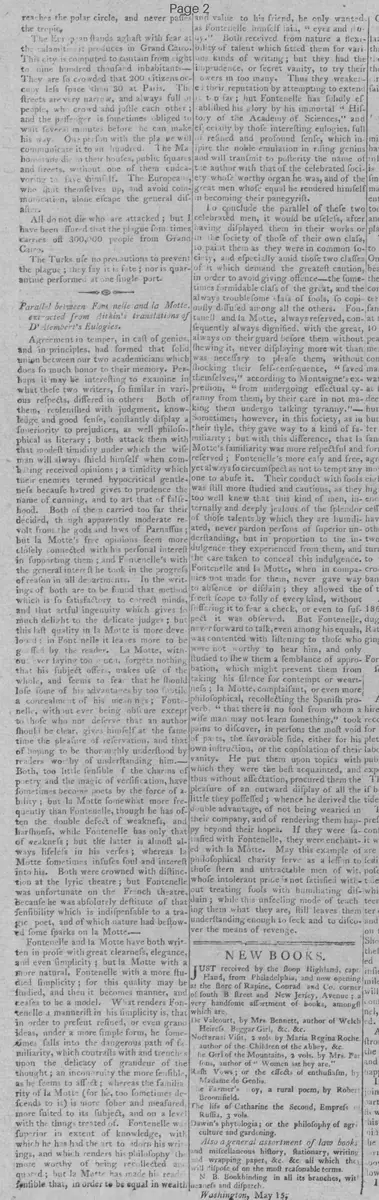
Parallel between Fontenelle and la Motte, extracted from Aitkin's translations of D'Alembert's Eulogies.
Agreement in temper, in cast of genius, and in principles, had formed that solid union between our two academicians which does so much honor to their memory. Perhaps it may be interesting to examine in what these two writers, so similar in various respects, differed in others. Both of them, replenished with judgment, knowledge and good sense, constantly display a superiority to prejudices, as well philosophical as literary; both attack them with that modest timidity under which the wise man will always shield himself when combating received opinions; a timidity which their enemies termed hypocritical gentleness because hatred gives to prudence the name of cunning, and to art that of falsehood. Both of them carried too far their decided, though apparently moderate revolt from the gods and laws of Parnassus:
but la Motte's free opinions seem more closely connected with his personal interest in supporting them; and Fontenelle's with the general interest he took in the progress of reason in all departments. In the writings of both are to be found that method which is so satisfactory to correct minds, and that artful ingenuity which gives so much delight to the delicate judges; but this last quality in la Motte is more developed: in Fontenelle it leaves more to be guessed by the reader. La Motte, without overlaying too much, forgets nothing that his subject offers, makes use of the whole, and seems to fear that he should lose some of his advantages by too studied a concealment of his intentions; Fontenelle, without ever being obscure except to those who do not deserve that an author should be clear, gives himself at the same time the pleasure of reservation, and that of hoping to be thoroughly understood by readers worthy of understanding him.
Both, too little sensible of the charms of poetry and the magic of versification, have sometimes become poets by the force of habit: but la Motte somewhat more frequently than Fontenelle, though he has often the double defect of weakness, and harshness, while Fontenelle has only that of weakness; but the latter is almost always lifeless in his verses; whereas la Motte sometimes infuses soul and interest into his. Both were crowned with distinction at the lyric theatre; but Fontenelle was unfortunate on the French theatre, because he was absolutely destitute of that sensibility which is indispensable to a tragic poet, and of which nature had bestowed some sparks on la Motte.
Fontenelle and la Motte have both written in prose with great clearness, elegance, and even simplicity; but la Motte with a more natural, Fontenelle with a more studied simplicity; or this quality may be studied, and then it becomes manner, and ceases to be a model. What renders Fontenelle a mannerist in his simplicity is, that in order to present refined, or even grand ideas, under a more simple form, he sometimes falls into the dangerous path of familiarity, which contrasts with and trenches upon the delicacy of grandeur of the thought; an incongruity the more sensible, as he seems to affect grandeur; whereas the familiarity of la Motte (for he, too sometimes descends to it) is more sober and measured, more suited to its subject, and on a level with the things treated of. Fontenelle was superior in extent of knowledge, with which he has had the art to adorn his writings, and which renders his philosophy the more worthy of being recollected and quoted; but la Motte has made his reader sensible that, in order to be equal in wealth, and value to his friend, he only wanted, as Fontenelle himself said, "eyes and judgment."
Both received from nature a flexibility of talent which fitted them for various kinds of writing; but they had the imprudence, or secret vanity, to try their powers in too many. Thus they weakened their reputation by attempting to extend it so far; but Fontenelle has solidly established his glory by his immortal "History of the Academy of Sciences," and especially by those interesting eulogies, full refined and profound sense, which inspire the noble emulation in rising genius and will transmit to posterity the name of the author with that of the celebrated society whose worthy organ he was, and of the great men whose equal he rendered himself in becoming their panegyrist.
Agreement in temper, in cast of genius, and in principles, had formed that solid union between our two academicians which does so much honor to their memory. Perhaps it may be interesting to examine in what these two writers, so similar in various respects, differed in others. Both of them, replenished with judgment, knowledge and good sense, constantly display a superiority to prejudices, as well philosophical as literary; both attack them with that modest timidity under which the wise man will always shield himself when combating received opinions; a timidity which their enemies termed hypocritical gentleness because hatred gives to prudence the name of cunning, and to art that of falsehood. Both of them carried too far their decided, though apparently moderate revolt from the gods and laws of Parnassus:
but la Motte's free opinions seem more closely connected with his personal interest in supporting them; and Fontenelle's with the general interest he took in the progress of reason in all departments. In the writings of both are to be found that method which is so satisfactory to correct minds, and that artful ingenuity which gives so much delight to the delicate judges; but this last quality in la Motte is more developed: in Fontenelle it leaves more to be guessed by the reader. La Motte, without overlaying too much, forgets nothing that his subject offers, makes use of the whole, and seems to fear that he should lose some of his advantages by too studied a concealment of his intentions; Fontenelle, without ever being obscure except to those who do not deserve that an author should be clear, gives himself at the same time the pleasure of reservation, and that of hoping to be thoroughly understood by readers worthy of understanding him.
Both, too little sensible of the charms of poetry and the magic of versification, have sometimes become poets by the force of habit: but la Motte somewhat more frequently than Fontenelle, though he has often the double defect of weakness, and harshness, while Fontenelle has only that of weakness; but the latter is almost always lifeless in his verses; whereas la Motte sometimes infuses soul and interest into his. Both were crowned with distinction at the lyric theatre; but Fontenelle was unfortunate on the French theatre, because he was absolutely destitute of that sensibility which is indispensable to a tragic poet, and of which nature had bestowed some sparks on la Motte.
Fontenelle and la Motte have both written in prose with great clearness, elegance, and even simplicity; but la Motte with a more natural, Fontenelle with a more studied simplicity; or this quality may be studied, and then it becomes manner, and ceases to be a model. What renders Fontenelle a mannerist in his simplicity is, that in order to present refined, or even grand ideas, under a more simple form, he sometimes falls into the dangerous path of familiarity, which contrasts with and trenches upon the delicacy of grandeur of the thought; an incongruity the more sensible, as he seems to affect grandeur; whereas the familiarity of la Motte (for he, too sometimes descends to it) is more sober and measured, more suited to its subject, and on a level with the things treated of. Fontenelle was superior in extent of knowledge, with which he has had the art to adorn his writings, and which renders his philosophy the more worthy of being recollected and quoted; but la Motte has made his reader sensible that, in order to be equal in wealth, and value to his friend, he only wanted, as Fontenelle himself said, "eyes and judgment."
Both received from nature a flexibility of talent which fitted them for various kinds of writing; but they had the imprudence, or secret vanity, to try their powers in too many. Thus they weakened their reputation by attempting to extend it so far; but Fontenelle has solidly established his glory by his immortal "History of the Academy of Sciences," and especially by those interesting eulogies, full refined and profound sense, which inspire the noble emulation in rising genius and will transmit to posterity the name of the author with that of the celebrated society whose worthy organ he was, and of the great men whose equal he rendered himself in becoming their panegyrist.
What sub-type of article is it?
Essay
What keywords are associated?
Fontenelle
La Motte
Parallel
Eulogies
D'alembert
Genius
Prose Style
Poetry Defects
Academy Sciences
What entities or persons were involved?
D'alembert (Translated By Aitkin)
Literary Details
Title
Parallel Between Fontenelle And La Motte, Extracted From Aitkin's Translations Of D'alembert's Eulogies.
Author
D'alembert (Translated By Aitkin)
Subject
Comparison Of Similarities And Differences Between Fontenelle And La Motte
Form / Style
Comparative Prose Essay
Key Lines
Agreement In Temper, In Cast Of Genius, And In Principles, Had Formed That Solid Union Between Our Two Academicians Which Does So Much Honor To Their Memory.
Both Of Them, Replenished With Judgment, Knowledge And Good Sense, Constantly Display A Superiority To Prejudices, As Well Philosophical As Literary;
Fontenelle Was Superior In Extent Of Knowledge, With Which He Has Had The Art To Adorn His Writings,
Fontenelle Has Solidly Established His Glory By His Immortal "History Of The Academy Of Sciences,"