Thank you for visiting SNEWPapers!
Sign up free
Letter to Editor
April 14, 1817
Kentucky Gazette
Lexington, Fayette County, Kentucky
What is this article about?
Matthew Lyon, in a letter to Kentuckians dated February 28, 1817, criticizes the legislature's refusal to allow an election for governor following a vacancy, arguing it violates fundamental constitutional rights. He praises Breckenridge's speech and dissects Mr. Mills' resolution, urging vigilance to protect suffrage.
Clipping
OCR Quality
98%
Excellent
Full Text
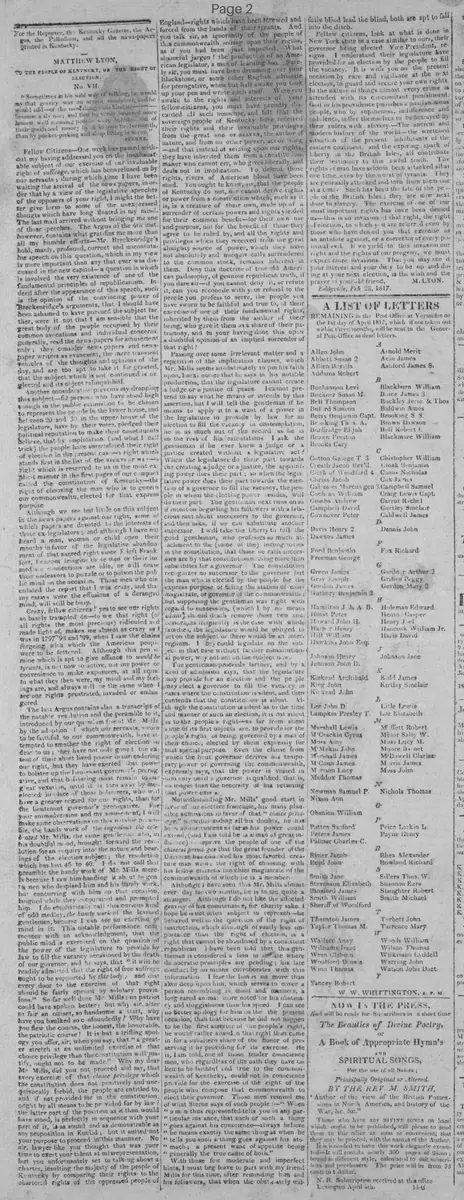
For the Reporter, the Kentucky Gazette, the Argus, the Palladium, and all the newspapers printed in Kentucky.
MATTHEW LYON.
TO THE PEOPLE OF KENTUCKY, ON THE EIGHT OF ELECTION.
No. VII.
Sometimes in his wild way of talking, he would say that gravity was an arrant scoundrel, and he would add—of the most dangerous kind too—because a sly one; and that I verily believed more honest well meaning people were bubbled out of their goods and money by it in one twelvemonth, than by pocket-picking and shop-lifting in seven.
STERNE.
Fellow Citizens—One week has passed without my having addressed you on the inexhaustible subject of our exercise of our invaluable right of suffrage, which has been refused us by our servants; during which time I have been waiting the arrival of the newspapers, in order that by a view of the legislative speeches of the opposers of your right, I might the better give form to some of the unexpressed thoughts which have long floated in my mind.
The last mail arrived without bringing me one of those speeches. The Argus of the 5th inst. however, contains what gratifies me more than all my humble efforts—Mr. Breckenridge's bold, manly, profound, correct and uncontroverted speech on this question, which in my view is more important than any that ever was discussed in the new capitol—a question in which is involved the very existence of one of the fundamental principles of republicanism.
In Mr. Breckenridge's arguments, that I should have indeed after the appearance of this speech, such been ashamed to have pursued the subject further, were it not that I am sensible that the great body of the people occupied by their common avocations and individual concerns generally, read the newspapers for amusement only; they consider newspapers and newspaper writers as evanescent, the mere transient echoes of the thoughts and opinions of the day, and are too apt to take it for granted, that the subject which is not continued is neglected and its object relinquished.
Another consideration prevents my dropping this subject—62 persons who have stood high enough in the public estimation to be chosen to represent the people in the lower house, and between 20 and 30 in the upper house of the legislature, have by their votes pledged their political reputation to make their constituents believe, that by implication (and what I call trick) the people have surrendered their right of election in this present case—a right which stands first in the list of the rights or maxims which is reserved to us in the most explicit manner in the first pages of our compact called the constitution of Kentucky—the representatives of our commonwealth, elected for that express purpose of choosing the man who is to govern our commonwealth.
Although we see but little on this subject in the newspapers against our right, some of which papers are devoted to the interests of those ex-legislators; and although I have not heard a man, woman or child open their mouths in favor of the legislative abandonment of that sacred right since I left Frankfort, I cannot imagine those men or their immediate connections are idle, or will cease their endeavors to puzzle or to poison the public mind on the occasion. Those men who circulated the report that I was crazy, and that my essays were the effusions of a deranged mind, will still be busy.
Crazy, fellow citizens! Yes, to see our rights (of all rights the most precious) ridiculed and go basely trampled on—to see that right made light of, makes me almost as crazy as I was in 1798, '99 and 1800, when I saw the chains forging with which the American people were to be fettered. Although this pen of mine which is apt to give offense to would-be tyrants, is not now so active, not my power or convenience to make exposures, at all equal to what they then were, my mind and my feelings are, and always will be the same when I see our rights prostrated, invaded or endangered.
The last Argus contains also a transcript of the notable resolution and the preamble to it, introduced by our quondam friend Mr. Mills, by the adoption of which our servants, sworn to be faithful to our commonwealth, have attempted to smother the right of election so dear to us: they have not only gone to the extent of their short-lived power in surrendering our right, but they have exerted that power to bolster up the lieutenant governor's prerogative. For your animadversion and my amusement, I will make some observations on this notable preamble, the handy work of the ingenious the celebrated Mr. Mills, the same gentleman who, in his doubtful mood, brought forward the resolution for an inquiry into the nature and bearings of the election subject; the resolution and preamble the handy work of Mr. Mills merely lost 45 to 40. I do not call that defeat, because I saw him handing it about to gentlemen who despised him and his handy work, but concurring with him on that occasion. They laughed while they encouraged and prompted him. I do emphatically call this curious kind of odd medley, the handy work of the learned gentleman, because I can see no exertion of mind in it. This notable performance commences with an acknowledgment, that the public mind is exercised on the question of the power of the legislature to provide by law to fill the vacancy occasioned by the death of our governor, and he says, that 'it will be readily admitted that the right of free suffrage ought to be supported by this body; and that every door to the exercise of that right should be fairly opened by salutary provisions.' So far well done Mr. Mills; no patriot could have spoken better; but why sir, after so fair an outset, so handsome a start, why have you baulked so confoundedly? Why have you flew the course, the honest, the honorable, the patriotic course? It is but a trifling apology you offer, sir, when you say, that 'a greater stretch at an unlimited exercise of that choice privilege than the Constitution will justify, ought not to be made.' Why my dear Mr. Mills, did you not proceed and say, that every exercise of that choice privilege which the constitution does not positively and unequivocally forbid, the people are entitled to, and if not provided for in the constitution, ought by all means to be provided for by law? The latter part of the position as it then would have stood, is perfectly in sequence with your former part of it, and as sound and as demonstrable as any proposition in Euclid; but it suited not your purpose to proceed in this manner. No sir, lawyer like you thought that was your time to exert your talent at misrepresentation, but you unfortunately set to talking about a charter, insulting the majesty of the people of Kentucky by comparing their rights to the chartered rights of the oppressed people of England—rights which have been screwed and forced from the hands of their tyrants. And you talk sir, as ignorantly of the people of this commonwealth seizing upon their rights, shameful jargon! the production of an American legislator, a man of learning too. Surely sir, you must have been dreaming over your Blackstone, or some other English advocate for prerogative, when but half awake you took up your pen and wrote such stuff. Were you awake to the rights and interests of your fellow-citizens, you must have proudly discarded all such nonsense, and felt that the sovereign people of Kentucky have received their rights and their invaluable privileges from the great GOD OF HEAVEN, the author of nature, and from no other power, act or thing; and that instead of seizing upon our rights, they have inherited them from a constitution maker who cannot err, who gives liberally and deals not in implication. To defend those rights, rivers of American blood have been shed. You ought to know, sir, that the people of Kentucky do not, nor cannot derive rights or power from a Constitution which, such as it is, is a creature of their own, made up of a surrender of certain powers and rights yielded for their common benefit—for their own use and purpose, not for the benefit of those they agree to be ruled by, and all the rights and privileges which they received from the great almighty source of power, which they have not absolutely and unequivocally surrendered to the common stock, remains inherent in them. Deny this doctrine of true old American philosophy, of genuine republican truth, if you dare sir—if you cannot deny it, or refute it, can you reconcile with your refusal to the people you profess to serve, the people you have sworn to be faithful and true to, of their exercise of one of their fundamental rights, inherited by them from the author of their being, who gave it them as a share of their patrimony, and to your having done this upon a doubtful opinion—of an implied surrender of that right?
Passing over some irrelevant matter and a repetition of the implication clauses, which Mr. Mills seems so obstinately to pin his faith upon, next notice that he says in his notable production, that the legislature cannot create a judge or a justice of peace. I cannot pretend to say what he means or intends by this assertion, but I will tell the gentleman if he means to apply it to a want of a power in the legislature to provide by law for an election to fill the vacancy in contemplation, he is as much out of the record as he is in the rest of his calculations. I ask the gentleman if he ever knew a judge or a justice created without a legislative act? When the legislature do their part towards the creating a judge or a justice, the appointing power does their part; so when the legislative power does their part towards the election of a governor to fill the vacancy, the people in whom the electing power resides, will do their part. The gentleman next runs on as if intent on beguiling his followers with a fallacious rant about successors to the governor, and then asks, if we can substitute another successor. I will take the liberty to tell the good gentleman, who professes so much attachment to the (some of the) incongruities in the constitution, that those he calls successors are by that constitution nothing more than substitutes for a governor. The Constitution recognizes no successor to the governor but the man who is elected by the people for the express purpose of filling the station of chief magistrate, or governor of the Commonwealth; but supposing the gentleman was right with regard to successors, (which I by no means admit), should death remove those two successors as frequently as the case with whole families, the legislature would be obliged to act on the subject or there would be an interregnum. They could legislate on the subject in that case without further constitutional power, why not act on the subject now. The gentleman proceeds farther, and by a kind of admission says, that the legislature may provide for an election and the people may elect a governor to fill the vacancy in cases where the constitution is silent, and then contends that the constitution is silent. Although the constitution is silent as to the time and manner of such an election, it is not silent as to the people's right—go far from silent some of its first objects are, to provide for the people's right of being governed by a man of their choice, elected by them expressly for that special purpose. Even the clause from which the lieut. governor derives his temporary power of governing the commonwealth, expressly says, that the power is vested in him only until a governor is qualified, that is, no longer than the necessity of his retaining that power exists.
Notwithstanding Mr. Mills' good start in favor of our elective franchise, his many plausible admissions in favor of that 'choice privilege,' notwithstanding all his doubts, he has been an instrument as far as his power could extend, (and I am told he is a man of great influence) to deprive the people of one of the choicest privileges that the great founder of the Universe has endowed his most favored creature man with; the right of choosing with his fellow citizens the chief magistrate of the commonwealth of which he is a member.
Although I have seen this Mr. Mills almost every day for two months, he is to me quite a stranger. Although I do not like the affected gravity of his countenance, for charity sake I hope he is not often subject to reproach—he behaved well in the question of the right of instruction, which although of vastly less importance than the right of election, is a right that cannot be abandoned by a consistent republican. I have been told that this gentleman is considered a lion incarnate where democratic principles are pending; his late conduct by no means corroborates with this information. I fear the lion is no more than skin deep upon him, which serves to cover a person resembling in mind and manners, a long eared animal more noted for his obstinacy and sluggishness than his speed. I can see no better apology for him on the present occasion, than that because he did not happen to be the first asserter of the people's right, he would rather abandon that right than come in for a subaltern share of the honor of preserving it by providing for its exercise. He is, I am told, one of those tender conscience men, who regardless of the oath they have taken to be faithful and true to the commonwealth of Kentucky, could not in conscience provide for the exercise of the right of the people who compose that commonwealth to elect their governor. Those men remind me of what Sterne says of such people :—' When a man thus represented tells you—in any particular instance, that such or such a thing goes against his conscience—always believe he means exactly the same thing as when he tells you such a thing goes against his stomach; a present want of appetite being generally the true cause of both.'
With those few moderate and imperfect hints, I must beg leave to part with my friend Mills for this time, after reminding him and his followers, that when the obstinately blind lead the fully blind, both are apt to fall into the ditch.
Fellow citizens, look at what is done in New York state in a case similar to ours, their governor being elected Vice President, resigns. I understand their legislature have provided for an election by the people to fill the vacancy. It is with you on the present occasion by care and vigilance at the next election, to guard and secure your own rights.
In the nature of things almost every crime is attended with its concomitant punishment. God in his providence punishes a pusillanimous people, who by supineness, indifference and indolence, suffer themselves to be betrayed by their rulers with slavery.—The ancient and modern history of the world—the wretched situation of the present inhabitants of the eastern continent, and the expiring spark of liberty in the British Isles, all contribute their testimony to this awful truth. The rights of man have seldom been attacked all at one time, even by the worst of tyrants. They are generally attacked and torn from them one at a time. Such has been the fate of the people of the British Isles: they are now next door to slavery. The exercise of one of our most important rights has once been denied us—this is an invasion of that right, the right of election, to which you are referred even by those who have denied you that exercise as an antidote against, or a corrector of every political evil. If we yield to this invasion our right and the rights of our progeny, we must expect more invasions. That you may see it your interest and your duty to be up and doing at your next election, is the wish and the prayer of your old friend,
M. LYON.
Eddyville, Feb. 28, 1817.
MATTHEW LYON.
TO THE PEOPLE OF KENTUCKY, ON THE EIGHT OF ELECTION.
No. VII.
Sometimes in his wild way of talking, he would say that gravity was an arrant scoundrel, and he would add—of the most dangerous kind too—because a sly one; and that I verily believed more honest well meaning people were bubbled out of their goods and money by it in one twelvemonth, than by pocket-picking and shop-lifting in seven.
STERNE.
Fellow Citizens—One week has passed without my having addressed you on the inexhaustible subject of our exercise of our invaluable right of suffrage, which has been refused us by our servants; during which time I have been waiting the arrival of the newspapers, in order that by a view of the legislative speeches of the opposers of your right, I might the better give form to some of the unexpressed thoughts which have long floated in my mind.
The last mail arrived without bringing me one of those speeches. The Argus of the 5th inst. however, contains what gratifies me more than all my humble efforts—Mr. Breckenridge's bold, manly, profound, correct and uncontroverted speech on this question, which in my view is more important than any that ever was discussed in the new capitol—a question in which is involved the very existence of one of the fundamental principles of republicanism.
In Mr. Breckenridge's arguments, that I should have indeed after the appearance of this speech, such been ashamed to have pursued the subject further, were it not that I am sensible that the great body of the people occupied by their common avocations and individual concerns generally, read the newspapers for amusement only; they consider newspapers and newspaper writers as evanescent, the mere transient echoes of the thoughts and opinions of the day, and are too apt to take it for granted, that the subject which is not continued is neglected and its object relinquished.
Another consideration prevents my dropping this subject—62 persons who have stood high enough in the public estimation to be chosen to represent the people in the lower house, and between 20 and 30 in the upper house of the legislature, have by their votes pledged their political reputation to make their constituents believe, that by implication (and what I call trick) the people have surrendered their right of election in this present case—a right which stands first in the list of the rights or maxims which is reserved to us in the most explicit manner in the first pages of our compact called the constitution of Kentucky—the representatives of our commonwealth, elected for that express purpose of choosing the man who is to govern our commonwealth.
Although we see but little on this subject in the newspapers against our right, some of which papers are devoted to the interests of those ex-legislators; and although I have not heard a man, woman or child open their mouths in favor of the legislative abandonment of that sacred right since I left Frankfort, I cannot imagine those men or their immediate connections are idle, or will cease their endeavors to puzzle or to poison the public mind on the occasion. Those men who circulated the report that I was crazy, and that my essays were the effusions of a deranged mind, will still be busy.
Crazy, fellow citizens! Yes, to see our rights (of all rights the most precious) ridiculed and go basely trampled on—to see that right made light of, makes me almost as crazy as I was in 1798, '99 and 1800, when I saw the chains forging with which the American people were to be fettered. Although this pen of mine which is apt to give offense to would-be tyrants, is not now so active, not my power or convenience to make exposures, at all equal to what they then were, my mind and my feelings are, and always will be the same when I see our rights prostrated, invaded or endangered.
The last Argus contains also a transcript of the notable resolution and the preamble to it, introduced by our quondam friend Mr. Mills, by the adoption of which our servants, sworn to be faithful to our commonwealth, have attempted to smother the right of election so dear to us: they have not only gone to the extent of their short-lived power in surrendering our right, but they have exerted that power to bolster up the lieutenant governor's prerogative. For your animadversion and my amusement, I will make some observations on this notable preamble, the handy work of the ingenious the celebrated Mr. Mills, the same gentleman who, in his doubtful mood, brought forward the resolution for an inquiry into the nature and bearings of the election subject; the resolution and preamble the handy work of Mr. Mills merely lost 45 to 40. I do not call that defeat, because I saw him handing it about to gentlemen who despised him and his handy work, but concurring with him on that occasion. They laughed while they encouraged and prompted him. I do emphatically call this curious kind of odd medley, the handy work of the learned gentleman, because I can see no exertion of mind in it. This notable performance commences with an acknowledgment, that the public mind is exercised on the question of the power of the legislature to provide by law to fill the vacancy occasioned by the death of our governor, and he says, that 'it will be readily admitted that the right of free suffrage ought to be supported by this body; and that every door to the exercise of that right should be fairly opened by salutary provisions.' So far well done Mr. Mills; no patriot could have spoken better; but why sir, after so fair an outset, so handsome a start, why have you baulked so confoundedly? Why have you flew the course, the honest, the honorable, the patriotic course? It is but a trifling apology you offer, sir, when you say, that 'a greater stretch at an unlimited exercise of that choice privilege than the Constitution will justify, ought not to be made.' Why my dear Mr. Mills, did you not proceed and say, that every exercise of that choice privilege which the constitution does not positively and unequivocally forbid, the people are entitled to, and if not provided for in the constitution, ought by all means to be provided for by law? The latter part of the position as it then would have stood, is perfectly in sequence with your former part of it, and as sound and as demonstrable as any proposition in Euclid; but it suited not your purpose to proceed in this manner. No sir, lawyer like you thought that was your time to exert your talent at misrepresentation, but you unfortunately set to talking about a charter, insulting the majesty of the people of Kentucky by comparing their rights to the chartered rights of the oppressed people of England—rights which have been screwed and forced from the hands of their tyrants. And you talk sir, as ignorantly of the people of this commonwealth seizing upon their rights, shameful jargon! the production of an American legislator, a man of learning too. Surely sir, you must have been dreaming over your Blackstone, or some other English advocate for prerogative, when but half awake you took up your pen and wrote such stuff. Were you awake to the rights and interests of your fellow-citizens, you must have proudly discarded all such nonsense, and felt that the sovereign people of Kentucky have received their rights and their invaluable privileges from the great GOD OF HEAVEN, the author of nature, and from no other power, act or thing; and that instead of seizing upon our rights, they have inherited them from a constitution maker who cannot err, who gives liberally and deals not in implication. To defend those rights, rivers of American blood have been shed. You ought to know, sir, that the people of Kentucky do not, nor cannot derive rights or power from a Constitution which, such as it is, is a creature of their own, made up of a surrender of certain powers and rights yielded for their common benefit—for their own use and purpose, not for the benefit of those they agree to be ruled by, and all the rights and privileges which they received from the great almighty source of power, which they have not absolutely and unequivocally surrendered to the common stock, remains inherent in them. Deny this doctrine of true old American philosophy, of genuine republican truth, if you dare sir—if you cannot deny it, or refute it, can you reconcile with your refusal to the people you profess to serve, the people you have sworn to be faithful and true to, of their exercise of one of their fundamental rights, inherited by them from the author of their being, who gave it them as a share of their patrimony, and to your having done this upon a doubtful opinion—of an implied surrender of that right?
Passing over some irrelevant matter and a repetition of the implication clauses, which Mr. Mills seems so obstinately to pin his faith upon, next notice that he says in his notable production, that the legislature cannot create a judge or a justice of peace. I cannot pretend to say what he means or intends by this assertion, but I will tell the gentleman if he means to apply it to a want of a power in the legislature to provide by law for an election to fill the vacancy in contemplation, he is as much out of the record as he is in the rest of his calculations. I ask the gentleman if he ever knew a judge or a justice created without a legislative act? When the legislature do their part towards the creating a judge or a justice, the appointing power does their part; so when the legislative power does their part towards the election of a governor to fill the vacancy, the people in whom the electing power resides, will do their part. The gentleman next runs on as if intent on beguiling his followers with a fallacious rant about successors to the governor, and then asks, if we can substitute another successor. I will take the liberty to tell the good gentleman, who professes so much attachment to the (some of the) incongruities in the constitution, that those he calls successors are by that constitution nothing more than substitutes for a governor. The Constitution recognizes no successor to the governor but the man who is elected by the people for the express purpose of filling the station of chief magistrate, or governor of the Commonwealth; but supposing the gentleman was right with regard to successors, (which I by no means admit), should death remove those two successors as frequently as the case with whole families, the legislature would be obliged to act on the subject or there would be an interregnum. They could legislate on the subject in that case without further constitutional power, why not act on the subject now. The gentleman proceeds farther, and by a kind of admission says, that the legislature may provide for an election and the people may elect a governor to fill the vacancy in cases where the constitution is silent, and then contends that the constitution is silent. Although the constitution is silent as to the time and manner of such an election, it is not silent as to the people's right—go far from silent some of its first objects are, to provide for the people's right of being governed by a man of their choice, elected by them expressly for that special purpose. Even the clause from which the lieut. governor derives his temporary power of governing the commonwealth, expressly says, that the power is vested in him only until a governor is qualified, that is, no longer than the necessity of his retaining that power exists.
Notwithstanding Mr. Mills' good start in favor of our elective franchise, his many plausible admissions in favor of that 'choice privilege,' notwithstanding all his doubts, he has been an instrument as far as his power could extend, (and I am told he is a man of great influence) to deprive the people of one of the choicest privileges that the great founder of the Universe has endowed his most favored creature man with; the right of choosing with his fellow citizens the chief magistrate of the commonwealth of which he is a member.
Although I have seen this Mr. Mills almost every day for two months, he is to me quite a stranger. Although I do not like the affected gravity of his countenance, for charity sake I hope he is not often subject to reproach—he behaved well in the question of the right of instruction, which although of vastly less importance than the right of election, is a right that cannot be abandoned by a consistent republican. I have been told that this gentleman is considered a lion incarnate where democratic principles are pending; his late conduct by no means corroborates with this information. I fear the lion is no more than skin deep upon him, which serves to cover a person resembling in mind and manners, a long eared animal more noted for his obstinacy and sluggishness than his speed. I can see no better apology for him on the present occasion, than that because he did not happen to be the first asserter of the people's right, he would rather abandon that right than come in for a subaltern share of the honor of preserving it by providing for its exercise. He is, I am told, one of those tender conscience men, who regardless of the oath they have taken to be faithful and true to the commonwealth of Kentucky, could not in conscience provide for the exercise of the right of the people who compose that commonwealth to elect their governor. Those men remind me of what Sterne says of such people :—' When a man thus represented tells you—in any particular instance, that such or such a thing goes against his conscience—always believe he means exactly the same thing as when he tells you such a thing goes against his stomach; a present want of appetite being generally the true cause of both.'
With those few moderate and imperfect hints, I must beg leave to part with my friend Mills for this time, after reminding him and his followers, that when the obstinately blind lead the fully blind, both are apt to fall into the ditch.
Fellow citizens, look at what is done in New York state in a case similar to ours, their governor being elected Vice President, resigns. I understand their legislature have provided for an election by the people to fill the vacancy. It is with you on the present occasion by care and vigilance at the next election, to guard and secure your own rights.
In the nature of things almost every crime is attended with its concomitant punishment. God in his providence punishes a pusillanimous people, who by supineness, indifference and indolence, suffer themselves to be betrayed by their rulers with slavery.—The ancient and modern history of the world—the wretched situation of the present inhabitants of the eastern continent, and the expiring spark of liberty in the British Isles, all contribute their testimony to this awful truth. The rights of man have seldom been attacked all at one time, even by the worst of tyrants. They are generally attacked and torn from them one at a time. Such has been the fate of the people of the British Isles: they are now next door to slavery. The exercise of one of our most important rights has once been denied us—this is an invasion of that right, the right of election, to which you are referred even by those who have denied you that exercise as an antidote against, or a corrector of every political evil. If we yield to this invasion our right and the rights of our progeny, we must expect more invasions. That you may see it your interest and your duty to be up and doing at your next election, is the wish and the prayer of your old friend,
M. LYON.
Eddyville, Feb. 28, 1817.
What sub-type of article is it?
Persuasive
Political
Provocative
What themes does it cover?
Constitutional Rights
Politics
What keywords are associated?
Election Rights
Kentucky Constitution
Governor Vacancy
Legislative Trickery
Suffrage Defense
Matthew Lyon
Mr Mills Resolution
What entities or persons were involved?
M. Lyon
To The People Of Kentucky
Letter to Editor Details
Author
M. Lyon
Recipient
To The People Of Kentucky
Main Argument
the kentucky legislature has wrongly denied the people's right to elect a governor to fill the vacancy, violating fundamental constitutional principles; lyon urges citizens to defend this suffrage at the next election.
Notable Details
Praises Mr. Breckenridge's Speech
Critiques Mr. Mills' Resolution And Preamble
References Sterne's Writings
Compares To New York State's Handling Of Similar Vacancy
Mentions Historical Defense Of Rights With American Blood