Thank you for visiting SNEWPapers!
Sign up free
Gazette Of The United States And Daily Evening Advertiser
Philadelphia, Philadelphia County, Pennsylvania
What is this article about?
French official journal details Admiral Villaret's fleet cruise from Brest (May 16-June 10, 1794), including recaptures, multiple naval battles with British fleet off Atlantic, heavy casualties (e.g., 200 killed on Montagne), dismasted ships, possible enemy sinkings, and success in saving American convoy.
Merged-components note: These two components continue the French official account of naval engagements with the British fleet, forming a single coherent foreign news story.
Clippings
1 of 2
OCR Quality
Full Text
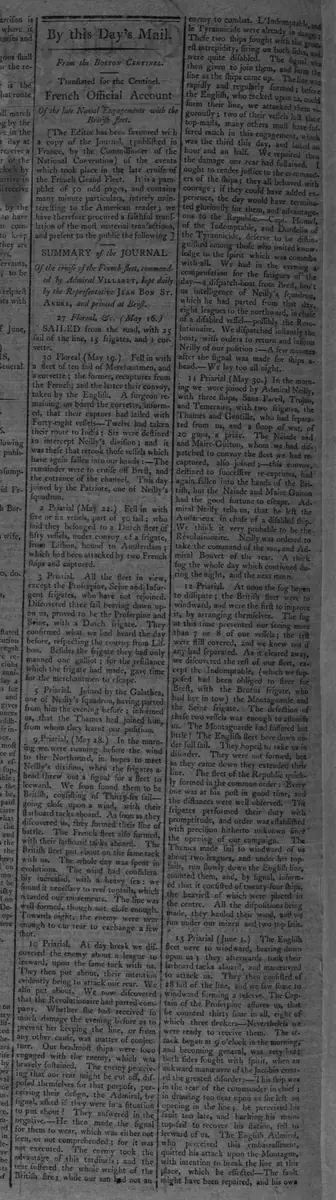
From the Boston Centinel.
Translated for the Centinel.
French Official Account
Of the late Naval Engagements with the
British fleet.
The Editor has been favoured with a copy of the Journal, (published in France, by the Commissioner of the National Convention) of the events which took place in the late cruise of the French Grand Fleet. It is a pamphlet of 50 odd pages, and contains many minute particulars, entirely uninteresting to the American reader; we have therefore procured a faithful translation of the most material transactions, and present to the public the following
SUMMARY of the JOURNAL
Of the cruise of the French fleet, commanded by Admiral VILLRET, kept daily by the Representative Jean Bon St. ANDRE, and printed at Brest.
27 Floreal, &c. (May 16.)
SAILED from the road, with 25 sail of the line, 15 frigates, and 5 corvettes.
30 Floreal (May 19.) Fell in with a fleet of ten sail of Merchantmen, and a corvette; the former, recaptures from the French; and the latter their convoy, taken by the English. A surgeon remaining on board the corvette, informed, that their captors had sailed with Forty-eight vessels--Twelve had taken their route to India: Six were destined to intercept Villaret's division; and it was these that retook those vessels which have again fallen into our hands:--The remainder were to cruise off Brest, and the entrance of the channel. This day joined by the Patriote, one of Villaret's squadron.
2 Prairial (May 22.) Fell in with five or six vessels, part of 50 sail; who said they belonged to a Dutch fleet of fifty vessels, under convoy of a frigate, from Lisbon, bound to Amsterdam; which had been attacked by two French ships and captured.
3 Prairial. All the fleet in view, except the Proserpine, Seine and Incorruptible frigates, who have not rejoined. Discovered three sail bearing down upon us, proved to be the Proserpine and Seine, with a Dutch frigate. They confirmed what we had heard the day before, respecting the convoy from Lisbon. Besides the frigate they had only manned one galliot; for the resistance which the frigate had made, gave time for the merchantmen to escape.
5 Prairial. Joined by the Galathea one of Villaret's squadron, having parted from him the evening before; informed us, that the Thames had joined him, from whom they learnt our position.
9 Prairial, (May 28.) In the morning we were running before the wind to the Northward, in hopes to meet Villaret's division, when the frigates ahead threw out a signal for a fleet to leeward. We soon found them to be British, consisting of Twenty-six sail--going close upon a wind, with their starboard tacks aboard. As soon as they discovered us, they formed their line of battle. The French fleet also formed, with their larboard tacks aboard. The British fleet put about on the same tack with us. The whole day was spent in evolutions. The wind had considerably increased, with a heavy sea: we found it necessary to reef topsails, which retarded our movements. The line was well formed, though not close enough. Towards night, the enemy were near enough to our rear to exchange a few shot.
10 Prairial. At day break we discovered the enemy about a league to leeward, upon the same tack with us. They then put about, their intention evidently being to attack our rear. We also put about. We now discovered that the Revolutionnaire had parted company. Whether he had received so much damage the evening before as to prevent her keeping the line, or from any other cause, was matter of conjecture. Our headmost ships were soon engaged with the enemy, which was bravely sustained. The enemy perceiving that our rear might be cut off, disposed themselves for that purpose, perceiving their design, the Admiral, by signal, asked if they were in a situation to put about? They answered in the negative.--He then made the signal for them to wear, which was either not seen, or not comprehended; for it was not executed. The enemy took the advantage of this tardiness; and the rear suffered the whole weight of the British fire; while our van had not an enemy to combat. L'Indomptable, and Le Tyrannicide were already in danger: These two ships fought with the greatest intrepidity, firing on both sides, and were quite disabled. The signal was then given to join them, and form the line as the Ships came up. The line was rapidly and regularly formed; before the English, who tacked upon us, could form their line, we attacked them vigorously; two of their vessels lost their top-masts, many others must have suffered much in this engagement, which was the third this day, and lasted an hour and an half. We repaired then the damage our rear had sustained. I ought to render justice to the commanders of the ships; they all behaved with courage; if they could have added experience, the day would have terminated gloriously for them, and advantageously to the Republic. Capt. Homel, of the Indomptable, and Dordelin of the Tyrannicide, deserve to be distinguished among those who united knowledge to the spirit which was common with all. We had in the evening a compensation for the fatigues of the day--a dispatch-boat from Brest, brought us intelligence of Villaret's squadron, which he had parted from that day, eight leagues to the northward, in chase of a disabled vessel--possibly the Revolutionnaire. We dispatched instantly the boat, with orders to return and inform Villaret of our position:--A few minutes after the signal was made for ships ahead.--We lay too all night.
11 Prairial (May 30.) In the morning we were joined by Admiral Villaret, with three ships, Sans Pareil, Trajan, and Temeraire, with two frigates, the Thames and Gentille, who had separated from us, and a sloop of war, of 20 guns, a prize. The Naiade and Montagne-Guiton, whom we had dispatched to convoy the fleet we had re-captured, also joined;--this convoy, destined to receive re-captures, had again fallen into the hands of the British, but the Naiade and Montagne Guiton had the good fortune to escape. Admiral Villaret tells us, that he left the Audacieux in chase of a disabled ship. We think it very probable to be the Revolutionnaire. Villaret was ordered to take the command of the van, and Admiral Bouvet of the rear. A thick fog the whole day which continued during the night, and the next morn.
12 Prairial. At noon the fog began to dissipate; the British fleet were to windward, and were the first to improve it, by arranging themselves. The fog at this time prevented our seeing more than 7 or 8 of our vessels; the rest were still covered, and we knew not if any had separated. As it cleared away, we discovered the rest of our fleet, except the Indomptable, (which we supposed had been obliged to steer for Brest, with the Brutus frigate, who had her in tow) the Montagnarde and the Seine frigate. The defection of these two vessels was enough to astonish us. The Montagnarde had suffered but little! The English fleet bore down under full sail. They hoped to take us in disorder. They were not formed, but as they came down they extended their line. The fleet of the Republic quickly formed in the common order: Every one was at his post in good time, and the distances were well observed. The frigates performed their duty with promptitude, and order was established with precision hitherto unknown since the opening of our campaign. The Thames made sail to windward of us about two leagues, and under her top-sails, run slowly down the English line, counted them, and, by signal, informed that it consisted of twenty-four ships, the heaviest of which were placed in the centre. All the dispositions being made, they hauled their wind, and we run under our mizen and two top-sails.
13 Prairial (June 1.) The English fleet were to windward, bearing down upon us; they afterwards took their larboard tacks aboard, and manoeuvred to attack us. They then consisted of 28 sail of the line, and we saw some to windward forming a reserve. The Captain of the Proserpine assures us, that he counted thirty-four in all, eight of which three deckers. Nevertheless we were ready to receive them. The attack began at 9 o'clock in the morning, and becoming general, was very hot; both sides fought with spirit, when an awkward manoeuvre of the Jacobin created the greatest disorder: This ship was in the rear of the commander in chief: in drawing too near upon us she left an opening in the line; he perceived his fault too late, and backing his main-top-sail to recover his station, fell to leeward of us. The English Admiral, who perceived this embarrassment, quitted his attack upon the Montagne, with intention to break the line at this place, which he effected. The fault might have been repaired, and his own ship taken, but the Montagne bore down upon him, and the Queen Charlotte was saved by the Russel coming to her assistance.
imprudence might have been turned to advantage against him, if the Jacobin had wore ship orders for which were given, but they were not obeyed. The English Admiral who attack was principally upon us, after discharging a broadside into the Achilles, raked the Montagne, with great execution. One hundred men, at least, were killed by these deadly discharges, and our stern suffered exceedingly. We received the rapid fire of the enemy, and could not return it, for fear of injuring one of our own vessels. At length we brought our guns to bear upon him, and presented our broadside, which he could not long sustain, but sheered off with the loss of his main and mizen mast.
Instantly we were surrounded by five or six ships. We fired on both sides, and sunk a ship of the enemy to windward, and all who came near us were roughly handled. The battle was horrible! The ships were engaged without order, and fought within pistol shot, with a carnage that has no example! The clouds of smoke prevented us from seeing what passed around. Our frigates report that the Montagnie was invisible for two hours, and that she could be discovered only by her tremendous artillery. However, through a gleam of light, the commander in chief perceived that the van had given way. Rear-Admiral Bouvet, who commanded, was the only one that maintained his post. He was to windward of the enemy, fighting obstinately, having lost his main-mast. To join his division he bore away through the British fleet with great boldness. The enemy seeing our van give way, attacked the rear. Admiral Villaret Joyeuse sustained the shock with firmness, and assures us, that he saw one of their ships sink.
It is impossible to be particular in the movements of this day. In the heat of the action we could only ascertain principal events. The battle slackened after about five hours. The Commander in Chief discovered the van two leagues to leeward. The rear could not be seen. Three ships were to windward of the enemy, with their starboard tacks aboard: they appeared to have suffered but little, and doubtless withdrew betimes.
We joined the rear: almost all the vessels that composed it were disabled. The Republican preserved only her mizen mast and every thing announced that they had made a resistance worthy of them.
Some of our disabled ships were very distant to windward, among the English Ships who were in the same situation. We lay too, to give time to take in tow such dismantled ships as our situation permitted us to relieve; and such was the weakness of the enemy, that we were not disturbed. We counted in the two fleets seventeen ships dismantled by the board, besides those who preserved the stumps of their masts. If the van had kept more to windward, we should not only have saved our own ships, but many of the English must have fallen into our hands. The English had the advantage of numbers, but not the superiority of courage or skill. They had also the advantage of the wind, which was the cause of some of our vessels falling into their hands, who, from their position, were totally unable to defend themselves, for all who preserved a stump to hoist a sail upon, after the most honorable resistance, escaped from the enemy. We left them in a worse state than we were; if it had still been possible for them to attack us, they had the opportunity, for we did not fly; they did not even move to prevent our small corvettes from taking in tow such of our ships as were out of the line. We lay too five or six hours to refit: after which we kept our wind under topsails. We collected nineteen large vessels, viz. La Montagne, Mucius, Trojan, Scipion, Republique, Entreprenant, Patriote, Caparin, Temeraire, Neptune, Terrible, Pelletier, Jacobin, Convention, Trente un Mai, Geqappes, Tyrannicide, Tourville, and the Eole.
The number of killed and wounded, has been great; the Montagne alone had 200 killed, and 100 nearly mortally wounded. I do not mention slight wounds, for scarce an individual on board the Montagne, had escaped unhurt. The ardor of the crews exceeds description; and it was the inexperience of some Captains, particularly of the Captain of the Jacobin, that snatched from us the most brilliant victory. After the engagement the wind was fortunately light, and the sea smooth, which gave us an opportunity of effecting the most urgent repairs. Some of the Trojan, Patriote, and Temeraire, were three of Villaret's four ships that sailed. our vessels had suffered very little. The dismasted ships were the Luicius, Scipion, Republican, Terrible and Gemappes. These bore the marks of the courage with which they fought. We learn from report of the Captains, that there was probably three English ships sunk. The Neptune saw one in the rear. and many others saw her.--It was the one that Villaret spoke of; the Tourville and Caparin saw the one sunk that we had seen. The Tourville saw an English ship close with the Impetueux; and in the shock both went down.
The following days afford nothing remarkable, the weather was mild and favorable for the necessary communications.
21 Prairial, (June 9.) Discovered seventeen sail ahead running upon a different tack; we soon found them to be a squadron of the enemy. They consisted of twelve ships of the line, and five frigates or sloops. They however did not think it to give us battle, and in our disabled state we could not oblige them to it. We gave chase with a light wind, but they crowding sail we gave up a fruitless pursuit. By this happy circumstance we drove them from the route of the convoy from the United States.
22 Prairial (June 10.) Made Cape Raz, and the next day anchored in the road of Bertheaume. Happily the American convoy arrived the day following, and, after a severe campaign, we had the pleasing reflection to think that we had saved it.
* * Some observations on this journal will appear in the next Centinel.
What sub-type of article is it?
What keywords are associated?
What entities or persons were involved?
Where did it happen?
Foreign News Details
Primary Location
Off Brest, Atlantic
Event Date
27 Floreal To 22 Prairial (May 16 To June 10, 1794)
Key Persons
Outcome
french fleet engaged british multiple times; montagne had 200 killed and 100 mortally wounded; several french ships dismasted (luicius, scipion, republican, terrible, gemappes); possible 3 english ships sunk; french saved american convoy from interception.
Event Details
The French Grand Fleet under Admiral Villaret sailed from Brest on May 16 with 25 ships of the line. They recaptured merchantmen, engaged British fleets in several battles from May 28 to June 1, suffering damage but maintaining formation. Joined by divisions, they repelled attacks, disabled enemy ships, and returned to Brest on June 11, having protected the American convoy.