Thank you for visiting SNEWPapers!
Sign up free
Editorial
January 6, 1961
Toledo Union Journal
Toledo, Lucas County, Ohio
What is this article about?
Edward P. Morgan critiques US equivocal UN policy on colonialism, highlighting abstentions on anti-colonial resolutions to appease allies like Britain and France, and pressures from Defense Dept. for South African base, urging principled stance under Kennedy.
Clipping
OCR Quality
98%
Excellent
Full Text
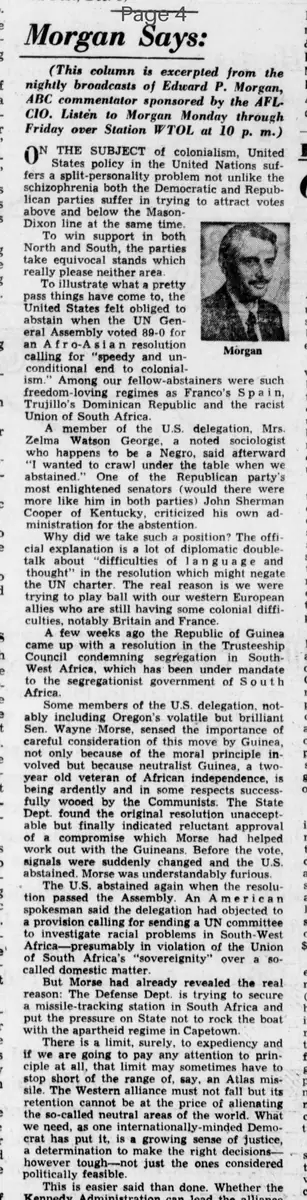
Morgan Says:
(This column is excerpted from the nightly broadcasts of Edward P. Morgan, ABC commentator sponsored by the AFL-CIO. Listen to Morgan Monday through Friday over Station WTOL at 10 p. m.)
ON THE SUBJECT of colonialism, United States policy in the United Nations suffers a split-personality problem not unlike the schizophrenia both the Democratic and Republican parties suffer in trying to attract votes above and below the Mason-Dixon line at the same time.
To win support in both North and South, the parties take equivocal stands which really please neither area.
To illustrate what a pretty pass things have come to, the United States felt obliged to abstain when the UN General Assembly voted 89-0 for an Afro-Asian resolution calling for "speedy and unconditional end to colonialism." Among our fellow-abstainers were such freedom-loving regimes as Franco's Spain, Trujillo's Dominican Republic and the racist Union of South Africa.
A member of the U.S. delegation, Mrs. Zelma Watson George, a noted sociologist who happens to be a Negro, said afterward "I wanted to crawl under the table when we abstained." One of the Republican party's most enlightened senators (would there were more like him in both parties) John Sherman Cooper of Kentucky, criticized his own administration for the abstention.
Why did we take such a position? The official explanation is a lot of diplomatic double-talk about "difficulties of language and thought" in the resolution which might negate the UN charter. The real reason is we were trying to play ball with our western European allies who are still having some colonial difficulties, notably Britain and France.
A few weeks ago the Republic of Guinea came up with a resolution in the Trusteeship Council condemning segregation in South-West Africa, which has been under mandate to the segregationist government of South Africa.
Some members of the U.S. delegation, notably including Oregon's volatile but brilliant Sen. Wayne Morse, sensed the importance of careful consideration of this move by Guinea, not only because of the moral principle involved but because neutralist Guinea, a two-year old veteran of African independence, is being ardently and in some respects successfully wooed by the Communists. The State Dept. found the original resolution unacceptable but finally indicated reluctant approval of a compromise which Morse had helped work out with the Guineans. Before the vote, signals were suddenly changed and the U.S. abstained. Morse was understandably furious.
The U.S. abstained again when the resolution passed the Assembly. An American spokesman said the delegation had objected to a provision calling for sending a UN committee to investigate racial problems in South-West Africa—presumably in violation of the Union of South Africa's "sovereignty" over a so-called domestic matter.
But Morse had already revealed the real reason: The Defense Dept. is trying to secure a missile-tracking station in South Africa and put the pressure on State not to rock the boat with the apartheid regime in Capetown.
There is a limit, surely, to expediency and if we are going to pay any attention to principle at all, that limit may sometimes have to stop short of the range of, say, an Atlas missile. The Western alliance must not fall but its retention cannot be at the price of alienating the so-called neutral areas of the world. What we need, as one internationally-minded Democrat has put it, is a growing sense of justice, a determination to make the right decisions—however tough—not just the ones considered politically feasible.
This is easier said than done. Whether the Kennedy Administration can lead the alliance along these lines remains to be seen. The hopefully operative factor for 1961 is that there are men in this new regime who are determined to try.
(This column is excerpted from the nightly broadcasts of Edward P. Morgan, ABC commentator sponsored by the AFL-CIO. Listen to Morgan Monday through Friday over Station WTOL at 10 p. m.)
ON THE SUBJECT of colonialism, United States policy in the United Nations suffers a split-personality problem not unlike the schizophrenia both the Democratic and Republican parties suffer in trying to attract votes above and below the Mason-Dixon line at the same time.
To win support in both North and South, the parties take equivocal stands which really please neither area.
To illustrate what a pretty pass things have come to, the United States felt obliged to abstain when the UN General Assembly voted 89-0 for an Afro-Asian resolution calling for "speedy and unconditional end to colonialism." Among our fellow-abstainers were such freedom-loving regimes as Franco's Spain, Trujillo's Dominican Republic and the racist Union of South Africa.
A member of the U.S. delegation, Mrs. Zelma Watson George, a noted sociologist who happens to be a Negro, said afterward "I wanted to crawl under the table when we abstained." One of the Republican party's most enlightened senators (would there were more like him in both parties) John Sherman Cooper of Kentucky, criticized his own administration for the abstention.
Why did we take such a position? The official explanation is a lot of diplomatic double-talk about "difficulties of language and thought" in the resolution which might negate the UN charter. The real reason is we were trying to play ball with our western European allies who are still having some colonial difficulties, notably Britain and France.
A few weeks ago the Republic of Guinea came up with a resolution in the Trusteeship Council condemning segregation in South-West Africa, which has been under mandate to the segregationist government of South Africa.
Some members of the U.S. delegation, notably including Oregon's volatile but brilliant Sen. Wayne Morse, sensed the importance of careful consideration of this move by Guinea, not only because of the moral principle involved but because neutralist Guinea, a two-year old veteran of African independence, is being ardently and in some respects successfully wooed by the Communists. The State Dept. found the original resolution unacceptable but finally indicated reluctant approval of a compromise which Morse had helped work out with the Guineans. Before the vote, signals were suddenly changed and the U.S. abstained. Morse was understandably furious.
The U.S. abstained again when the resolution passed the Assembly. An American spokesman said the delegation had objected to a provision calling for sending a UN committee to investigate racial problems in South-West Africa—presumably in violation of the Union of South Africa's "sovereignty" over a so-called domestic matter.
But Morse had already revealed the real reason: The Defense Dept. is trying to secure a missile-tracking station in South Africa and put the pressure on State not to rock the boat with the apartheid regime in Capetown.
There is a limit, surely, to expediency and if we are going to pay any attention to principle at all, that limit may sometimes have to stop short of the range of, say, an Atlas missile. The Western alliance must not fall but its retention cannot be at the price of alienating the so-called neutral areas of the world. What we need, as one internationally-minded Democrat has put it, is a growing sense of justice, a determination to make the right decisions—however tough—not just the ones considered politically feasible.
This is easier said than done. Whether the Kennedy Administration can lead the alliance along these lines remains to be seen. The hopefully operative factor for 1961 is that there are men in this new regime who are determined to try.
What sub-type of article is it?
Foreign Affairs
Imperialism
What keywords are associated?
Us Un Policy
Colonialism
Abstentions
South Africa
Guinea Resolution
Wayne Morse
John Sherman Cooper
Anti Colonialism
Neutralist Countries
Western Alliance
What entities or persons were involved?
United States
United Nations
Edward P. Morgan
Mrs. Zelma Watson George
John Sherman Cooper
Wayne Morse
Guinea
South Africa
Britain
France
Franco's Spain
Trujillo's Dominican Republic
Union Of South Africa
Kennedy Administration
Editorial Details
Primary Topic
Us Abstentions On Un Anti Colonial Resolutions
Stance / Tone
Critical Of Us Equivocal Policy, Advocating Principled Anti Colonial Stance
Key Figures
United States
United Nations
Edward P. Morgan
Mrs. Zelma Watson George
John Sherman Cooper
Wayne Morse
Guinea
South Africa
Britain
France
Franco's Spain
Trujillo's Dominican Republic
Union Of South Africa
Kennedy Administration
Key Arguments
Us Policy In Un On Colonialism Is Equivocal Like Party Stances On North South Issues
Us Abstained On Un Resolution For End To Colonialism, Joining Repressive Regimes
Us Delegation Member Embarrassed By Abstention
Senator Cooper Criticized Administration
Official Excuse Is Diplomatic Double Talk; Real Reason Is Supporting European Allies With Colonies
Us Initially Approved Compromise On Guinea's Resolution Against South West Africa Segregation But Then Abstained
Real Reason For Abstention: Defense Dept. Wants Missile Tracking Station In South Africa
Expediency Should Not Override Principle; Need Sense Of Justice Over Political Feasibility
Hope Kennedy Administration Will Lead On Principled Decisions