Thank you for visiting SNEWPapers!
Sign up free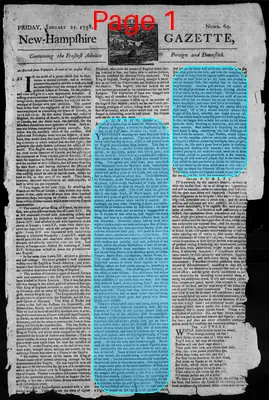
The New Hampshire Gazette
Portsmouth, Rockingham County, New Hampshire
What is this article about?
On December 1, 1756, HMS Hibernia off Rajipore, south of Bombay, rescued a captured ketch from Marawa pirates on the Malabar coast. The ketch's crew of 25, led by Captain/Nabab (possibly Capt. Scott), repelled multiple attacks, suffering heavy wounds and one death before the rescue. Cargo valued at 5000 rupees retaken.
Clipping
OCR Quality
Full Text
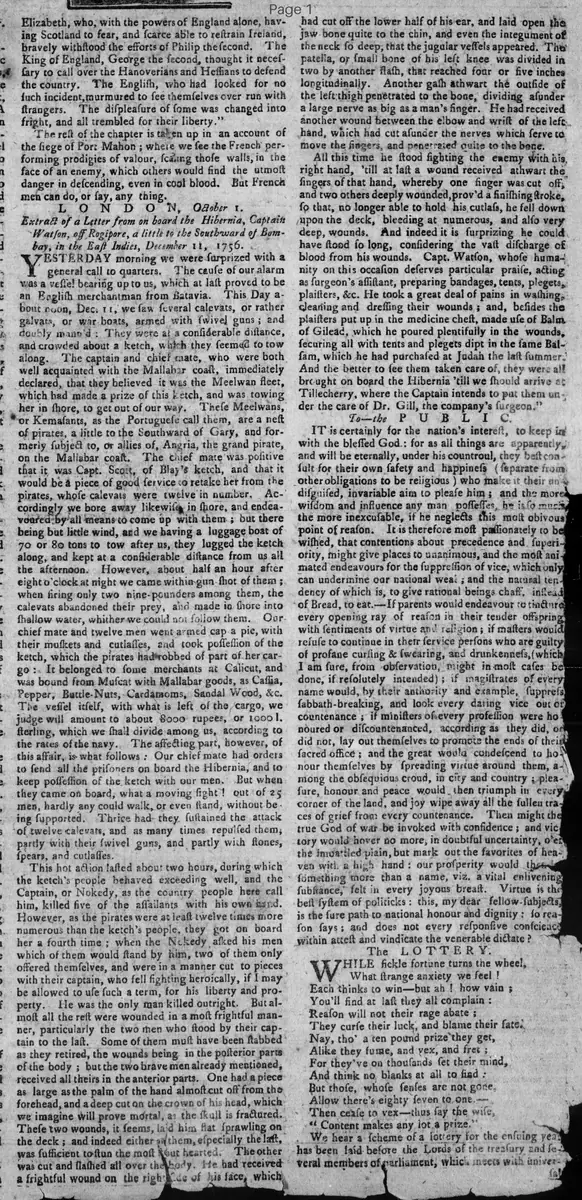
Extract of a Letter from on board the Hibernia, Captain Watson, off Rajipore, a little to the Southward of Bombay, in the East Indies, December 1st. 1756.
YESTERDAY morning we were surprised with a general call to quarters. The cause of our alarm was a vessel bearing up to us, which at last proved to be an English merchantman from Batavia. This Day about noon, Dec. 11, we saw several calavats, or rather galivats, or war-boats, armed with swivel guns; and doubly manned: They were at a considerable distance, and crowded about a ketch, which they seemed to tow along. The captain and chief mate, who were both well acquainted with the Malabar coast, immediately declared, that they believed it was the Marawa fleet, which had made a prize of this ketch, and was towing her in shore, to get out of our way. These Marawas, or Kemants, as the Portuguese call them, are a nest of pirates, a little to the Southward of Goa, and formerly subject to, or allies of, Angria, the grand pirate, on the Malabar coast. The chief mate was positive that it was Capt. Scott of Bay's ketch, and that it would be a piece of good service to retake her from the pirates, whose calavats were twelve in number. Accordingly we bore away likewise in shore, and endeavoured by all means to come up with them; but there being but little wind, and we having a luggage boat of 70 or 80 tons to tow after us, they hugged the ketch along, and kept at a considerable distance from us all the afternoon. However, about half an hour after eight o'clock at night we came within gun-shot of them; when firing only two nine-pounders among them, the calavats abandoned their prey, and made in shore into shallow water, whither we could not follow them. Our chief mate and twelve men went armed cap a pie, with their muskets and cutlasses, and took possession of the ketch, which the pirates had robbed of part of her cargo. It belonged to some merchants at Calicut, and was bound from Muscat with Malabar goods, as Chia, Pepper, Betel-Nuts, Cardamoms, Sandal Wood, &c. The vessel itself, with what is left of the cargo, we judge will amount to about 5000 rupees, or 1000l. sterling, which we shall divide among us, according to the rates of the navy. The affecting part, however, of this affair, is what follows: Our chief mate had orders to send all the prisoners on board the Hibernia, and to keep possession of the ketch with our men. But when they came on board, what a moving sight! out of 25 men, hardly any could walk, or even stand, without being supported. Thrice had they sustained the attack of twelve calavats, and as many times repulsed them; partly with their swivel guns, and partly with stones, spears, and cutlasses.
This hot action lasted about two hours, during which the ketch's people behaved exceeding well, and the Captain, or Nabob, as the country people here call him, killed five of the assailants with his own hand. However, as the pirates were at least twelve times more numerous than the ketch's people, they got on board her a fourth time; when the Nabob asked his men which of them would stand by him, two of them only offered themselves, and were in a manner cut to pieces with their captain, who fell fighting heroically, if I may be allowed to use such a term, for his liberty and property. He was the only man killed outright. But almost all the rest were wounded in a most frightful manner, particularly the two men who stood by their captain to the last. Some of them must have been stabbed as they retired, the wounds being in the posterior parts of the body; but the two brave men already mentioned, received all theirs in the anterior parts. One had a piece as large as the palm of the hand almost cut off from the forehead, and a deep cut on the crown of his head, which we imagine will prove mortal, as the skull is fractured. These two wounds, it seems, laid him stark sprawling on the deck; and indeed either of them, especially the last, was sufficient to stun the most stout hearted. The other was cut and slashed all over the body. He had received a frightful wound on the right side of his face, which had cut off the lower half of his ear, and laid open the jaw bone quite to the chin, and even the integument of the neck so deep, that the jugular vessels appeared. The patella, or small bone of his left knee was divided in two by another slash, that reached four or five inches longitudinally. Another gash athwart the outside of the left thigh penetrated to the bone, dividing asunder a large nerve as big as a man's finger. He had received another wound between the elbow and wrist of the left hand, which had cut asunder the nerves which serve to move the fingers, and penetrated quite to the bone.
All this time he stood fighting the enemy with his right hand, 'till at last a wound received athwart the fingers of that hand, whereby one finger was cut off, and two others deeply wounded, prov'd a finishing stroke, so that, no longer able to hold his cutlass, he fell down upon the deck, bleeding at numerous, and also very deep, wounds. And indeed it is surprising he could have stood so long, considering the vast discharge of blood from his wounds. Capt. Watson, whose humanity on this occasion deserves particular praise, acting as surgeon's assistant, preparing bandages, tents, pledgets, plasters, &c. He took a great deal of pains in washing, cleaning and dressing their wounds; and, besides the plasters put up in the medicine chest, made use of Balm of Gilead, which he poured plentifully in the wounds, securing all with tents and pledgets dipt in the same Balsam, which he had purchased at Jidda the last summer. And the better to see them taken care of, they were all brought on board the Hibernia 'till we should arrive at Tellicherry, where the Captain intends to put them under the care of Dr. Gill, the company's surgeon.
What sub-type of article is it?
What keywords are associated?
What entities or persons were involved?
Where did it happen?
Foreign News Details
Primary Location
Rajipore, A Little To The Southward Of Bombay, In The East Indies
Event Date
December 1st, 1756
Key Persons
Outcome
ketch's nabob/captain killed; 24 crew wounded, many severely; 5 pirates killed by nabob; ketch and remaining cargo (valued at 5000 rupees or 1000l. sterling) retaken and to be divided per navy rates.
Event Details
HMS Hibernia encountered Marawa (Kemants) pirates towing a captured ketch. After pursuit, fired shots causing pirates to abandon the prize in shallow water. Hibernia crew boarded the ketch, which belonged to Calicut merchants, bound from Muscat with goods like chia, pepper, betel-nuts. The ketch's crew had repelled three attacks from 12 calavats, killing 5 pirates, but on fourth boarding, only two stood with captain who was killed; others wounded.