Thank you for visiting SNEWPapers!
Sign up free
Phenix Gazette
Alexandria, Virginia
What is this article about?
Edmund Charles Genet sends a rare Roman medal of Caesar to President Andrew Jackson as a tribute to his military and public service, likening Jackson's victories to Caesar's 'Veni, vidi, vici.' Jackson accepts it gratefully, reflecting on Caesar's history as a caution against power's corrupting influence. Dated December 21, 1831, and January 2, 1832.
Clipping
OCR Quality
Full Text
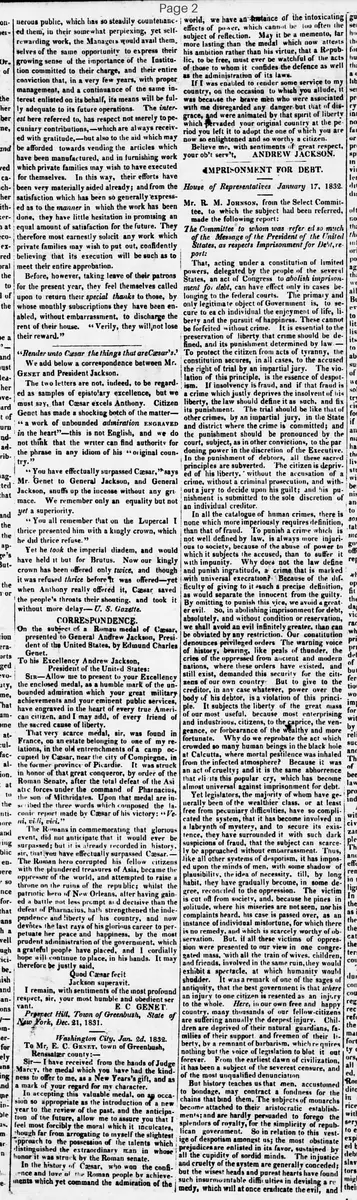
On the subject of a Roman medal of Cæsar, presented to General Andrew Jackson, President of the United States, by Edmund Charles Genet.
To his Excellency Andrew Jackson, President of the United States:
SIR--Allow me to present to your Excellency the enclosed medal, as a humble mark of the unbounded admiration which your great military achievements and your eminent public services, have engraved in the heart of every true American citizen, and I may add, of every friend of the sacred cause of liberty.
That very scarce medal, sir, was found in France, on an estate belonging to one of my relations, in the old entrenchments of a camp occupied by Cæsar, near the city of Compiègne, in the former province of Picardie. It was struck in honor of that great conqueror, by order of the Roman Senate, after the total defeat of the Asiatic forces under the command of Pharnaces, the son of Mithridates. Upon that medal are inscribed the three words which composed the laconic report made by Cæsar of his victory: Veni, vidi, vici."
The Romans in commemorating that glorious event, did not anticipate that it would ever be surpassed; but it is already recorded in history, sir, that you have effectually surpassed Cæsar.--The Roman hero corrupted his fellow citizens with the plundered treasures of Asia, became the oppressor of the world, and attempted to raise a throne on the ruins of the republic; whilst the patriotic hero of New Orleans, after having gained a battle not less prompt and decisive than the defeat of Pharnaces, hath strengthened the independence and liberty of his country, and now devotes the last rays of his glorious career to perpetuate her peace and happiness, by the most prudent administration of the government, which a grateful people have placed, and I cordially hope will continue to place, in his hands. It may therefore be justly said,
Quod Cæsar fecit
Jackson superavit.
I remain, with sentiments of the most profound respect, sir, your most humble and obedient servant,
E. C. GENET.
Prospect Hill, Town of Greenbush, State of New York, Dec. 21, 1831.
Washington City, Jan. 2d, 1832.
To Mr. E. C. Genet, town of Greenbush, Rensselær county:--
SIR--I have received from the hands of Judge Marcy, the medal which you have had the kindness to offer to me, as a New Year's gift, and as a mark of your regard for my character.
In accepting this valuable medal, on an occasion so appropriate as the introduction of a new year to the review of the past, and the anticipation of the future, allow me to assure you that I feel most forcibly the moral which it inculcates, though far from arrogating to myself the slightest approach to the possession of the talents which distinguished the extraordinary man in whose honor it was struck by the Roman senate.
In the history of Cæsar, who won the confidence and love of the Roman people by achievements which yet command the admiration of the world; we have an instance of the intoxicating effects of power, which cannot be too often the subject of reflection. May it be a memento, far more lasting than the medal which now attests his ambition rather than his virtue, that a Republic, to be free, must ever be watchful of the acts of those to whom it confides the defence as well as the administration of its laws.
If I was enabled to render some service to my country, on the occasion to which you allude, it was because the brave men who were associated with me disregarded any danger--but that of disgrace, and were animated by that spirit of liberty which pervaded your original country at the period you left it to adopt the one of which you are now so enlightened and so worthy a citizen.
Believe me, with sentiments of great respect, your ob't serv't,
ANDREW JACKSON.
What sub-type of article is it?
What keywords are associated?
What entities or persons were involved?
Where did it happen?
Domestic News Details
Primary Location
Washington City
Event Date
Dec. 21, 1831; Jan. 2, 1832
Key Persons
Outcome
medal presented and accepted as a new year's gift and tribute.
Event Details
Edmund Charles Genet presents a Roman medal commemorating Caesar's victory to President Andrew Jackson, praising Jackson's superior achievements in service to liberty. Jackson accepts it, reflecting on Caesar's history as a warning against power's dangers and crediting his success to his comrades' bravery.