Thank you for visiting SNEWPapers!
Sign up free
National Gazette
Philadelphia, Philadelphia County, Pennsylvania
What is this article about?
An editorial from the Delaware Gazette criticizes a clause in Delaware's newly adopted constitution excluding clergymen from civil offices, arguing it stems from unfounded prejudice, ignores historical context, violates natural rights, and degrades religion. It praises Mr. Dickinson's opposition and calls for repeal.
Merged-components note: These three components form a continuous editorial on the exclusion of clergy from civil office in Delaware's constitution.
Clipping
OCR Quality
Full Text
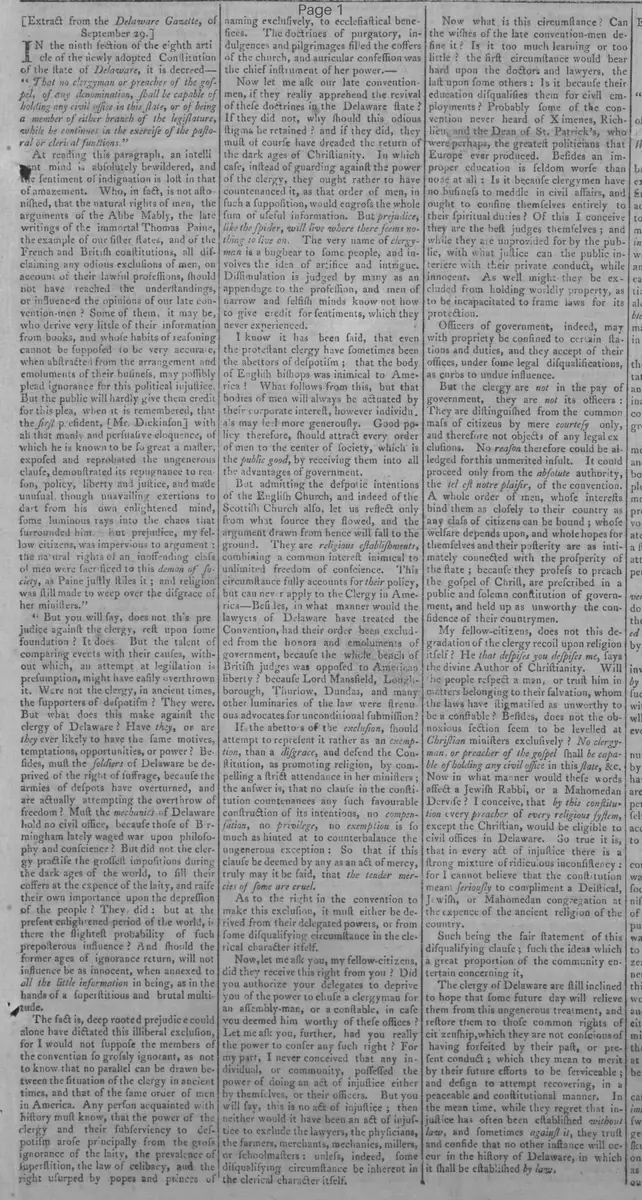
In the ninth section of the eighth article of the newly adopted Constitution of the state of Delaware, it is decreed-
"That no clergyman or preacher of the gospel, of any denomination, shall be capable of holding any civil office in this state, or of being a member of either branch of the legislature, while he continues in the exercise of the pastoral or clerical functions."
At reading this paragraph, an intelligent mind is absolutely bewildered, and the sentiment of indignation is lost in that of amazement. Who, in fact, is not astonished, that the natural rights of men, the arguments of the Abbe Mably, the late writings of the immortal Thomas Paine, the example of our sister states, and of the French and British constitutions, all disclaiming any odious exclusions of men, on account of their lawful professions, should not have reached the understandings, or influenced the opinions of our late convention-men? Some of them, it may be, who derive very little of their information from books, and whose habits of reasoning cannot be supposed to be very accurate, when abstracted from the arrangement and emoluments of their business, may possibly plead ignorance for this political injustice. But the public will hardly give them credit for this plea, when it is remembered, that their president, [Mr. Dickinson] with all that manly and persuasive eloquence, of which he is known to be so great a master, exposed and reprobated the ungenerous clause, demonstrated its repugnance to reason, policy, liberty and justice, and made unusual, though unavailing exertions to dart from his own enlightened mind, some luminous rays into the chaos that surrounded him. But prejudice, my fellow citizens, was impervious to argument: the natural rights of an inoffending class of men were sacrificed to this demon of society, as Paine justly styles it; and religion was still made to weep over the disgrace of her ministers.
But you will say, does not this prejudice against the clergy, rest upon some foundation? It does. But the talent of comparing events with their causes, without which, an attempt at legislation is presumption, might have easily overthrown it. Were not the clergy, in ancient times, the supporters of despotism? They were. But what does this make against the clergy of Delaware? Have they, or are they ever likely to have the same motives, temptations, opportunities, or power? Besides, must the soldiers of Delaware be deprived of the right of suffrage, because the armies of despots have overturned, and are actually attempting the overthrow of freedom? Must the mechanics of Delaware hold no civil office, because those of Birmingham lately waged war upon philosophy and conscience? But did not the clergy practice the grossest impositions during the dark ages of the world, to fill their coffers at the expense of the laity, and raise their own importance upon the depression of the people? They did: but at the present enlightened period of the world, is there the slightest probability of such preposterous influence? And should the former ages of ignorance return, will not influence be as innocent, when annexed to all the little information in being, as in the hands of a superstitious and brutal multitude.
The fact is, deep rooted prejudice could alone have dictated this illiberal exclusion, for I would not suppose the members of the convention so grossly ignorant, as not to know that no parallel can be drawn between the situation of the clergy in ancient times, and that of the same order of men in America. Any person acquainted with history must know, that the power of the clergy and their subserviency to despotism arose principally from the gross ignorance of the laity, the prevalence of superstition, the law of celibacy, and the right usurped by popes and princes of naming exclusively, to ecclesiastical benefices. The doctrines of purgatory, indulgences and pilgrimages filled the coffers of the church, and auricular confession was the chief instrument of her power.—
Now let me ask our late convention-men, if they really apprehend the revival of these doctrines in the Delaware state? If they did not, why should this odious stigma be retained? and if they did, they must of course have dreaded the return of the dark ages of Christianity. In which case, instead of guarding against the power of the clergy, they ought rather to have countenanced it, as that order of men, in such a supposition, would engross the whole sum of useful information. But prejudice, like the spider, will live where there seems nothing to live on. The very name of clergyman is a bugbear to some people, and involves the idea of artifice and intrigue. Dissimulation is judged by many as an appendage to the profession, and men of narrow and selfish minds know not how to give credit for sentiments, which they never experienced.
I know it has been said, that even the protestant clergy have sometimes been the abettors of despotism; that the body of English bishops was inimical to America! What follows from this, but that bodies of men will always be actuated by their corporate interest, however individuals may feel more generously. Good policy therefore, should attract every order of men to the center of society, which is the public good, by receiving them into all the advantages of government.
But admitting the despotic intentions of the English Church, and indeed of the Scottish Church also, let us reflect only from what source they flowed, and the argument drawn from hence will fall to the ground. They are religious establishments, combining a common interest inimical to unlimited freedom of conscience. This circumstance fully accounts for their policy, but can never apply to the Clergy in America—Besides, in what manner would the lawyers of Delaware have treated the Convention, had their order been excluded from the honors and emoluments of government, because the whole bench of British judges was opposed to American liberty? because Lord Mansfield, Loughborough, Thurlow, Dundas, and many other luminaries of the law were strenuous advocates for unconditional submission?
If the abettors of the exclusion, should attempt to represent it rather as an exemption, than a disgrace, and defend the Constitution, as promoting religion, by compelling a strict attendance in her ministers; the answer is, that no clause in the constitution countenances any such favourable construction of its intentions, no compensation, no privilege, no exemption is so much as hinted at to counterbalance the ungenerous exception: So that if this clause be deemed by any as an act of mercy, truly may it be said, that the tender mercies of some are cruel.
As to the right in the convention to make this exclusion, it must either be derived from their delegated powers, or from some disqualifying circumstance in the clerical character itself.
Now, let me ask you, my fellow-citizens, did they receive this right from you? Did you authorize your delegates to deprive you of the power to choose a clergyman for an assembly-man, or a constable, in case you deemed him worthy of these offices? Let me ask you, further, had you really the power to confer any such right? For my part, I never conceived that any individual, or community, possessed the power of doing an act of injustice either by themselves, or their officers. But you will say, this is no act of injustice; then neither would it have been an act of injustice to exclude the lawyers, the physicians, the farmers, merchants, mechanics, millers, or schoolmasters: unless, indeed, some disqualifying circumstance be inherent in the clerical character itself.
Now what is this circumstance? Can the wishes of the late convention-men define it? Is it too much learning or too little? the first circumstance would bear hard upon the doctors and lawyers, the last upon some others: Is it because their education disqualifies them for civil employments? Probably some of the convention never heard of Ximenes, Richelieu, and the Dean of St. Patrick's, who were perhaps, the greatest politicians that Europe ever produced. Besides an improper education is seldom worse than none at all: Is it because clergymen have no business to meddle in civil affairs, and ought to confine themselves entirely to their spiritual duties? Of this I conceive they are the best judges themselves; and while they are unprovided for by the public, with what justice can the public interfere with their private conduct, while innocent. As well might they be excluded from holding worldly property, as to be incapacitated to frame laws for its protection.
Officers of government, indeed, may with propriety be confined to certain stations and duties, and they accept of their offices, under some legal disqualifications, as curbs to undue influence. But the clergy are not in the pay of government, they are not its officers: They are distinguished from the common mass of citizens by mere courtesy only, and therefore not objects of any legal exclusions. No reason therefore could be alleged for this unmerited insult. It could proceed only from the absolute authority, the tel et notre plaisir, of the convention.
A whole order of men, whose interests bind them as closely to their country as any class of citizens can be bound; whose welfare depends upon, and whose hopes for themselves and their posterity are as intimately connected with the prosperity of the state; because they profess to preach the gospel of Christ, are proscribed in a public and solemn constitution of government, and held up as unworthy the confidence of their countrymen.
My fellow-citizens, does not this degradation of the clergy recoil upon religion itself? He that despises you despises me, says the divine Author of Christianity. Will the people respect a man, or trust him in matters belonging to their salvation, whom the laws have stigmatised as unworthy to be a constable? Besides, does not the obnoxious section seem to be levelled at Christian ministers exclusively? No clergyman, or preacher of the gospel shall be capable of holding any civil office in this state, &c.
Now in what manner would these words affect a Jewish Rabbi, or a Mahomedan Dervise? I conceive, that by this constitution every preacher of every religious system, except the Christian, would be eligible to civil offices in Delaware. So true it is, that in every act of injustice there is a strong mixture of ridiculous inconsistency: for I cannot believe that the constitution meant seriously to compliment a Deistical, or Mahomedan congregation at the expense of the ancient religion of the country.
Such being the fair statement of this disqualifying clause; such the ideas which a great proportion of the community entertain concerning it,
The clergy of Delaware are still inclined to hope that some future day will relieve them from this ungenerous treatment, and restore them to those common rights of citizenship, which they are not conscious of having forfeited by their past, or present conduct; which they mean to merit by their future efforts to be serviceable; and deign to attempt recovering, in a peaceable and constitutional manner. In the mean time, while they regret that injustice has often been established without law, and sometimes against it, they trust and confide that no other instance will occur in the history of Delaware, in which it shall be established by law.
What sub-type of article is it?
What keywords are associated?
What entities or persons were involved?
Editorial Details
Primary Topic
Opposition To Exclusion Of Clergymen From Civil Offices In Delaware Constitution
Stance / Tone
Indignant Criticism Of Prejudice And Injustice
Key Figures
Key Arguments