Thank you for visiting SNEWPapers!
Sign up free
Norfolk Gazette And Publick Ledger
Norfolk, Virginia
What is this article about?
The Columbian Centinel editorial criticizes Democrats for hypocritically using John Adams' recent letter to support their electioneering, despite past slanders against him. It publishes Adams' full 1809 letter affirming national unity and neutrality toward France and England, and counters with extracts showing his opposition to French influence.
Merged-components note: The text in the second component continues directly from the first (mid-sentence connection on Adams letter and politics), spanning pages with sequential reading order.
Clippings
1 of 2
OCR Quality
Full Text
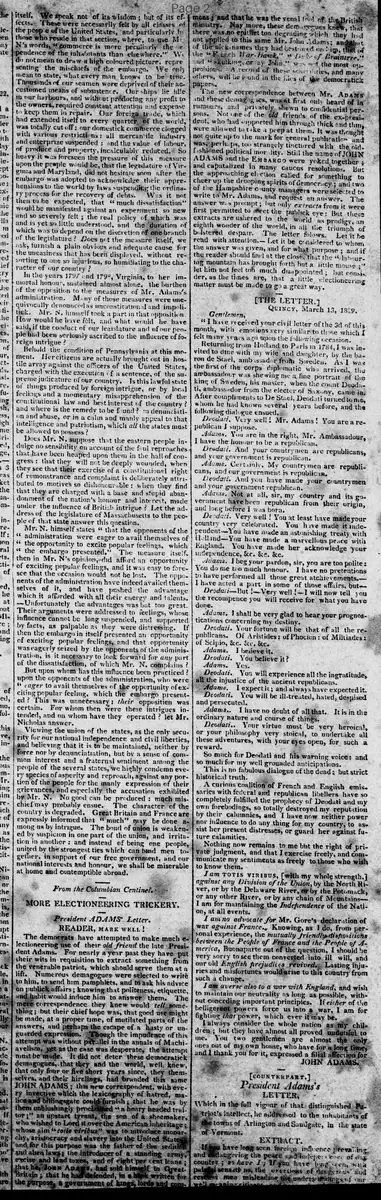
MORE ELECTIONEERING TRICKERY.
President ADAMS Letter.
READER, MARK WELL!
The democrats have attempted to make much electioneering use of their old friend the late President Adams. For nearly a year past they have put their wits in requisition to extract something from the venerable patriot, which should serve them at a lift. Numerous demagogues were selected to write to him, to send him pamphlets, and to ask his advice on publick affairs; knowing that politeness, etiquette, and habit would induce him to answer them. The mere correspondence they knew would tell something; but their chief hope was, that good use might be made, at a proper time, of mutilated parts of the answers, and perhaps the escape of a hasty or unguarded expression. Although the impudence of this attempt was without parallel in the annals of Machiavellism, yet as the case was desperate, the attempt must be made. It did not deter these democratick demagogues, that they and the world, well knew, that only four or five short years since, they themselves, and their hirelings, had branded this same JOHN ADAMS; this new correspondent, with every invective which the lexicography of hatred, malice and billingsgate could furnish; that he was by them unblushingly proclaimed "a hoary headed traitor;" an upstart tyrant, the son of a shoemaker, who wished to lord it over the American inheritance: whose aim "totis viribus" was to introduce monarchy, aristocracy and slavery into the United States and for this purpose was the father of the sedition and alien laws; the introducer of a standing army excise and land taxes, and of eight per cent loans; that he John Adams, had sold himself to Great Britain: that he had defended, in a book written for the purpose, a government of kings, lords and commons and that he was the venal tool of the British ministry Nay more, these demagogues knew, that there was no epithet too degrading which they had not applied to this same Mr. John Adams; and that of the nick-names they had bestowed on him, that of the "French Har-Hawk." "Baker of Braintree," and "waddling, crazy John," was not the most opprobrious. A record of these slanders, and many others, will be found in the files of the democratick papers.
The new correspondence between Mr. Adams and these demagogues, was at first only heard of in rumours, and privately shewn to confidential persons. Not one of the old friends of the ex-president, who had supported him through thick and thin, were allowed to take a peep at them. It was thought not quite up to the mark for general publication and was, perhaps, too strangely tinctured with the old-fashioned political morality. Still the name of JOHN ADAMS and the EMBARGO were yoked together and capitalized in many caucus resolutions. But the approaching election called for something to cheer up the drooping spirits of democracy; and two of the Hampshire county managers were selected to write to Mr. Adams, and request an answer. The answer was prompt; but only extracts from it were first permitted to meet the publick eye: But these extracts are ushered to the world as prodigy, an eighth wonder of the world, in all the triumph of bolstered despair. The letter follows. Let it be read with attention. Let it be considered to whom the answer was given, and for what purpose; and if the reader should find at the close, that the "laboring mountain has brought forth but a little mouse;" let him not feel too much disappointed; but consider, as the times are, that a little electioneering matter must be made to go a great way.
[THE LETTER.]
Quincy, March 13, 1809.
Gentlemen,
"I have received your civil letter of the 3d of this month, with emotions very similar to those which I felt many years ago upon the following occasion. Returning from Holland to Paris in 1784, I was invited to dine with my wife and daughter, by the baron de Stael, ambassador from Sweden. As I was the first of the corps diplomatic who arrived, the ambassador was shewing me a fine portrait of the king of Sweden, his master, when the count Deodati, ambassador from the elector of Saxony, came in. After compliments to De Stael, Deodati turned to me, whom he had known several years before, and the following dialogue ensued.
Deodati. Very well! Mr. Adams! You are a republican I suppose.
Adams. You are in the right, Mr. Ambassador, I have the honour to be a republican.
Deodati. And your countrymen are republicans, and your government is republican.
Adams. Certainly. My countrymen are republicans, and our government is republican.
Deodati. And you have made your countrymen and your government republican.
Adams. Not at all, sir, my country and its government have been republican from their origin, and long before I was born.
Deodati. Very well! You at least have made your country very celebrated. You have made it independent--You have made an astonishing treaty with Holland--You have made a marvellous peace with England. You have made her acknowledge your independence, &c. &c. &c.
Adams. I beg your pardon, sir, you are too polite: You do me too much honour. I have no pretensions to have performed all those great achievements.-- I have acted a part in some of those affairs, but--
Deodati. But!--Very well!--I will now tell you the recompence you will receive for what you have done.
Adams. I shall be very glad to hear your prognostications concerning my destiny.
Deodati. Your fortune will be that of all the republicans. Of Aristides: of Phocion: of Miltiades: of Scipio, &c. &c. &c.
Adams. I believe it.
Deodati. You believe it?
Adams. Yes.
Deodati. You will experience all the ingratitude, all the injustice of the ancient republicans.
Adams. I expect it; and always have expected it.
Deodati. You will be ill-treated, hated, despised and persecuted.
Adams. I have no doubt of all that. It is in the ordinary nature and course of things.
Deodati. Your virtue must be very heroical, or your philosophy very stoical, to undertake all these adventures, with your eyes open, for such a reward.
So much for Deodati and his warning voice: and so much for my well grounded anticipations. This is no fabulous dialogue of the dead: but strict historical truth.
A curious coalition of French and English emissaries with federal and republican libellers have so completely fulfilled the prophecy of Deodati and my own forebodings, so totally destroyed my reputation by their calumnies, and I have now neither power nor influence to do any thing for my country, to assist her present distresses, or guard her against future calamities.
Nothing now remains to me but the right of private judgment, and that I exercise freely, and communicate my sentiments as freely to those who wish to know them.
I am totis viribus, [with my whole strength,] against any Division of the Union, by the North River, or by the Delaware River, or by the Potomac, or any other River, or by any chain of Mountains-- I am for maintaining the Independence of the Nation, at all events.
I am no advocate for Mr. Gore's declaration of war against France. Knowing, as I do, from personal experience, the mutually friendly dispositions between the People of France and the People of America, Buonaparte out of the question, I should be very sorry to see them converted into ill will, and our old English prejudices revived Lasting injuries and misfortunes would arise to this country from such a change.
I am averse also to a war with England, and wish to maintain our neutrality as long as possible, without conceding important principles. If either of the belligerent powers force us into a war, I am for fighting that power, which ever it may be.
I always consider the whole nation as my children; but they have almost all proved undutiful to me. You two gentlemen are almost the only ones out of my own house, who have for a long time, and I thank you for it, expressed a filial affection for JOHN ADAMS."
[COUNTERPART.]
President Adams's
LETTER,
Which in the full vigour of that distinguished Patriot's intellect, he addressed to the inhabitants of the towns of Arlington and Sandgate, in the state of Vermont.
EXTRACT
If you have long seen foreign influence prevailing and endangering the peace and independence of our country; as have I: If you have long seen, with painful sensations, the exertions of demagogues and restless men misleading the understandings of our well-meaning citizens
measures as would sink the glory of our country, and
PROSTRATE HER LIBERTIES AT THE
FEET OF FRANCE—SO ALSO HAVE I.
"I have seen in the conduct of the French nation,
for the last twelve years, a repetition of their cha-
racter displayed under Louis the XIV. and a little
more excepting the extravagancies, which have
been intermixed with it, of the wildest philosophy,
which was ever professed in this world. since the
building of Babel, and the fables of the Giants, who
by piling mountains on mountains, invaded the skies.
If the spell is broken, let human nature exult and re-
joice. The veil may be removed from the eyes of
many, but I fear not of all. The snare is not yet
entirely broken, and we are not yet escaped."
Extract of a letter from the same to the inhabitants
of the town of Newbern, N. C.
"There have been, for many years, strong indica-
tions that nothing would satisfy the rulers of the
French, but our taking with them an active part in
the war against all their enemies, and exhausting
the last resources of our property to support them,
not only in the pursuit of their chimerical ideas of
liberty, but of UNIVERSAL EMPIRE: this we
were not only under no obligation to do, but had rea-
son to believe would have ruined the laws, constitu-
tion, and the morale of our country as well as our
credit and prosperity."
What sub-type of article is it?
What keywords are associated?
What entities or persons were involved?
Editorial Details
Primary Topic
Democratic Electioneering Manipulation Of John Adams' Letter
Stance / Tone
Anti Democratic, Pro Adams, Federalist Defense
Key Figures
Key Arguments