Thank you for visiting SNEWPapers!
Sign up free
New Hampshire Statesman And State Journal
Concord, Merrimack County, New Hampshire
What is this article about?
After Napoleon's fall, generals like Grouchy and Lefebvre-Desnouettes received Alabama land grants in 1817 to cultivate vines and olives. They settled in Marengo County, adapting from nobility to farming, but dispersed by 1833.
Clipping
OCR Quality
Full Text
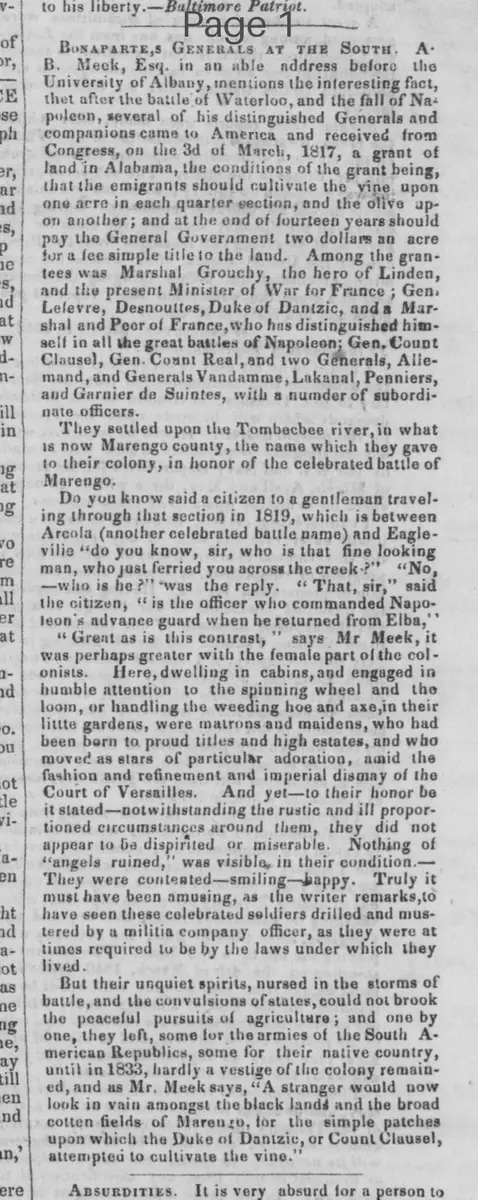
They settled upon the Tombigbee river, in what is now Marengo county, the name which they gave to their colony, in honor of the celebrated battle of Marengo.
Do you know said a citizen to a gentleman traveling through that section in 1819, which is between Arcola (another celebrated battle name) and Eagleville "do you know, sir, who is that fine looking man, who just ferried you across the creek?" "No, who is he?" was the reply. "That, sir," said the citizen, "is the officer who commanded Napoleon's advance guard when he returned from Elba."
Great as is this contrast, "says Mr. Meek, it was perhaps greater with the female part of the colonists. Here, dwelling in cabins, and engaged in humble attention to the spinning wheel and the loom, or handling the weeding hoe and axe, in their little gardens, were matrons and maidens, who had been born to proud titles and high estates, and who moved as stars of particular adoration, amid the fashion and refinement and imperial dismay of the Court of Versailles. And yet—to their honor be it stated—notwithstanding the rustic and ill proportioned circumstances around them, they did not appear to be dispirited or miserable. Nothing of "angels ruined," was visible, in their condition.—They were contented—smiling—happy. Truly it must have been amusing, as the writer remarks, to have seen these celebrated soldiers drilled and mustered by a militia company officer, as they were at times required to be by the laws under which they lived.
But their unquiet spirits, nursed in the storms of battle, and the convulsions of states, could not brook the peaceful pursuits of agriculture; and one by one, they left, some for the armies of the South American Republics, some for their native country, until in 1833, hardly a vestige of the colony remained, and as Mr. Meek says, "A stranger would now look in vain amongst the black lands and the broad cotton fields of Marengo, for the simple patches upon which the Duke of Dantzic, or Count Clausel, attempted to cultivate the vine."
What sub-type of article is it?
What themes does it cover?
What keywords are associated?
What entities or persons were involved?
Where did it happen?
Story Details
Key Persons
Location
Tombigbee River, Marengo County, Alabama, Between Arcola And Eagleville
Event Date
After The Battle Of Waterloo; Land Grant On The 3d Of March, 1817; Traveler Anecdote In 1819; Colony Dispersed By 1833
Story Details
After Napoleon's defeat at Waterloo, several of his generals received a land grant in Alabama from Congress in 1817, on condition of cultivating vine and olive. They settled in Marengo county along the Tombigbee river, naming it after the battle of Marengo. Despite their noble backgrounds, they adapted to farming life contentedly. However, they eventually left for other pursuits, and by 1833, the colony was gone.