Thank you for visiting SNEWPapers!
Sign up free
Editorial
February 22, 1851
The Caledonian
Saint Johnsbury, Caledonia County, Vermont
What is this article about?
Editorial criticizes the arrest of a fugitive slave in Boston under the Fugitive Slave Law, arguing it heightens anti-slavery excitement in New England despite compromise measures. Praises the rescue by colored friends and faults local authorities for inaction. Warns of potential violence and suggests Southerners let fugitives go to quell unrest.
Clipping
OCR Quality
95%
Excellent
Full Text
ST. JOHNSBURY, SATURDAY, FEBRUARY 22, 1851.
THE ARREST OF A FUGITIVE IN BOSTON.
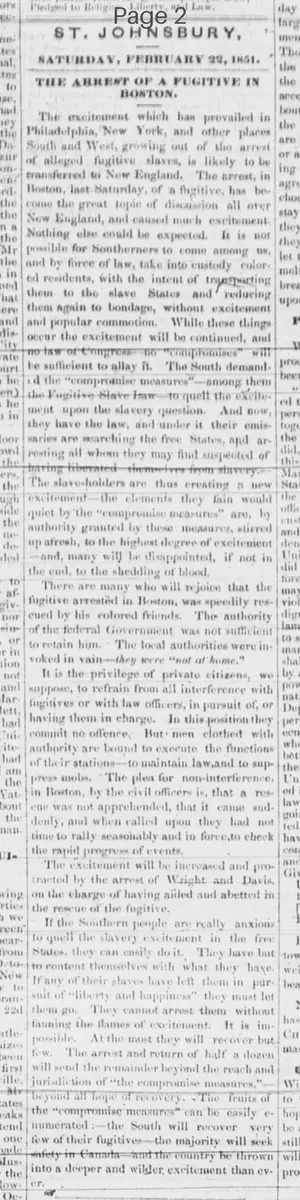
The excitement which has prevailed in Philadelphia, New York, and other places South and West, growing out of the arrest of alleged fugitive slaves, is likely to be transferred to New England. The arrest, in Boston, last Saturday, of a fugitive, has become the great topic of discussion all over New England, and caused much excitement. Nothing else could be expected. It is not possible for Southerners to come among us, and by force of law, take into custody colored residents, with the intent of transporting them to the slave States and reducing them again to bondage, without excitement and popular commotion. While these things occur the excitement will be continued, and no law of Congress no "compromises" will be sufficient to allay it. The South demanded the "compromise measures"—among them the Fugitive Slave Law to quell the excitement upon the slavery question. And now, they have the law, and under it their emissaries are searching the free States, and arresting all whom they may find suspected of having liberated themselves from slavery. The slave-holders are thus creating a new excitement the elements they fain would quiet by the "compromise measures" are, by authority granted by these measures, stirred up afresh, to the highest degree of excitement—and, many will be disappointed, if not in the end, to the shedding of blood.
There are many who will rejoice that the fugitive arrested in Boston, was speedily rescued by his colored friends. The authority of the federal Government was not sufficient to retain him. The local authorities were invoked in vain—they were "not at home."
It is the privilege of private citizens, we suppose, to refrain from all interference with fugitives or with law officers, in pursuit of, or having them in charge. In this position they commit no offence. But men clothed with authority are bound to execute the functions of their stations—to maintain law, and to suppress mobs. The plea for non-interference, in Boston, by the civil officers is, that a rescue was not apprehended, that it came suddenly, and when called upon they had not time to rally seasonably and in force, to check the rapid progress of events.
The excitement will be increased and protracted by the arrest of Wright and Davis, on the charge of having aided and abetted in the rescue of the fugitive.
If the Southern people are really anxious to quell the slavery excitement in the free States, they can easily do it. They have but to content themselves with what they have. If any of their slaves have left them in pursuit of "liberty and happiness" they must let them go. They cannot arrest them without fanning the flames of excitement. It is impossible. At the most they will recover but few. The arrest and return of half a dozen will send the remainder beyond the reach and jurisdiction of "the compromise measures."—beyond all hope of recovery. The fruits of the "compromise measures" can be easily enumerated;—the South will recover very few of their fugitives—the majority will seek safety in Canada—and the country be thrown into a deeper and wider excitement than ever.
THE ARREST OF A FUGITIVE IN BOSTON.
The excitement which has prevailed in Philadelphia, New York, and other places South and West, growing out of the arrest of alleged fugitive slaves, is likely to be transferred to New England. The arrest, in Boston, last Saturday, of a fugitive, has become the great topic of discussion all over New England, and caused much excitement. Nothing else could be expected. It is not possible for Southerners to come among us, and by force of law, take into custody colored residents, with the intent of transporting them to the slave States and reducing them again to bondage, without excitement and popular commotion. While these things occur the excitement will be continued, and no law of Congress no "compromises" will be sufficient to allay it. The South demanded the "compromise measures"—among them the Fugitive Slave Law to quell the excitement upon the slavery question. And now, they have the law, and under it their emissaries are searching the free States, and arresting all whom they may find suspected of having liberated themselves from slavery. The slave-holders are thus creating a new excitement the elements they fain would quiet by the "compromise measures" are, by authority granted by these measures, stirred up afresh, to the highest degree of excitement—and, many will be disappointed, if not in the end, to the shedding of blood.
There are many who will rejoice that the fugitive arrested in Boston, was speedily rescued by his colored friends. The authority of the federal Government was not sufficient to retain him. The local authorities were invoked in vain—they were "not at home."
It is the privilege of private citizens, we suppose, to refrain from all interference with fugitives or with law officers, in pursuit of, or having them in charge. In this position they commit no offence. But men clothed with authority are bound to execute the functions of their stations—to maintain law, and to suppress mobs. The plea for non-interference, in Boston, by the civil officers is, that a rescue was not apprehended, that it came suddenly, and when called upon they had not time to rally seasonably and in force, to check the rapid progress of events.
The excitement will be increased and protracted by the arrest of Wright and Davis, on the charge of having aided and abetted in the rescue of the fugitive.
If the Southern people are really anxious to quell the slavery excitement in the free States, they can easily do it. They have but to content themselves with what they have. If any of their slaves have left them in pursuit of "liberty and happiness" they must let them go. They cannot arrest them without fanning the flames of excitement. It is impossible. At the most they will recover but few. The arrest and return of half a dozen will send the remainder beyond the reach and jurisdiction of "the compromise measures."—beyond all hope of recovery. The fruits of the "compromise measures" can be easily enumerated;—the South will recover very few of their fugitives—the majority will seek safety in Canada—and the country be thrown into a deeper and wider excitement than ever.
What sub-type of article is it?
Slavery Abolition
Partisan Politics
Legal Reform
What keywords are associated?
Fugitive Slave Arrest
Boston Rescue
Fugitive Slave Law
Compromise Measures
Slavery Excitement
Southern Slave Holders
Anti Slavery Agitation
What entities or persons were involved?
Southerners
Slave Holders
Federal Government
Local Authorities In Boston
Colored Friends
Wright And Davis
Editorial Details
Primary Topic
Arrest Of Fugitive Slave In Boston And Criticism Of Fugitive Slave Law
Stance / Tone
Strongly Anti Slavery And Critical Of Southern Actions And Compromise Measures
Key Figures
Southerners
Slave Holders
Federal Government
Local Authorities In Boston
Colored Friends
Wright And Davis
Key Arguments
Arrests Of Fugitives In Free States Cause Widespread Excitement And Commotion
Fugitive Slave Law And Compromise Measures Fail To Quell Slavery Agitation And Instead Intensify It
Rescue Of The Boston Fugitive By Colored Friends Is Praiseworthy
Local Authorities Neglected Duty By Not Intervening In The Rescue
Arrests Of Rescuers Like Wright And Davis Will Prolong Excitement
Southerners Should Allow Fugitives To Go Free To Reduce Anti Slavery Fervor
Enforcement Of The Law Drives More Fugitives To Canada And Risks Bloodshed