Thank you for visiting SNEWPapers!
Sign up free
Editorial
April 22, 1807
The National Intelligencer And Washington Advertiser
Washington, District Of Columbia
What is this article about?
The Virginia Argus editorial defends its prior interpretation of Chief Justice Marshall's opinion in the Aaron Burr treason trial, claiming it implied criticism of General Wilkinson. It expresses satisfaction with his clarification but questions his intentions, impartiality, and actions, including dining with Burr and accepting low bail.
Clipping
OCR Quality
95%
Excellent
Full Text
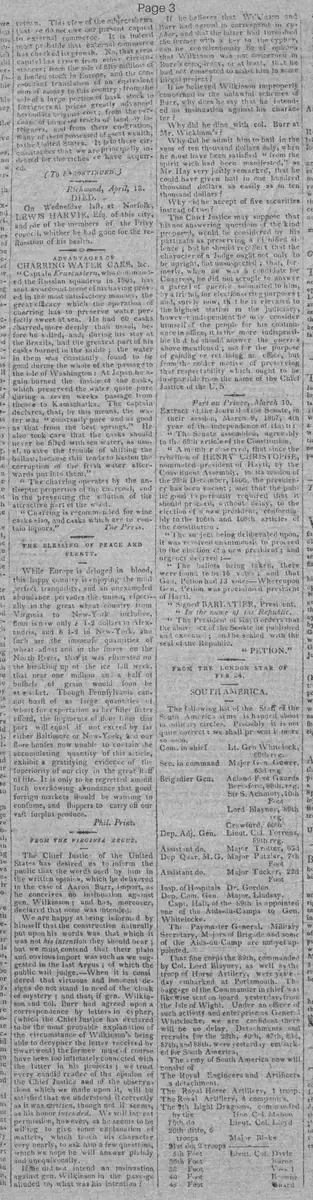
FROM THE VIRGINIA ARGUS.
The Chief Justice of the United States has desired us to inform the public that the words used by him in the written opinion, which he delivered in the case of Aaron Burr, import, as he conceives no insinuation against gen. Wilkinson; and has, moreover, declared that none was intended:
We are happy at being informed by himself that the construction naturally put upon his words was that which it was not his intention they should bear; but we must contend that their plain and obvious import was such as we suggested in the last Argus; of which the public will judge. When it is considered that virtuous and innocent designs do not stand in need of the cloak of mystery; and that, if gen. Wilkinson and col. Burr had agreed upon a correspondence by letters in cypher, (which the Chief Justice has declared to be the most probable explanation of the circumstance of Wilkinson's being able to decypher the letter received by Swartwout) the former must of course have been too intimately connected with the latter in his projects; we trust every candid reader of the opinion of the Chief Justice and of the observations which we made upon it, will be satisfied that we understood it correctly as it was written, though not it seems, as his honor intended. We will intreat permission, however, as he seems to be willing to give some explanation of matters, which touch his character very nearly, to ask him a few questions, which we hope he will answer plainly and unequivocally.
If he did not intend an insinuation against gen. Wilkinson in the passage alluded to, what was his intention?
If he believes that Wilkinson and Burr had agreed to correspond in cypher, and that the latter had furnished the former with a key to the cypher, can he conscientiously be of opinion that Wilkinson was not concerned in Burr's conspiracy, or at least, that he had not consented to assist him in some illegal project?
If he believed Wilkinson improperly concerned in the unlawful schemes of Burr, why does he say that he intended no insinuation against his character?
Why did he dine with col. Burr at Mr. Wickham's?
Why did he admit him to bail in the sum of ten thousand dollars only, when he must have been satisfied "from the spirit which had been manifested," as Mr. Hay very justly remarked, that he could have given bail in one hundred thousand dollars as easily as in ten thousand dollars?
Why did he accept of five securities instead of two?
The Chief Justice may suppose that his not answering questions of the kind proposed, would be considered by his partizans as preserving a dignified silence: but he should recollect that the character of a Judge ought not only to be upright, but unsuspected; that, formerly, when he was a Candidate for Congress, he did not scruple to answer a parcel of queries submitted to him by a trifler, for electioneering purposes; and, surely now, that he is elevated to the highest station in the judiciary, however independent he may consider himself, of the people for his continuance in office, it is the more indispensable that he should answer the queries above mentioned: not for the purpose of gaining or retaining an office, but from the nobler motive of preserving that respectability which ought to be inseparable from the name of the Chief Justice of the U. S.
The Chief Justice of the United States has desired us to inform the public that the words used by him in the written opinion, which he delivered in the case of Aaron Burr, import, as he conceives no insinuation against gen. Wilkinson; and has, moreover, declared that none was intended:
We are happy at being informed by himself that the construction naturally put upon his words was that which it was not his intention they should bear; but we must contend that their plain and obvious import was such as we suggested in the last Argus; of which the public will judge. When it is considered that virtuous and innocent designs do not stand in need of the cloak of mystery; and that, if gen. Wilkinson and col. Burr had agreed upon a correspondence by letters in cypher, (which the Chief Justice has declared to be the most probable explanation of the circumstance of Wilkinson's being able to decypher the letter received by Swartwout) the former must of course have been too intimately connected with the latter in his projects; we trust every candid reader of the opinion of the Chief Justice and of the observations which we made upon it, will be satisfied that we understood it correctly as it was written, though not it seems, as his honor intended. We will intreat permission, however, as he seems to be willing to give some explanation of matters, which touch his character very nearly, to ask him a few questions, which we hope he will answer plainly and unequivocally.
If he did not intend an insinuation against gen. Wilkinson in the passage alluded to, what was his intention?
If he believes that Wilkinson and Burr had agreed to correspond in cypher, and that the latter had furnished the former with a key to the cypher, can he conscientiously be of opinion that Wilkinson was not concerned in Burr's conspiracy, or at least, that he had not consented to assist him in some illegal project?
If he believed Wilkinson improperly concerned in the unlawful schemes of Burr, why does he say that he intended no insinuation against his character?
Why did he dine with col. Burr at Mr. Wickham's?
Why did he admit him to bail in the sum of ten thousand dollars only, when he must have been satisfied "from the spirit which had been manifested," as Mr. Hay very justly remarked, that he could have given bail in one hundred thousand dollars as easily as in ten thousand dollars?
Why did he accept of five securities instead of two?
The Chief Justice may suppose that his not answering questions of the kind proposed, would be considered by his partizans as preserving a dignified silence: but he should recollect that the character of a Judge ought not only to be upright, but unsuspected; that, formerly, when he was a Candidate for Congress, he did not scruple to answer a parcel of queries submitted to him by a trifler, for electioneering purposes; and, surely now, that he is elevated to the highest station in the judiciary, however independent he may consider himself, of the people for his continuance in office, it is the more indispensable that he should answer the queries above mentioned: not for the purpose of gaining or retaining an office, but from the nobler motive of preserving that respectability which ought to be inseparable from the name of the Chief Justice of the U. S.
What sub-type of article is it?
Legal Reform
Partisan Politics
Crime Or Punishment
What keywords are associated?
Burr Trial
Chief Justice Marshall
Wilkinson Insinuation
Judicial Impartiality
Cypher Correspondence
Bail Decision
What entities or persons were involved?
Chief Justice Of The United States
Gen. Wilkinson
Col. Burr
Mr. Hay
Mr. Wickham
Editorial Details
Primary Topic
Criticism Of Chief Justice's Conduct In Aaron Burr Trial
Stance / Tone
Defensive And Interrogative Towards Chief Justice
Key Figures
Chief Justice Of The United States
Gen. Wilkinson
Col. Burr
Mr. Hay
Mr. Wickham
Key Arguments
Words In Opinion Plainly Implied Insinuation Against Wilkinson Despite Chief Justice's Denial
Agreement On Cypher Correspondence Suggests Wilkinson's Involvement In Burr's Projects
Virtuous Designs Do Not Require Mystery
Questions Chief Justice's Intentions If No Insinuation Was Meant
Challenges Belief That Wilkinson Was Uninvolved If Cypher Use Is Accepted
Queries Dining With Burr And Accepting Low Bail As Signs Of Bias
Demands Answers To Preserve Judicial Respectability