Thank you for visiting SNEWPapers!
Sign up free
Story
July 11, 1890
The Iola Register
Iola, Allen County, Kansas
What is this article about?
Chauncy M. Depew's speech in Chicago praises Queen Isabella's role in funding Columbus's voyage, crediting American women for similar opportunities. The Woman's Journal critiques this, questioning if men would boast similarly if women made all laws.
Clipping
OCR Quality
95%
Excellent
Full Text
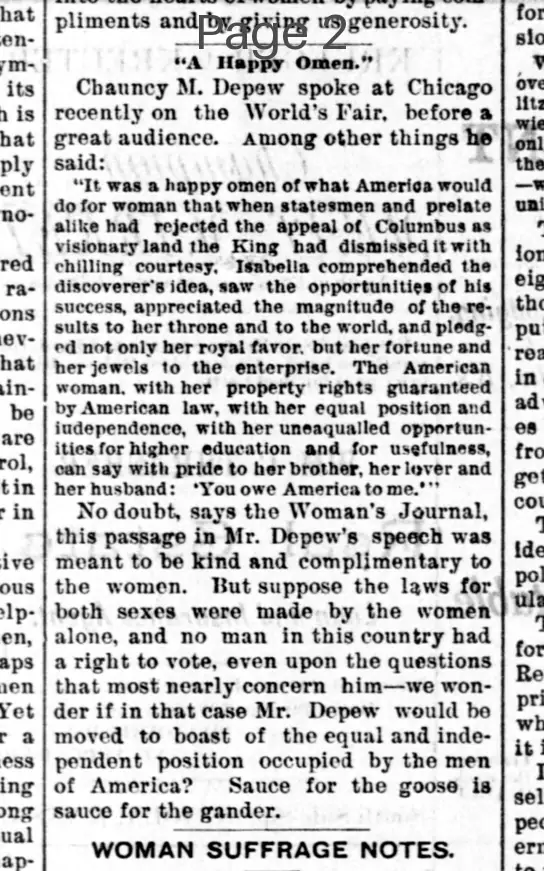
"A Happy Omen."
Chauncy M. Depew spoke at Chicago recently on the World's Fair, before a great audience. Among other things he said:
"It was a happy omen of what America would do for woman that when statesmen and prelate alike had rejected the appeal of Columbus as visionary the King had dismissed it with chilling courtesy. Isabella comprehended the discoverer's idea, saw the opportunities of his success, appreciated the magnitude of the results to her throne and to the world, and pledged not only her royal favor, but her fortune and her jewels to the enterprise. The American woman, with her property rights guaranteed by American law, with her equal position and independence, with her unparalleled opportunities for higher education and for usefulness can say with pride to her brother, her lover and her husband: You owe America to me."
No doubt, says the Woman's Journal this passage in Mr. Depew's speech was meant to be kind and complimentary to the women. But suppose the laws for both sexes were made by the women alone, and no man in this country had a right to vote, even upon the questions that most nearly concern him-we wonder if in that case Mr. Depew would be moved to boast of the equal and independent position occupied by the men of America?
Sauce for the goose is sauce for the gander.
Chauncy M. Depew spoke at Chicago recently on the World's Fair, before a great audience. Among other things he said:
"It was a happy omen of what America would do for woman that when statesmen and prelate alike had rejected the appeal of Columbus as visionary the King had dismissed it with chilling courtesy. Isabella comprehended the discoverer's idea, saw the opportunities of his success, appreciated the magnitude of the results to her throne and to the world, and pledged not only her royal favor, but her fortune and her jewels to the enterprise. The American woman, with her property rights guaranteed by American law, with her equal position and independence, with her unparalleled opportunities for higher education and for usefulness can say with pride to her brother, her lover and her husband: You owe America to me."
No doubt, says the Woman's Journal this passage in Mr. Depew's speech was meant to be kind and complimentary to the women. But suppose the laws for both sexes were made by the women alone, and no man in this country had a right to vote, even upon the questions that most nearly concern him-we wonder if in that case Mr. Depew would be moved to boast of the equal and independent position occupied by the men of America?
Sauce for the goose is sauce for the gander.
What sub-type of article is it?
Historical Event
What themes does it cover?
Social Manners
Justice
What keywords are associated?
Women's Rights
Historical Speech
Gender Equality
Columbus Voyage
Queen Isabella
What entities or persons were involved?
Chauncy M. Depew
Isabella
Columbus
Where did it happen?
Chicago
Story Details
Key Persons
Chauncy M. Depew
Isabella
Columbus
Location
Chicago
Story Details
Depew recounts Isabella's support for Columbus's voyage as an omen for American women's opportunities, allowing them to claim credit for America. The Woman's Journal questions the equality by hypothesizing reversed gender roles in law-making.