Thank you for visiting SNEWPapers!
Sign up free
The Virginia Gazette
Richmond, Williamsburg, Richmond County, Virginia
What is this article about?
An anonymous British officer in Boston writes a letter to a noble Lord, apologizing for not visiting the General and explaining his opposition to taxing America without consent. He praises American loyalty, criticizes ministers like North, Bernard, and Hutchinson, and urges the Lord to read a pamphlet supporting the colonists' cause to avert calamity for Britain.
Merged-components note: Spatial overlap between image bbox and story text bbox indicates the image is an embedded illustration or element within the letter story.
Clipping
OCR Quality
Full Text
MY LORD,
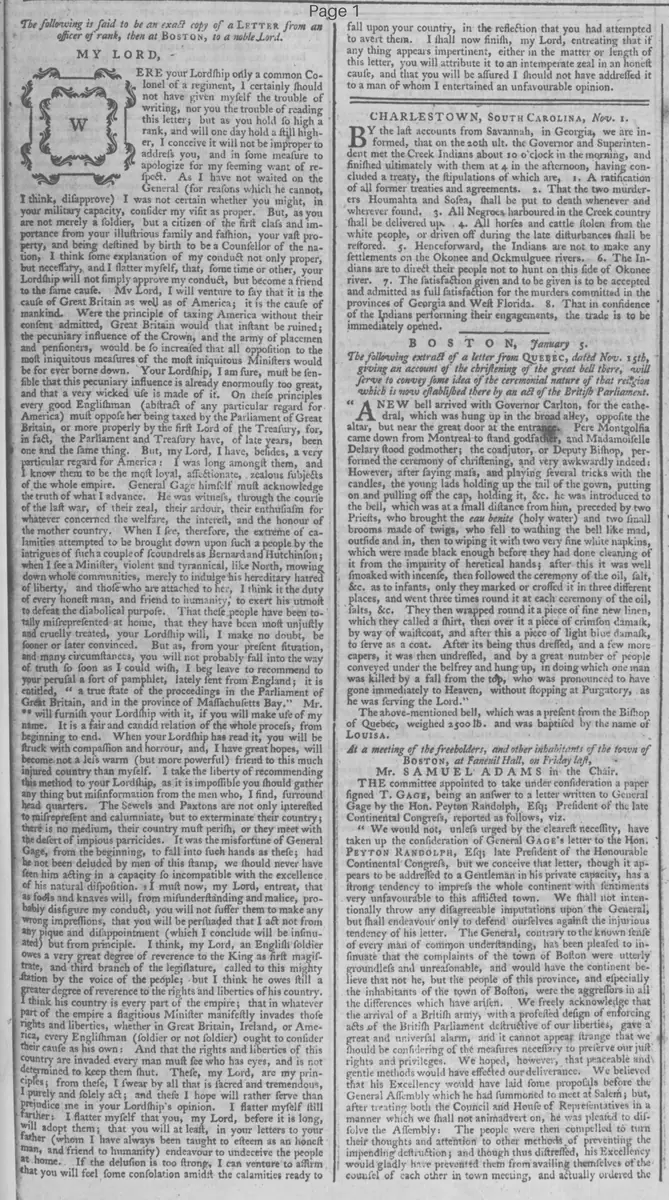
If your Lordship were only a common Colonel of a regiment, I certainly should not have given myself the trouble of writing, nor you the trouble of reading this letter; but as you hold so high a rank, and will one day hold a still higher, I conceive it will not be improper to address you, and in some measure to apologize for my seeming want of respect. As I have not waited on the General (for reasons which he cannot, I think, disapprove) I was not certain whether you might, in your military capacity, consider my visit as proper. But, as you are not merely a soldier, but a citizen of the first class and importance from your illustrious family and fashion, your vast property, and being destined by birth to be a Counsellor of the nation, I think some explanation of my conduct not only proper, but necessary, and I flatter myself, that, some time or other, your Lordship will not simply approve my conduct, but become a friend to the same cause. My Lord, I will venture to say that it is the cause of Great Britain as well as of America; it is the cause of mankind. Were the principle of taxing America without their consent admitted, Great Britain would that instant be ruined; the pecuniary influence of the Crown, and the army of placemen and pensioners, would be so increased that all opposition to the most iniquitous measures of the most iniquitous Ministers would be for ever borne down. Your Lordship, I am sure, must be sensible that this pecuniary influence is already enormously too great, and that a very wicked use is made of it. On these principles every good Englishman (abstract of any particular regard for America) must oppose her being taxed by the Parliament of Great Britain, or more properly by the first Lord of the Treasury, for, in fact, the Parliament and Treasury have, of late years, been one and the same thing. But, my Lord, I have, besides, a very particular regard for America: I was long amongst them, and I know them to be the most loyal, affectionate, zealous subjects of the whole empire. General Gage himself must acknowledge the truth of what I advance. He was witness, through the course of the last war, of their zeal, their ardour, their enthusiasm for whatever concerned the welfare, the interest, and the honour of the mother country. When I see, therefore, the extremes of calamities attempted to be brought down upon such a people by the intrigues of such a couple of scoundrels as Bernard and Hutchinson; when I see a Minister, violent and tyrannical, like North, mowing down whole communities, merely to indulge his hereditary hatred of liberty, and those who are attached to her, I think it the duty of every honest man, and friend to humanity, to exert his utmost to defeat the diabolical purpose. That these people have been totally misrepresented at home, that they have been most unjustly and cruelly treated, your Lordship will, I make no doubt, be sooner or later convinced. But as, from your present situation, and many circumstances, you will not probably fall into the way of truth so soon as I could wish, I beg leave to recommend to your perusal a short pamphlet, lately sent from England; it is entitled, "a true state of the proceedings in the Parliament of Great Britain, and in the province of Massachusetts Bay." Mr. [name] will furnish your Lordship with it, if you will make use of my name. It is a fair and candid relation of the whole process, from beginning to end. When your Lordship has read it, you will be struck with compassion and horror, and, I have great hopes, will become not a less warm (but more powerful) friend to this much injured country than myself. I take the liberty of recommending this method to your Lordship, as it is impossible you should gather any thing but misinformation from the men who, I find, surround head quarters. The Sewels and Paxtons are not only interested to misrepresent and calumniate, but to exterminate their country; there is no medium, their country must perish, or they meet with the desert of impious parricides. It was the misfortune of General Gage, from the beginning, to fall into such hands as these; had he not been deluded by men of this stamp, we should never have seen him acting in a capacity so incompatible with the excellence of his natural disposition. I must now, my Lord, entreat, that as fools and knaves will, from misunderstanding and malice, probably disfigure my conduct, you will not suffer them to make any wrong impressions, that you will be persuaded that I act not from any pique and disappointment (which I conclude will be insinuated) but from principle. I think, my Lord, an English soldier owes a very great degree of reverence to the King as first magistrate, and third branch of the legislature, called to this mighty station by the voice of the people; but I think he owes still a greater degree of reverence to the rights and liberties of his country. I think his country is every part of the empire; that in whatever part of the empire a factious Minister manifestly invades those rights and liberties, whether in Great Britain, Ireland, or America, every Englishman (soldier or not soldier) ought to consider their cause as his own: And that the rights and liberties of this country are invaded every man must see who has eyes, and is not determined to keep them shut. These, my Lord, are my principles; from these, I swear by all that is sacred and tremendous, I purely and solely act; and these I hope will rather serve than prejudice me in your Lordship's opinion. I flatter myself still farther: I flatter myself that you, my Lord, before it is long, will adopt them; that you will at least, in your letters to your father (whom I have always been taught to esteem as an honest man, and friend to humanity) endeavour to undeceive the people at home. If the delusion is too strong, I can venture to affirm that you will feel some consolation amidst the calamities ready to fall upon your country, in the reflection that you had attempted to avert them. I shall now finish, my Lord, entreating that if any thing appears impertinent, either in the matter or length of this letter, you will attribute it to an intemperate zeal in an honest cause, and that you will be assured I should not have addressed it to a man of whom I entertained an unfavourable opinion.
What sub-type of article is it?
What themes does it cover?
What keywords are associated?
What entities or persons were involved?
Where did it happen?
Story Details
Key Persons
Location
Boston
Story Details
A British officer in Boston writes to a noble Lord, justifying his refusal to visit the General due to principled opposition to taxing America without consent. He extols American loyalty from the last war, denounces British officials like North, Bernard, and Hutchinson for misrepresenting and oppressing the colonists, recommends a pamphlet detailing the proceedings, and urges the Lord to support the cause to prevent ruin for Britain and mankind.