Thank you for visiting SNEWPapers!
Sign up free
The New Hampshire Gazette
Portsmouth, Rockingham County, New Hampshire
What is this article about?
On January 9, 1794, US Minister Thomas Pinckney in London informs the Secretary of State about a new British instruction to warships revoking the November 6 order, which had targeted US-bound vessels from St. Domingo. Discussions with Lord Grenville highlight British goodwill towards US neutrality and efforts to prevent irritations in US-British relations.
Clipping
OCR Quality
Full Text
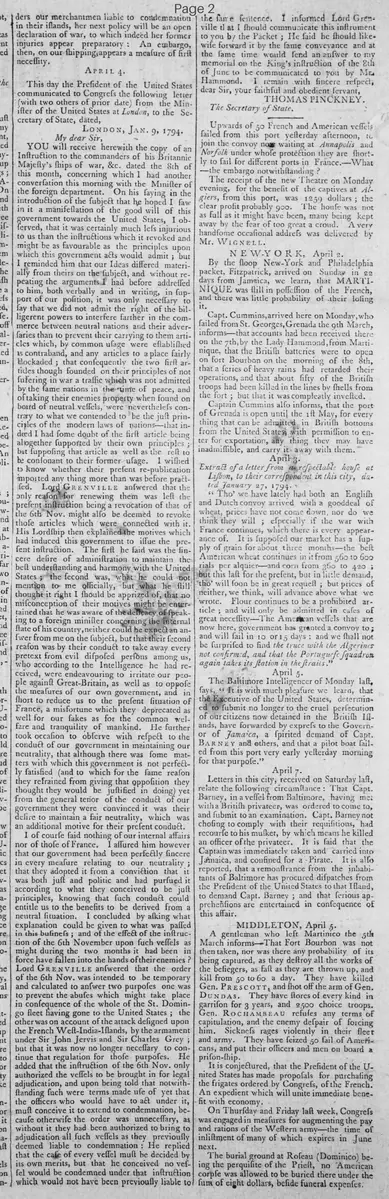
This day the President of the United States communicated to Congress the following letter (with two others of prior date) from the Minister of the United States at London, to the Secretary of State, dated,
London, Jan. 9, 1794.
My dear Sir,
YOU will receive herewith the copy of an Instruction to the commanders of his Britannic Majesty's ships of war, &c. dated the 8th of this month, concerning which I had another conversation this morning with the Minister of the foreign department. On his saying in the introduction of the subject that he hoped I saw in it a manifestation of the good will of this government towards the United States, I observed, that it was certainly much less injurious to us than the instructions which it revoked and might be as favourable as the principles upon which this government acts would admit; but I reminded him that our Ideas differed materially from theirs on the subject, and without repeating the arguments I had before addressed to him, both verbally and in writing, in support of our position, it was only necessary to say that we did not admit the right of the belligerent powers to interfere farther in the commerce between neutral nations and their adversaries than to prevent their carrying to them articles which, by common usage were established as contraband, and any articles to a place fairly blockaded: that consequently the two first articles though founded on their principles of not suffering in war a traffic which was not admitted by the same nations in the time of peace, and of taking their enemies property when found on board of neutral vessels, were nevertheless contrary to what we contended to be the just principles of the modern laws of nations--that indeed I had some doubt of the first article being altogether supported by their own principles; but supposing that article as well as the rest to be consonant to their former usage. I wished to know whether their present re-publication imported any thing more than was before practised. Lord GRENVILLE answered that the only reason for renewing them was lest the present instruction being a revocation of that of the 6th Nov. might also be deemed to revoke those articles which were connected with it.
His Lordship then explained the motives which had induced this government to issue the present instruction. The first he said was the sincere desire of administration to maintain the best understanding and harmony with the United States; the second was, what he could not mention to me officially, but what he still thought it right I should be apprised of, that no misconception of their motives might be entertained that he was aware of the delicacy of speaking to a foreign minister concerning the internal state of his country, neither could he expect an answer from me on the subject, but that their second reason was by their conduct to take away every pretext from evil disposed persons among us, who according to the Intelligence he had received, were endeavouring to irritate our people against Great-Britain, as well as to oppose the measures of our own government, and in short to reduce us to the present situation of France, a misfortune which they deprecated as well for our sakes as for the common welfare and tranquility of mankind. He further took occasion to observe with respect to the conduct of our government in maintaining our neutrality, that although there was some matters with which this government is not perfectly satisfied (and to which for the same reason they refrained from giving that opposition they thought they would be justified in doing) yet from the general tenor of the conduct of our government they were convinced it was their desire to maintain a fair neutrality, which was an additional motive for their present conduct.
I of course said nothing of our internal affairs nor of those of France. I assured him however that our government had been perfectly sincere in every measure relating to our neutrality; that they adopted it from a conviction that it was both just and politic and had pursued it according to what they conceived to be just principles, knowing that such conduct could entitle us to the benefits to be derived from a neutral situation. I concluded by asking what explanation could be given to what was passed in this business; and of the effect of the instruction of the 6th November upon such vessels as might during the two months it had been in force have fallen into the hands of their enemies?
Lord GRENVILLE answered that the order of the 6th Nov. was intended to be temporary and calculated to answer two purposes one was to prevent the abuses which might take place in consequence of the whole of the St. Domingo fleet having gone to the United States; the other was on account of the attack designed upon the French West-India-Islands, by the armament under Sir John Jervis and Sir Charles Grey; but that it was now no longer necessary to continue that regulation for those purposes. He added that the instruction of the 6th Nov. only authorized the vessels to be brought in for legal adjudication, and upon being told that notwithstanding such were terms made use of yet that the officers who would have to act under it, must conceive it to extend to condemnation, because otherwise the order was unnecessary, as without it they had been authorized to bring to adjudication all such vessels as they previously deemed liable to condemnation: He replied that the case of every vessel must be decided by its own merits, but that he conceived no vessel would be condemned under that instruction which would not have been previously liable to the same sentence. I informed Lord Grenville that I should communicate this instrument to you by the Packet: He said he should likewise forward it by the same conveyance and at the same time would send an answer to my memorial on the King's instruction of the 8th of June to be communicated to you by Mr. Hammond.
I remain with sincere respect,
dear Sir, your faithful and obedient servant,
THOMAS PINCKNEY.
The Secretary of State.
What sub-type of article is it?
What keywords are associated?
What entities or persons were involved?
Where did it happen?
Foreign News Details
Primary Location
London
Event Date
Jan. 9, 1794
Key Persons
Outcome
revocation of the november 6, 1793 instruction to british warships; assurances of british goodwill towards us neutrality and harmony; no additional condemnations beyond prior liabilities.
Event Details
Thomas Pinckney reports a conversation with Lord Grenville regarding a new British instruction dated January 8, 1794, revoking the November 6 order that had authorized seizure of US-bound vessels carrying French property. Pinckney argues against British principles on neutral commerce, limited to contraband and blockades. Grenville explains motives as maintaining US-British harmony and countering agitators, praising US neutrality efforts. The November order was temporary for St. Domingo fleet issues and planned attacks on French West Indies.