Thank you for visiting SNEWPapers!
Sign up free
Literary
October 3, 1837
The Caledonian
Saint Johnsbury, Caledonia County, Vermont
What is this article about?
A moral tale about little Ellen, a deformed hunchback girl, who faces taunts but finds solace in her mother's teachings on inner beauty, goodness, and heaven. Despite her suffering, she remains kind and patient, ultimately dying young and peacefully, leaving her mother to continue good works.
Clipping
OCR Quality
98%
Excellent
Full Text
MORAL & RELIGIOUS.
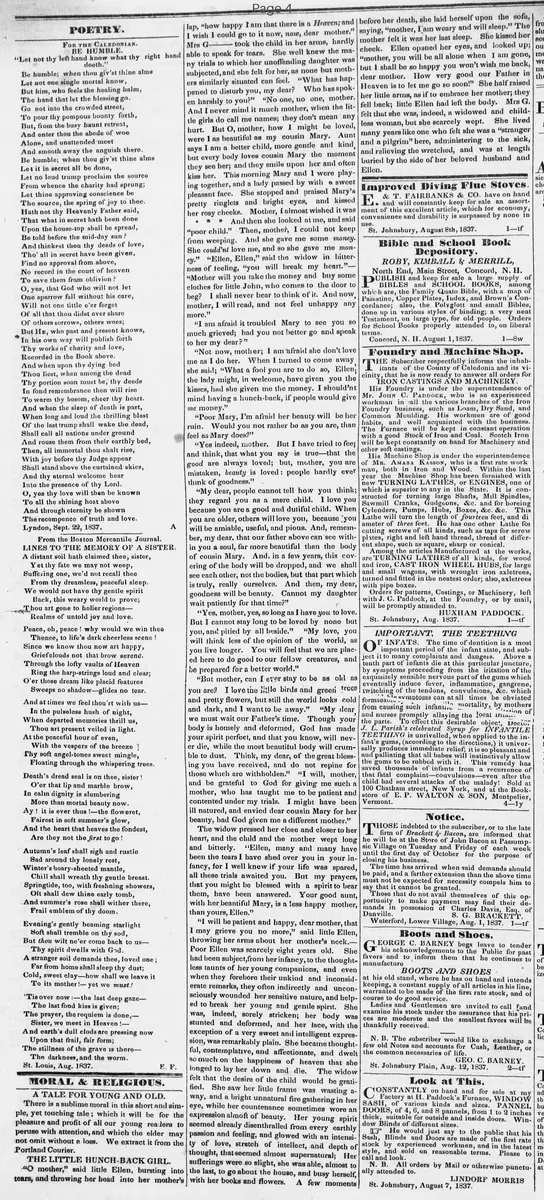
A TALE FOR YOUNG AND OLD.
There is a sublime moral in this short and simple, yet touching tale; which it will be for the pleasure and profit of all our young readers to peruse with attention, and which the elder may not omit without a loss. We extract it from the Portland Courier.
THE LITTLE HUNCH-BACK GIRL.
"Mother," said little Ellen, bursting into tears, and throwing her head into her mother's lap, "how happy I am that there is a Heaven; and I wish I could go to it now, now, dear mother."
Mrs. G—— took the child in her arms, hardly able to speak for tears. She well knew the many trials to which her unoffending daughter was subjected, and she felt for her, as none but mothers similarly situated can feel. "What has happened to disturb you, my dear? Who has spoken harshly to you?" "No one, no one, mother. And I never mind it much mother, when the little girls do call me names; they don't mean any hurt. But O, mother, how I might be loved, were I as beautiful as my cousin Mary. Aunt says I am a better child, more gentle and kind but every body loves cousin Mary the moment they see her; and they smile upon her and often kiss her. This morning Mary and I were playing together, and a lady passed by with a sweet pleasant face. She stopped and praised Mary's pretty ringlets and bright eyes, and kissed her rosy cheeks. Mother, I almost wished it was me she was kissing, and then she looked at me, and said "poor child." Then, mother, I could not keep from weeping. And she gave me some money. She couldn't love me, and so she gave me money." "Ellen, Ellen," said the widow in bitterness of feeling, "you will break my heart."
"Mother will you take the money and buy some clothes for little John, who comes to the door to beg? I shall never bear to think of it. And now mother, I will read, and not feel unhappy any more."
"I am afraid it troubled Mary to see you so much grieved; had you not better go and speak to her my dear?" "Not now, mother; I am afraid she don't love me as I do her. When I turned to come away she said; "What a fool you are to do so, Ellen; the lady might, in welcome, have given you the kisses, had she given me the money. I shouldn't mind having a hunch-back, if people would give me money." "Poor Mary, I'm afraid her beauty will be her ruin. Would you not rather be as you are, than feel as Mary does?" "Yes indeed, mother. But I have tried to feel and think, that what you say is true—that the good are always loved; but, mother, you are mistaken, beauty is loved: people hardly ever think of goodness." "My dear, people cannot tell how you think; they regard you as a mere child. I love you because you are a good and dutiful child. When you are older, others will love you, because you will be amiable, useful, and pious. And, remember, my dear, that our father above can see within you a soul, far more beautiful than the body of cousin Mary. And, in a few years, this covering of the body will be dropped, and we shall see each other, not the bodies, but that part which is truly, really ourselves. And then, my dear, goodness will be beauty. Cannot my daughter wait patiently for that time?" "Yes, mother, yes, so long as I have you to love. But I cannot stay long to be loved by none but you, and pitied by all beside." "My love, you will think less of the opinion of the world, as you live longer. You will feel that we are placed here to do good to our fellow creatures, and be prepared for a better world." "But mother, can I ever stay to be as old as you are? I love the little birds and green trees and pretty flowers, but still the world looks cold and dark, and I want to be away." "My dear we must wait our Father's time. Though your body is homely and deformed, God has made your spirit perfect, and that you know, will never die, while the most beautiful body will crumble to dust. Think, my dear, of the great blessing you have received, and do not repine for those which are withholden." "I will, mother, and be grateful to God for giving me such a mother, who has taught me to be patient and contented under my trials. I might have been ill natured, and envied dear cousin Mary for her beauty, had God given me a different mother."
The widow pressed her close and closer to her heart, and the child and the mother wept long and bitterly. "Ellen, many and many have been the tears I have shed over you in your infancy, for I well knew if your life was spared, all these trials awaited you. But my prayers, that you might be blessed with a spirit to bear them, have been answered. Your good aunt, with her beautiful Mary, is a less happy mother, than yours, Ellen." "I will be patient and happy, dear mother, that I may grieve you no more," said little Ellen, throwing her arms about her mother's neck.—
Poor Ellen was scarcely eight years old. She had been subject, from her infancy, to the thoughtless taunts of her young companions, and even when they forebore their unkind and inconsiderate remarks, they often indirectly and unconsciously wounded her sensitive nature, and helped to break her young and gentle spirit. She was, indeed, sorely stricken; her body was stunted and deformed, and her face, with the exception of a very sweet and intelligent expression, was remarkably plain. She became thoughtful, contemplative, and affectionate, and dwelt so much on the happiness of heaven that she longed to lay her down and die. The widow felt that the desire of the child would be gratified. She saw her little frame was wasting away, and a bright unnatural fire gathering in her eye, while her countenance sometimes wore an expression almost of beauty. Her young spirit seemed already disenthralled from every earthly passion and feeling, and glowed with an intensity of love, stretch of intellect, and depth of thought, that seemed almost supernatural; Her sufferings were so slight, she was able, almost to the last, to go about the house, and busy herself, with her books and flowers. A few moments before her death, she laid herself upon the sofa, saying, "mother, I am weary and will sleep." The mother felt it was her last sleep. She kissed her cheek. Ellen opened her eyes, and looked up; "mother, you will be all alone when I am gone, but I shall be so happy you won't wish me back, dear mother. How very good our Father in Heaven is to let me go so soon!" She half raised her little arms, as if to embrace her mother; they fell back; little Ellen had left the body. Mrs. G. felt that she was, indeed, a widowed and childless woman, but she scarcely wept. She lived many years like one who felt she was a "stranger and a pilgrim" here, administering to the sick, and relieving the wretched, and was at length buried by the side of her beloved husband and Ellen.
A TALE FOR YOUNG AND OLD.
There is a sublime moral in this short and simple, yet touching tale; which it will be for the pleasure and profit of all our young readers to peruse with attention, and which the elder may not omit without a loss. We extract it from the Portland Courier.
THE LITTLE HUNCH-BACK GIRL.
"Mother," said little Ellen, bursting into tears, and throwing her head into her mother's lap, "how happy I am that there is a Heaven; and I wish I could go to it now, now, dear mother."
Mrs. G—— took the child in her arms, hardly able to speak for tears. She well knew the many trials to which her unoffending daughter was subjected, and she felt for her, as none but mothers similarly situated can feel. "What has happened to disturb you, my dear? Who has spoken harshly to you?" "No one, no one, mother. And I never mind it much mother, when the little girls do call me names; they don't mean any hurt. But O, mother, how I might be loved, were I as beautiful as my cousin Mary. Aunt says I am a better child, more gentle and kind but every body loves cousin Mary the moment they see her; and they smile upon her and often kiss her. This morning Mary and I were playing together, and a lady passed by with a sweet pleasant face. She stopped and praised Mary's pretty ringlets and bright eyes, and kissed her rosy cheeks. Mother, I almost wished it was me she was kissing, and then she looked at me, and said "poor child." Then, mother, I could not keep from weeping. And she gave me some money. She couldn't love me, and so she gave me money." "Ellen, Ellen," said the widow in bitterness of feeling, "you will break my heart."
"Mother will you take the money and buy some clothes for little John, who comes to the door to beg? I shall never bear to think of it. And now mother, I will read, and not feel unhappy any more."
"I am afraid it troubled Mary to see you so much grieved; had you not better go and speak to her my dear?" "Not now, mother; I am afraid she don't love me as I do her. When I turned to come away she said; "What a fool you are to do so, Ellen; the lady might, in welcome, have given you the kisses, had she given me the money. I shouldn't mind having a hunch-back, if people would give me money." "Poor Mary, I'm afraid her beauty will be her ruin. Would you not rather be as you are, than feel as Mary does?" "Yes indeed, mother. But I have tried to feel and think, that what you say is true—that the good are always loved; but, mother, you are mistaken, beauty is loved: people hardly ever think of goodness." "My dear, people cannot tell how you think; they regard you as a mere child. I love you because you are a good and dutiful child. When you are older, others will love you, because you will be amiable, useful, and pious. And, remember, my dear, that our father above can see within you a soul, far more beautiful than the body of cousin Mary. And, in a few years, this covering of the body will be dropped, and we shall see each other, not the bodies, but that part which is truly, really ourselves. And then, my dear, goodness will be beauty. Cannot my daughter wait patiently for that time?" "Yes, mother, yes, so long as I have you to love. But I cannot stay long to be loved by none but you, and pitied by all beside." "My love, you will think less of the opinion of the world, as you live longer. You will feel that we are placed here to do good to our fellow creatures, and be prepared for a better world." "But mother, can I ever stay to be as old as you are? I love the little birds and green trees and pretty flowers, but still the world looks cold and dark, and I want to be away." "My dear we must wait our Father's time. Though your body is homely and deformed, God has made your spirit perfect, and that you know, will never die, while the most beautiful body will crumble to dust. Think, my dear, of the great blessing you have received, and do not repine for those which are withholden." "I will, mother, and be grateful to God for giving me such a mother, who has taught me to be patient and contented under my trials. I might have been ill natured, and envied dear cousin Mary for her beauty, had God given me a different mother."
The widow pressed her close and closer to her heart, and the child and the mother wept long and bitterly. "Ellen, many and many have been the tears I have shed over you in your infancy, for I well knew if your life was spared, all these trials awaited you. But my prayers, that you might be blessed with a spirit to bear them, have been answered. Your good aunt, with her beautiful Mary, is a less happy mother, than yours, Ellen." "I will be patient and happy, dear mother, that I may grieve you no more," said little Ellen, throwing her arms about her mother's neck.—
Poor Ellen was scarcely eight years old. She had been subject, from her infancy, to the thoughtless taunts of her young companions, and even when they forebore their unkind and inconsiderate remarks, they often indirectly and unconsciously wounded her sensitive nature, and helped to break her young and gentle spirit. She was, indeed, sorely stricken; her body was stunted and deformed, and her face, with the exception of a very sweet and intelligent expression, was remarkably plain. She became thoughtful, contemplative, and affectionate, and dwelt so much on the happiness of heaven that she longed to lay her down and die. The widow felt that the desire of the child would be gratified. She saw her little frame was wasting away, and a bright unnatural fire gathering in her eye, while her countenance sometimes wore an expression almost of beauty. Her young spirit seemed already disenthralled from every earthly passion and feeling, and glowed with an intensity of love, stretch of intellect, and depth of thought, that seemed almost supernatural; Her sufferings were so slight, she was able, almost to the last, to go about the house, and busy herself, with her books and flowers. A few moments before her death, she laid herself upon the sofa, saying, "mother, I am weary and will sleep." The mother felt it was her last sleep. She kissed her cheek. Ellen opened her eyes, and looked up; "mother, you will be all alone when I am gone, but I shall be so happy you won't wish me back, dear mother. How very good our Father in Heaven is to let me go so soon!" She half raised her little arms, as if to embrace her mother; they fell back; little Ellen had left the body. Mrs. G. felt that she was, indeed, a widowed and childless woman, but she scarcely wept. She lived many years like one who felt she was a "stranger and a pilgrim" here, administering to the sick, and relieving the wretched, and was at length buried by the side of her beloved husband and Ellen.
What sub-type of article is it?
Prose Fiction
What themes does it cover?
Moral Virtue
Religious
Death Mortality
What keywords are associated?
Moral Tale
Hunchback Girl
Inner Beauty
Heavenly Reward
Mother Daughter Bond
Deformity
Patience
Goodness
What entities or persons were involved?
From The Portland Courier
Literary Details
Title
The Little Hunch Back Girl.
Author
From The Portland Courier
Subject
A Tale For Young And Old On Inner Beauty And Heavenly Reward
Form / Style
Moral Tale In Prose With Dialogue
Key Lines
"Mother," Said Little Ellen, Bursting Into Tears, And Throwing Her Head Into Her Mother's Lap, "How Happy I Am That There Is A Heaven; And I Wish I Could Go To It Now, Now, Dear Mother."
"And, Remember, My Dear, That Our Father Above Can See Within You A Soul, Far More Beautiful Than The Body Of Cousin Mary. And, In A Few Years, This Covering Of The Body Will Be Dropped, And We Shall See Each Other, Not The Bodies, But That Part Which Is Truly, Really Ourselves. And Then, My Dear, Goodness Will Be Beauty."
"Mother, You Will Be All Alone When I Am Gone, But I Shall Be So Happy You Won't Wish Me Back, Dear Mother. How Very Good Our Father In Heaven Is To Let Me Go So Soon!"
"I Will, Mother, And Be Grateful To God For Giving Me Such A Mother, Who Has Taught Me To Be Patient And Contented Under My Trials."