Thank you for visiting SNEWPapers!
Sign up free
Gazette Of The United States, & Philadelphia Daily Advertiser
Philadelphia, Philadelphia County, Pennsylvania
What is this article about?
Phocion No. XIV critiques Thomas Jefferson's aversion to President Washington's 1793 Neutrality Proclamation, claiming it arose from pro-French enthusiasm and risked war by encouraging French minister Genet's intrigues. It defends the President's authority and accuses Jefferson of duplicity in later opposing Genet.
Merged-components note: Continuation of the Phocion No. XIV editorial across bounding boxes.
Clipping
OCR Quality
Full Text
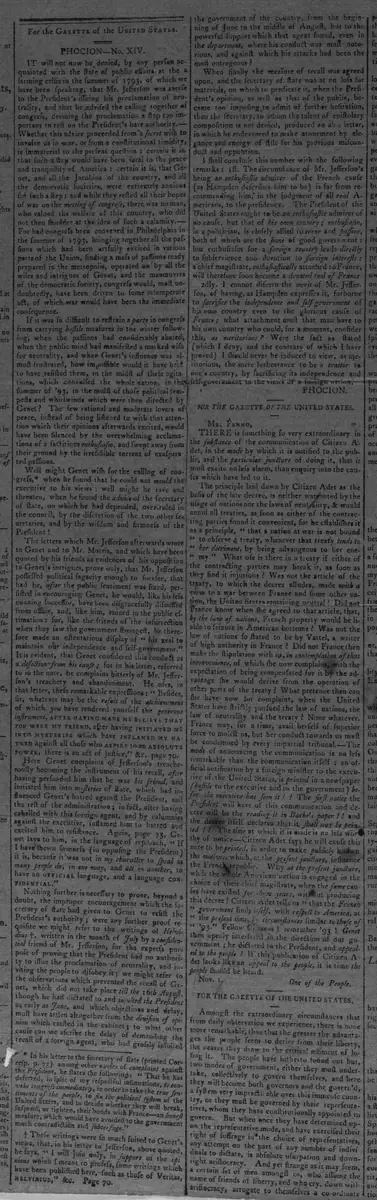
PHOCION—No. XIV.
IT will not now be denied, by any person acquainted with the state of public affairs at the alarming crisis in the summer of 1793, of which we have been speaking, that Mr. Jefferson was averse to the President's issuing his proclamation of neutrality, and that he advised the calling together of congress, deeming the proclamation a step too important to rest on the President's bare authority.—Whether this advice proceeded from a secret wish to involve us in war, or from a constitutional timidity, is immaterial to the present question: certain it is, that such a step would have been fatal to the peace and tranquility of America: certain it is, that Genet, and all the Jacobins of the country, and all the democratic societies, were extremely anxious for such a step: and while they rested all their hopes of war on the meeting of congress, there was no man, who valued the welfare of this country, who did not then shudder at the idea of such a calamity.—For had congress been convened in Philadelphia in the summer of 1793, bringing together all the passions which had been artfully excited in various parts of the Union, finding a mass of passions ready prepared in the metropolis, operated on by all the wiles and intrigues of Genet, and the manoeuvres of the democratic society, congress would, most undoubtedly, have been driven to some intemperate act, of which war would have been the immediate consequence.
If it was so difficult to restrain a party in congress from carrying hostile measures in the winter following, when the passions had considerably abated, when the public mind had manifested a marked wish for neutrality, and when Genet's influence was almost frustrated, how impossible would it have been to have resisted them, in the midst of these agitations, which convulsed the whole nation, in the summer of '93, in the midst of those political tempests and whirlwinds which were then directed by Genet? The few rational and moderate lovers of peace, instead of being listened to with that attention which their opinions afterwards excited, would have been silenced by the overwhelming acclamations of a factitious enthusiasm, and swept away from their ground by the irresistible torrent of exasperated passions.
Well might Genet wish for the calling of congress, when he found that he could not mould the executive to his views: well might he rave and threaten, when he found the advice of the secretary of state, on which he had depended, over-ruled in the council, by the discretion of the two other secretaries, and by the wisdom and firmness of the President!
The letters which Mr. Jefferson afterwards wrote to Genet and to Mr. Morris, and which have been quoted by his friends as evidences of his opposition to Genet's intrigues, prove only, that Mr. Jefferson possessed political sagacity enough to foresee, that had he, after the public sentiment was fixed, persisted in encouraging Genet, he would, like his less cunning successor, have been disgracefully dismissed from office, and, like him, ruined in the public estimation: for, like the friends of the insurrection when they saw the government strong, he therefore made an ostentatious display of "his zeal to maintain our independence and self-government."
It is evident, that Genet considered this conduct as a defection from his cause; for in his letter, referred to in the note, he complains bitterly of Mr. Jefferson's treachery and abandonment. He uses, in that letter, these remarkable expressions: "Besides. sir, whatever may be the result of the achievement of which you have rendered yourself the generous instrument, AFTER HAVING MADE ME BELIEVE THAT YOU WERE MY FRIEND, after having INITIATED ME INTO MYSTERIES which have INFLAMED MY HATRED against all those who ASPIRE to an ABSOLUTE power, there is an act of justice," &c. page 70.
Here Genet complains of Jefferson's treacherously becoming the instrument of his recall, after having persuaded him that he was his friend, and initiated him into mysteries of state, which had influenced Genet's hatred against the President, and the rest of the administration; in fact, after having caballed with this foreign agent, and by calumnies against the executive, inflamed him to hatred and excited him to resistance. Again, page 73, Genet says to him, in the language of reproach, "If I have shewn firmness (in opposing the President) it is, because it was not in my character to speak as many people do, in one way, and act in another, to have an official language, and a language CONFIDENTIAL."
Nothing further is necessary to prove, beyond a doubt, the improper encouragement which the secretary of state had given to Genet to resist the President's authority; were any further proof requisite we might refer to the writings of Helvidius, written in the month of July by a confidential friend of Mr. Jefferson, for the express purpose of proving that the President had no authority to issue the proclamation of neutrality, and inviting the people to disobey it; we might refer to the observations which prevented the recall of Genet, which did not take place till the 16th August, though he had dictated to and insulted the President as early as June, and which objections and delay must have arisen altogether from the division of opinion which existed in the cabinet; to what other cause can we ascribe the delay of demanding the recall of a foreign agent, who had grossly insulted
* In his letter to the secretary of state (printed Correp. p. 73) among other causes of complaint against the President, he states the following: "That he has deferred, in spite of my respectful insinuations, to convoke congress immediately, in order to take the true sentiments of the people, to fix the political system of the United States, and to decide whether they will break, suspend, or tighten, their bonds with France—an honest measure, which would have avoided to the government much contradiction and subterfuge."
These writings were so much suited to Genet's views, that, in his letter to Jefferson, above quoted. he says, "I will join only, in support of the opinions which I meant to profess, some writings which have been published here, such as those of Veritas, HELVIDIUS," &c. Page 70.
the government of the country, from the beginning of June to the middle of August, but to the powerful support which that agent found, even in the department, where his conduct was most notorious, and against which his attacks had been the most outrageous?
When finally the measure of recall was agreed upon, and the secretary of state was at no loss for materials, on which to predicate it, when the President's opinion, as well as that of the public, became too imposing to admit of further hesitation, then the secretary, to whom the talent of epistolary composition is not denied, produced an able letter, in which he endeavored to make atonement by elegance and energy of style for his previous misconduct and opposition.
I shall conclude this number with the following remarks: 1st. The circumstance of Mr. Jefferson's being an enthusiastic admirer of the French cause (as Hampden describes him to be) is far from recommending him, in the judgment of all real Americans, to the presidency. The President of the United States ought to be an enthusiastic admirer of no cause, but that of his own country; enthusiasm, in a politician, is closely allied to error and passion, both of which are the bane of good government: but enthusiasm for a foreign country leads directly to subservience and devotion to foreign interests: a chief magistrate, enthusiastically attached to France, will therefore soon become a devoted tool of France
2dly. I cannot discern the merit of Mr. Jefferson, of having, as Hampden expresses it, forborne to sacrifice the independence and self government of his own country even to the glorious cause of France; what attachment must that man have to his own country who could, for a moment, consider this, as meritorious? Were the fact as stated (which I deny, and the contrary of which I have proved) I should never be induced to view, as meritorious, the mere forbearance to be a traitor to one's country, by sacrificing its independence and self-government to the views of a foreign nation."
PHOCION.
What sub-type of article is it?
What keywords are associated?
What entities or persons were involved?
Editorial Details
Primary Topic
Criticism Of Jefferson's Opposition To The 1793 Neutrality Proclamation And Encouragement Of Genet
Stance / Tone
Strongly Critical Of Jefferson, Supportive Of Washington's Administration
Key Figures
Key Arguments