Thank you for visiting SNEWPapers!
Sign up free
Gazette Of The United States
New York, New York County, New York
What is this article about?
E.Z. submits an excerpt from a European publication detailing the British East India Company's abuse of trade privileges in India under Mogul rule, leading to monopolies, oppression of native princes like Cosim Ali Khawn and Jaffier Ali Khan, and economic control after 1757 and 1765.
Merged-components note: The text in the second component directly continues the letter to the editor from the first component, discussing the British in India, so they should be merged. The label is changed from foreign_news to letter_to_editor to reflect the overall content.
Clippings
1 of 2
OCR Quality
Full Text
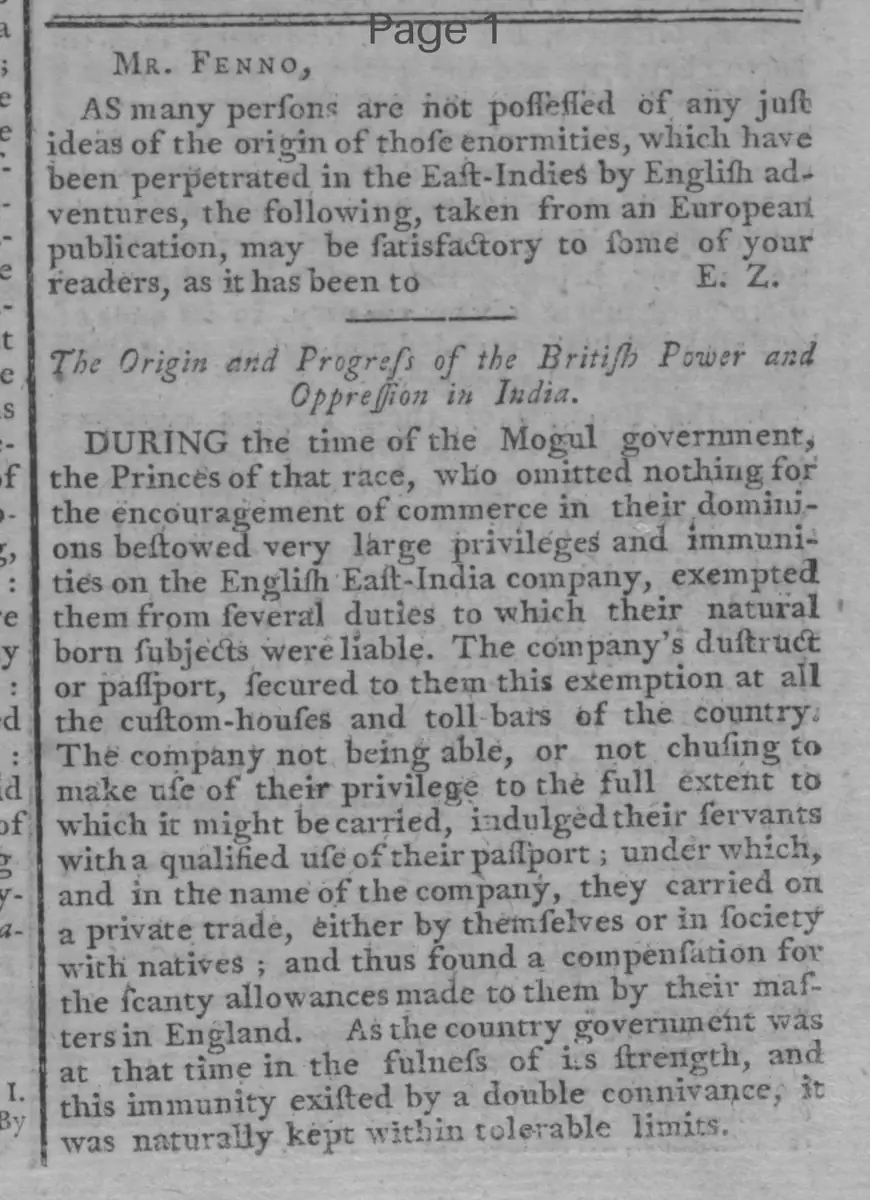
AS many persons are not possessed of any just ideas of the origin of those enormities, which have been perpetrated in the East-Indies by English adventurers, the following, taken from an European publication, may be satisfactory to some of your readers, as it has been to
E. Z.
The Origin and Progress of the British Power and Oppression in India.
DURING the time of the Mogul government, the Princes of that race, who omitted nothing for the encouragement of commerce in their dominions bestowed very large privileges and immunities on the English East-India company, exempted them from several duties to which their natural born subjects were liable. The company's dustruck or passport, secured to them this exemption at all the custom-houses and toll bars of the country. The company not being able, or not choosing to make use of their privilege to the full extent to which it might be carried, indulged their servants with a qualified use of their passport; under which, and in the name of the company, they carried on a private trade, either by themselves or in society with natives; and thus found a compensation for the scanty allowances made to them by their masters in England. As the country government was at that time in the fulness of its strength, and this immunity existed by a double connivance. it was naturally kept within tolerable limits.
But by the revolution in 1757, the company's servants obtained a mighty ascendant over the native Princes of Bengal, who owed their elevation to the British arms. The company, which was new to that kind of power, and not yet thoroughly apprised of its real character and situation, considered itself still as a trader in the territories of a foreign potentate, in the property of whose country it had neither interest nor duty. The servants, with the same ideas, followed their fortune in the channels in which it had hitherto ran, only enlarging them with the enlargement of their power. For their first ideas of profit were not official; nor were their oppressions those of ordinary despotism. The first instruments of their power were so new out of evasions of their ancient subjections. The passport of the company in the hands of its servants was no longer under any restraint; and in a very short time their immunity began to cover all the merchandise of the country. Cosim Ali Khawn, the second of the Nabobs whom they had set up, was but ill disposed to the instruments of his greatness. He bore the yoke of this imperious commerce with the utmost impatience: he saw his subjects excluded as aliens from their own trade, and the revenues of the Prince overwhelmed in the ruin of the commerce of his dominions. Finding his reiterated remonstrances on the extent and abuse of the passport ineffectual, he had recourse to an unexpected expedient, which was to declare his resolution at once to annul all the duties on trade, setting it equally free to subjects and to foreigners.
Never was the method of defeating the oppressions of monopoly more forcible, more simple, or more equitable: no sort of plausible objections could be made; and it was in vain to think of evading it. It was therefore met with the confidence of avowed and determined injustice. The presidency of Calcutta openly denied to the Prince the power of protecting the trade of his subjects, by the remission of his own duties. It was evident that his authority drew to its period; many reasons and motives concurred, and his fall was hastened by the odium of the oppressions which he exercised voluntarily, as well as those to which he was obliged to submit.
When this example was made, Jaffier Ali Khan, who had been disposed to make room for the last actor, was brought from penury and exile to a station, the terms of which he could not misunderstand. During his life, and in the time of his children who succeeded him, parts of the territorial revenue were assigned to the company; and the whole, under the name of residency at the Nabob's court, was brought directly or indirectly, under the controul of British subjects. The company's servants, armed with authorities delegated from the nominal government, or attended with what was a stronger guard, the fame of their own power, appeared as magistrates in the markets in which they dealt as traders. It was impossible for the natives in general to distinguish, in the proceedings of the same persons, what was transacted on the company's account, from what was done on their own; and it will ever be so difficult to draw this line of distinction, that, as long as the company does, directly or indirectly, aim at any advantage to itself in the purchase of any commodity whatever, so long will it be impracticable to prevent the servants availing themselves of the same privilege.
The servants therefore, for themselves, or for their employers, monopolized every article of trade, foreign and domestic; not only the raw merchantable commodities, but the manufactures, and not only these, but the necessaries of life, or what in these countries, habit has confounded with them; not only silk, cotton, piece goods, opium, saltpetre, but not unfrequently salt, tobacco, betel nut and the grain of most ordinary consumption. In the name of the country government they laid on or took off, and at their pleasure heightened or lowered, all duties upon goods: the whole trade of the country was either destroyed, or in shackles. The acquisition of the Duanne, in 1765, bringing the English into the immediate government of the country, in its most essential branches, extended and confirmed all the former means of monopoly.
In the progress of these ruinous measures, through all their details, innumerable grievances were suffered by the native inhabitants, which were represented in the strongest, that is, their true colours, in England. Whilst the far greater part of the British in India were in eager pursuit of the forced and exorbitant gains of trade carried on by power, contests naturally arose among the competitors: those who were overpowered by their rivals, became loud in their complaints to the court of directors, and were very capable, from experience, of pointing out every mode of abuse.
What sub-type of article is it?
What themes does it cover?
What keywords are associated?
What entities or persons were involved?
Letter to Editor Details
Author
E. Z.
Recipient
Mr. Fenno
Main Argument
the british east india company and its servants abused trade privileges granted by mogul princes, leading to monopolies, oppression of native rulers like cosim ali khawn and jaffier ali khan, and eventual british control over bengal's economy and government after 1757 and 1765.
Notable Details