Thank you for visiting SNEWPapers!
Sign up free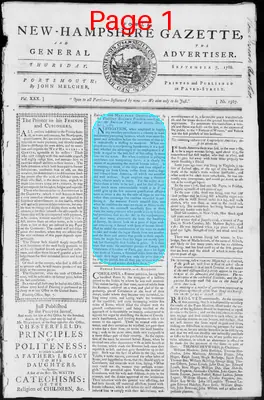
Editorial
September 7, 1786
Fowle's New Hampshire Gazette And General Advertiser
Portsmouth, Rockingham County, New Hampshire
What is this article about?
Extract from Benjamin Franklin's 'Maritime Observations' critiquing navigation's role in preventing famines but condemning its use for luxury trade, slave transport, and wars over sugar islands, highlighting moral costs like human misery and bloodshed, read to the American Philosophical Society on December 2, 1785.
Clipping
OCR Quality
95%
Excellent
Full Text
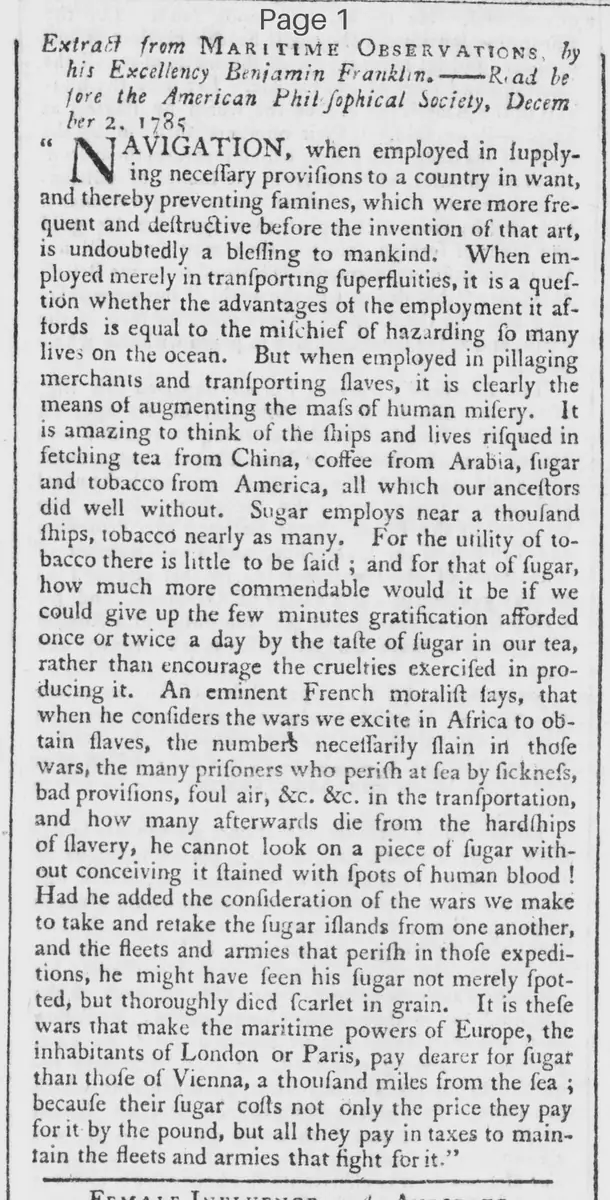
Extract from Maritime Observations, by
his Excellency Benjamin Franklin.--Read before the American Philosophical Society, December
2, 1785.
NAVIGATION, when employed in supplying
necessary provisions to a country in want,
and thereby preventing famines, which were more frequent
and destructive before the invention of that art,
is undoubtedly a blessing to mankind. When employed
merely in transporting superfluities, it is a question whether the advantages of the employment it affords
is equal to the mischief of hazarding so many
lives on the ocean. But when employed in pillaging
merchants and transporting slaves, it is clearly the
means of augmenting the mass of human misery. It
is amazing to think of the ships and lives risked in
fetching tea from China, coffee from Arabia, sugar
and tobacco from America, all which our ancestors
did well without. Sugar employs near a thousand
ships, tobacco nearly as many. "For the utility of tobacco
there is little to be said: and for that of sugar,
how much more commendable would it be if we
could give up the few minutes gratification afforded
once or twice a day by the taste of sugar in our tea,
rather than encourage the cruelties exercised in producing
it. An eminent French moralist says, that
when he considers the wars we excite in Africa to obtain
slaves, the numbers necessarily slain in those
wars, the many prisoners who perish at sea by sickness,
bad provisions, foul air, &c. &c. in the transportation,
and how many afterwards die from the hardships
of slavery, he cannot look on a piece of sugar without
conceiving it stained with spots of human blood!
Had he added the consideration of the wars we make
to take and retake the sugar islands from one another,
and the fleets and armies that perish in those expeditions,
he might have seen his sugar not merely spotted,
but thoroughly dyed scarlet in grain. It is these
wars that make the maritime powers of Europe, the
inhabitants of London or Paris, pay dearer for sugar
than those of Vienna, a thousand miles from the sea;
because their sugar costs not only the price they pay
for it by the pound, but all they pay in taxes to maintain
the fleets and armies that fight for it."
his Excellency Benjamin Franklin.--Read before the American Philosophical Society, December
2, 1785.
NAVIGATION, when employed in supplying
necessary provisions to a country in want,
and thereby preventing famines, which were more frequent
and destructive before the invention of that art,
is undoubtedly a blessing to mankind. When employed
merely in transporting superfluities, it is a question whether the advantages of the employment it affords
is equal to the mischief of hazarding so many
lives on the ocean. But when employed in pillaging
merchants and transporting slaves, it is clearly the
means of augmenting the mass of human misery. It
is amazing to think of the ships and lives risked in
fetching tea from China, coffee from Arabia, sugar
and tobacco from America, all which our ancestors
did well without. Sugar employs near a thousand
ships, tobacco nearly as many. "For the utility of tobacco
there is little to be said: and for that of sugar,
how much more commendable would it be if we
could give up the few minutes gratification afforded
once or twice a day by the taste of sugar in our tea,
rather than encourage the cruelties exercised in producing
it. An eminent French moralist says, that
when he considers the wars we excite in Africa to obtain
slaves, the numbers necessarily slain in those
wars, the many prisoners who perish at sea by sickness,
bad provisions, foul air, &c. &c. in the transportation,
and how many afterwards die from the hardships
of slavery, he cannot look on a piece of sugar without
conceiving it stained with spots of human blood!
Had he added the consideration of the wars we make
to take and retake the sugar islands from one another,
and the fleets and armies that perish in those expeditions,
he might have seen his sugar not merely spotted,
but thoroughly dyed scarlet in grain. It is these
wars that make the maritime powers of Europe, the
inhabitants of London or Paris, pay dearer for sugar
than those of Vienna, a thousand miles from the sea;
because their sugar costs not only the price they pay
for it by the pound, but all they pay in taxes to maintain
the fleets and armies that fight for it."
What sub-type of article is it?
Moral Or Religious
Slavery Abolition
Trade Or Commerce
What keywords are associated?
Maritime Navigation
Slave Trade
Sugar Production
Tobacco Trade
Human Misery
Moral Critique
Luxury Imports
Wars For Colonies
What entities or persons were involved?
Benjamin Franklin
American Philosophical Society
Eminent French Moralist
Editorial Details
Primary Topic
Critique Of Maritime Trade In Luxuries And Slaves
Stance / Tone
Moral Condemnation Of Slave Trade And Luxury Imports
Key Figures
Benjamin Franklin
American Philosophical Society
Eminent French Moralist
Key Arguments
Navigation Supplies Provisions To Prevent Famines, A Blessing To Mankind
Transporting Superfluities Hazards Lives Unnecessarily
Pillaging Merchants And Transporting Slaves Augments Human Misery
Ships And Lives Risked For Tea, Coffee, Sugar, Tobacco, Which Ancestors Did Without
Sugar And Tobacco Employ Thousands Of Ships With Little Utility
Sugar Gratification Encourages Cruelties In Production
Wars In Africa For Slaves Cause Deaths And Misery
Sugar Stained With Human Blood From Slave Trade And Wars
Wars Over Sugar Islands Dye Sugar Scarlet With Blood
Maritime Powers Pay More For Sugar Due To Taxes For Fleets And Armies