Thank you for visiting SNEWPapers!
Sign up free
Literary
October 14, 1905
The Caldwell Tribune
Caldwell, Canyon County, Idaho
What is this article about?
In Sir Walter Besant's 'His Heart's Desire,' David Leighan returns to his Devon family after years abroad, confronting his uncle over seized land. Facing rejection, David plots revenge amid family tensions, loss of social graces, and ghostly visions that drew him home. Relatives discuss impending inheritance shifts and rural struggles.
Clipping
OCR Quality
95%
Excellent
Full Text
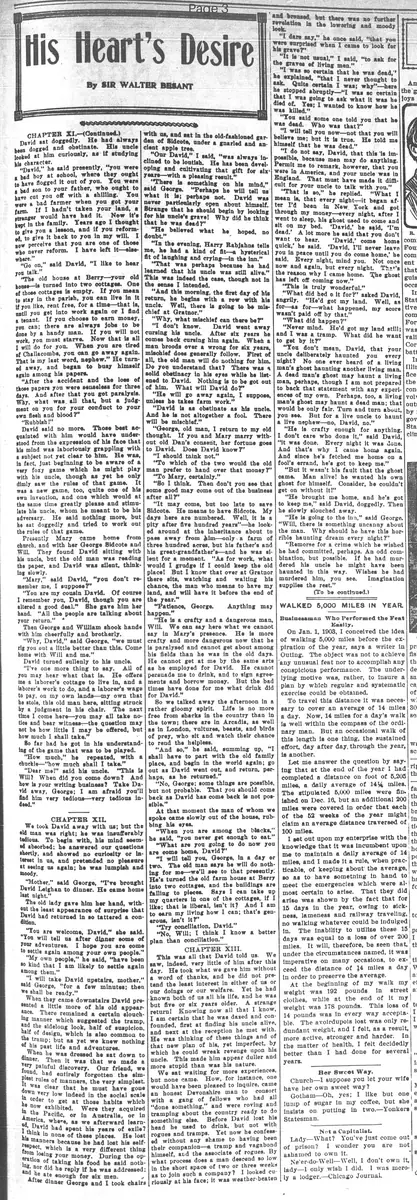
His Heart's Desire
By SIR WALTER BESANT
CHAPTER II.—(Continued)
David sat doggedly. He had always been dogged and obstinate. His uncle looked at him curiously, as if studying his character.
"David," he said presently, "you were a bad boy at school, where they ought to have flogged it out of you. You were a bad son to your father, who ought to have cut you off with a shilling. You were a bad farmer when you got your farm. If I hadn't taken your land, a stranger would have had it. Now it's kept in the family. Years ago I thought to give you a lesson, and if you reformed, to give it back to you in my will. I now perceive that you are one of those who never reform. I have left it elsewhere."
"Go on," said David, "I like to hear you talk."
"The old house at Berry—your old house—is turned into two cottages. One of those cottages is empty. If you mean to stay in the parish, you can live in it if you like, rent free, for a time—that is, until you get into work again or I find a tenant. If you choose to earn money, you can; there are always jobs to be done by a handy man. If you will not work, you must starve. Now that is all I will do for you. When you are tired of Challacombe, you can go away again. That is my last word, nephew." He turned away, and began to busy himself again among his papers.
"After the accident and the loss of those papers you were senseless for three days. And after that you got paralysis. Why, what was all that, but a judgment on you for your conduct to your own flesh and blood?"
"Rubbish!"
David said no more. Those best acquainted with him would have understood from the expression of his face that his mind was laboriously grappling with a subject not yet clear to him. He was, in fact, just beginning to be aware of a very foxy game which he might play with his uncle, though as yet he only dimly saw the rules of that game. It was a new game, too, quite one of his own invention, and one which would at the same time greatly please and stimulate his uncle, whom he meant to be his adversary. He said nothing more, but he sat doggedly and tried to work out the rules of that game.
Presently Mary came home from church, and with her George Bidcote and Will. They found David sitting with his uncle, but the old man was reading the paper, and David was silent, thinking slowly.
"Mary," said David, "you don't remember me, I suppose?"
"You are my cousin David. Of course I remember you, David, though you are altered a good deal." She gave him her hand. "All the people are talking about your return."
Then George and William shook hands with him cheerfully and brotherly.
"Why, David," said George, "we must rig you out a little better than this. Come home with Will and me."
David turned sullenly to his uncle.
"I've one more thing to say. All of you may hear what that is. He offers me a laborer's cottage to live in, and a laborer's work to do, and a laborer's wage to pay, on my own lands—my own that he stole. This old man here, sitting struck by a judgment in his chair. The next time I come here—you may all take notice and bear witness—the question may not be how little I may be offered, but how much I shall take."
So far had he got in his understanding of the game that was to be played.
"How much," he repeated, with a chuckle—"how much shall I take."
"Dear me!" said his uncle. "This is Will? When did you come down? And how is your writing business? Take David away, George: I am afraid you'll find him very tedious—very tedious indeed."
CHAPTER XII.
We took David away with us; but the old man was right; he was insufferably tedious. To begin with, his mind seemed absorbed; he answered our questions shortly, and showed no curiosity or interest in us, and pretended no pleasure at seeing us again; he was lumpish and moody.
"Mother," said George, "I've brought David Leighan to dinner. He came home last night."
The old lady gave him her hand, without the least appearance of surprise that David had returned in so tattered a condition.
"You are welcome, David," she said. "You will tell us after dinner some of your adventures. I hope you are come to settle again among your own people."
"My own people," he said, "have been so kind that I am likely to settle again among them."
"I will take David upstairs, mother," said George, "for a few minutes; then we shall be ready."
When they came downstairs David presented a little more of his old appearance. There remained a certain slouching manner which suggested the tramp, and the sidelong look, half of suspicion, half of design, which is also common to the tramp; but as yet we knew nothing of his past life and adventures.
When he was dressed he sat down to dinner. Then it was that we made a very painful discovery. Our friend, we found, had entirely forgotten the simplest rules of manners, the very simplest.
It was clear that he must have gone down very low indeed in the social scale in order to get at those habits which he now exhibited. Were they acquired in the Pacific, or in America, where, as we afterward learned, David had spent his years of wandering, or in Australia, or in none of these places? He lost his manners because he had lost his self-respect, which is a very different thing from losing your money.
During the operation of taking his food he said nothing, nor did he reply if he was addressed; and he ate enough for six men.
After dinner George and I took chairs with us, and sat in the old-fashioned garden of Sidcote, under a gnarled and ancient apple tree.
"Our David," I said, "was always inclined to be loutish. He has been developing and cultivating that gift for six years—with a pleasing result."
"There is something on his mind," said George. "Perhaps he will tell us what it is; perhaps not. David was never particularly open about himself. Strange that he should begin by looking for his uncle's grave! Why did he think that he was dead?"
"He believed what he hoped, no doubt."
"In the evening, Harry Rabjohns tells me, he had a kind of fit hysterical fit of laughing and crying—in the inn."
"That was perhaps because he had learned that his uncle was still alive."
This was indeed the case, though not in the sense I intended.
"And this morning, the first day of his return, he begins with a row with his uncle. Well, there is going to be mischief at Gratnor."
"Why, what mischief can there be?"
"I don't know, David went away cursing his uncle. After six years he comes back cursing him again. When a man broods over a wrong for six years, mischief does generally follow. First of all, the old man will do nothing for him. Do you understand that? There was a solid obstinacy in his eyes while he listened to David. Nothing is to be got out of him. What will David do?"
"He will go away again, I suppose, unless he takes farm work."
"David is as obstinate as his uncle. And he is not altogether a fool. There will be mischief."
"George, old man, I return to my old thought. If you and Mary marry without old Dan's consent, her fortune goes to David. Does David know that?"
"I should think not."
"To which of the two would the old man prefer to hand over that money?"
"To Mary, certainly."
"So I think. Then don't you see that some good may come out of the business after all?"
"It may come, but too late to save Sidcote. He means to have Sidcote. My days here are numbered. Well, it is a pity after five hundred years"—he looked around at the inheritance about to pass away from him—only a farm of three hundred acres, but his father's and his great-grandfather's—and he was silent for a moment. "As for work, what would I grudge if I could keep the old place? But I know that over at Gratnor there sits, watching and waiting his chance, the man who means to have my land, and will have it before the end of the year."
"Patience, George. Anything may happen."
"He is a crafty and a dangerous man, Will. We can say here what we cannot say in Mary's presence. He is more crafty and more dangerous now that he is paralyzed and cannot get about among his fields than he was in the old days. He cannot get at me by the same arts as he employed for David. He cannot persuade me to drink, and to sign agreements and borrow money. But the bad times have done for me what drink did for David."
So we talked away the afternoon in a rather gloomy spirit. Life is no more free from sharks in the country than in the town; there are in Arcadia, as well as in London, vultures, beasts, and birds of prey, who sit and watch their chance to rend the helpless.
"And so," he said, summing up, "I shall have to part with the old family place, and begin in the world again; go out as David went out, and return, perhaps, as he returned."
"No, George; some things are possible, but not probable. That you should come back as David has come back is not possible."
At that moment the man of whom we spoke came slowly out of the house, rubbing his eyes.
"When you are among the blacks," he said, "you never get enough to eat."
"What are you going to do now you are come home, David?"
"I will tell you, George, in a day or two. The old man says he will do nothing for me—we'll see to that presently: He's turned the old farm house at Berry into two cottages, and the buildings are falling to pieces. Says I can take up my quarters in one of the cottages, if I like: that is liberal, isn't it? And I am to earn my living how I can; that's generous, isn't it?"
"Try conciliation, David."
"No, Will; I think I know a better plan than conciliation."
CHAPTER XIII.
This was all that David told us. We saw, indeed, very little of him after this day. He took what we gave him without a word of thanks, and he did not pretend the least interest in either of us or our doings or our welfare. Yet he had known both of us all his life, and he was but five or six years older. A strange return! Knowing now all that I know, I am certain that he was dazed and confounded, first at finding his uncle alive, and next at the reception he met with. He was thinking of these things and of that new plan of his, yet imperfect, by which he could wreak revenge upon his uncle. This made him appear duller and more stupid than was his nature.
We sat waiting for more experiences, but none came. How, for instance, one would have been pleased to inquire, came an honest Devonshire man to consort with a gang of fellows who had all "done something," and were roving and tramping about the country ready to do something else. Before David lost his head he used to drink, but not with rogues and tramps. Yet now he confessed without any shame to having been their companion—a tramp and vagabond himself, and the associate of rogues. By what process does a man descend so low in the short space of two or three weeks? I looked curiously at his face; it was weather-beaten and bronzed, but there was no further revelation in the lowering and moody look.
"I dare say," he once said, "that you were surprised when I came to look for his grave?"
"It is not usual," I said, "to ask for the graves of living men."
"I was so certain that he was dead," he explained, "that I never thought to ask. Quite certain I was; why"—here he stopped abruptly—I was so certain that I was going to ask what it was he died of. Yes; I wanted to know how he was killed."
"You said some one told you that he was dead. Who was that?"
"I will tell you now—not that you will believe me; but it is true. He told me himself that he was dead."
"I do not say, David, that this is impossible, because men may do anything. Permit me to remark, however, that you were in America, and your uncle was in England. That must have made it difficult for your uncle to talk with you."
"That is so," he replied. "What I mean is, that every night—it began after I'd been in New York and got through my money—every night, after I went to sleep, his ghost used to come and sit on my bed. 'David,' he said, 'I'm dead.' A lot more he said that you don't want to hear. 'David, come home quick,' he said. 'David, I'll never leave you in peace until you do come home,' he said. Every night, mind you. Not once now and again, but every night. That's the reason why I came home. The ghost has left off coming now."
"This is truly wonderful."
"What did he do it for?" asked David, angrily. "He'd got my land. Well, as for—as for what happened, my score wasn't paid off by that."
"Never mind. He'd got my land still; and I was a tramp. What did he want to get by it?"
"You don't mean, David, that your uncle deliberately haunted you every night? No one ever heard of a living man's ghost haunting another living man. A dead man's ghost may haunt a living man, perhaps, though I am not prepared to back that statement with any experiences of my own. Perhaps, too, a living man's ghost may haunt a dead man; that would be only fair. Turn and turn about, you see. But for a live uncle to haunt a live nephew—no, David, no."
"He is crafty enough for anything. I don't care who done it," said David, "it was done. Every night it was done. And that's why I came home again. And since he's fetched me home on a fool's errand, he's got to keep me."
"But it wasn't his fault that the ghost came. Man alive! he wanted his own ghost for himself. Consider, he couldn't get on without it!"
"He brought me home, and he's got to keep me," said David, doggedly. Then he slowly slouched away.
"He is going to the inn," said George. "Will, there is something uncanny about the man. Why should he have this horrible haunting dream every night?"
"Remorse for a crime which he wished he had committed, perhaps. An odd combination, but possible. If he had murdered his uncle he might have been haunted in this way. Wishes he had murdered him, you see. Imagination supplies the rest."
(To be continued.)
By SIR WALTER BESANT
CHAPTER II.—(Continued)
David sat doggedly. He had always been dogged and obstinate. His uncle looked at him curiously, as if studying his character.
"David," he said presently, "you were a bad boy at school, where they ought to have flogged it out of you. You were a bad son to your father, who ought to have cut you off with a shilling. You were a bad farmer when you got your farm. If I hadn't taken your land, a stranger would have had it. Now it's kept in the family. Years ago I thought to give you a lesson, and if you reformed, to give it back to you in my will. I now perceive that you are one of those who never reform. I have left it elsewhere."
"Go on," said David, "I like to hear you talk."
"The old house at Berry—your old house—is turned into two cottages. One of those cottages is empty. If you mean to stay in the parish, you can live in it if you like, rent free, for a time—that is, until you get into work again or I find a tenant. If you choose to earn money, you can; there are always jobs to be done by a handy man. If you will not work, you must starve. Now that is all I will do for you. When you are tired of Challacombe, you can go away again. That is my last word, nephew." He turned away, and began to busy himself again among his papers.
"After the accident and the loss of those papers you were senseless for three days. And after that you got paralysis. Why, what was all that, but a judgment on you for your conduct to your own flesh and blood?"
"Rubbish!"
David said no more. Those best acquainted with him would have understood from the expression of his face that his mind was laboriously grappling with a subject not yet clear to him. He was, in fact, just beginning to be aware of a very foxy game which he might play with his uncle, though as yet he only dimly saw the rules of that game. It was a new game, too, quite one of his own invention, and one which would at the same time greatly please and stimulate his uncle, whom he meant to be his adversary. He said nothing more, but he sat doggedly and tried to work out the rules of that game.
Presently Mary came home from church, and with her George Bidcote and Will. They found David sitting with his uncle, but the old man was reading the paper, and David was silent, thinking slowly.
"Mary," said David, "you don't remember me, I suppose?"
"You are my cousin David. Of course I remember you, David, though you are altered a good deal." She gave him her hand. "All the people are talking about your return."
Then George and William shook hands with him cheerfully and brotherly.
"Why, David," said George, "we must rig you out a little better than this. Come home with Will and me."
David turned sullenly to his uncle.
"I've one more thing to say. All of you may hear what that is. He offers me a laborer's cottage to live in, and a laborer's work to do, and a laborer's wage to pay, on my own lands—my own that he stole. This old man here, sitting struck by a judgment in his chair. The next time I come here—you may all take notice and bear witness—the question may not be how little I may be offered, but how much I shall take."
So far had he got in his understanding of the game that was to be played.
"How much," he repeated, with a chuckle—"how much shall I take."
"Dear me!" said his uncle. "This is Will? When did you come down? And how is your writing business? Take David away, George: I am afraid you'll find him very tedious—very tedious indeed."
CHAPTER XII.
We took David away with us; but the old man was right; he was insufferably tedious. To begin with, his mind seemed absorbed; he answered our questions shortly, and showed no curiosity or interest in us, and pretended no pleasure at seeing us again; he was lumpish and moody.
"Mother," said George, "I've brought David Leighan to dinner. He came home last night."
The old lady gave him her hand, without the least appearance of surprise that David had returned in so tattered a condition.
"You are welcome, David," she said. "You will tell us after dinner some of your adventures. I hope you are come to settle again among your own people."
"My own people," he said, "have been so kind that I am likely to settle again among them."
"I will take David upstairs, mother," said George, "for a few minutes; then we shall be ready."
When they came downstairs David presented a little more of his old appearance. There remained a certain slouching manner which suggested the tramp, and the sidelong look, half of suspicion, half of design, which is also common to the tramp; but as yet we knew nothing of his past life and adventures.
When he was dressed he sat down to dinner. Then it was that we made a very painful discovery. Our friend, we found, had entirely forgotten the simplest rules of manners, the very simplest.
It was clear that he must have gone down very low indeed in the social scale in order to get at those habits which he now exhibited. Were they acquired in the Pacific, or in America, where, as we afterward learned, David had spent his years of wandering, or in Australia, or in none of these places? He lost his manners because he had lost his self-respect, which is a very different thing from losing your money.
During the operation of taking his food he said nothing, nor did he reply if he was addressed; and he ate enough for six men.
After dinner George and I took chairs with us, and sat in the old-fashioned garden of Sidcote, under a gnarled and ancient apple tree.
"Our David," I said, "was always inclined to be loutish. He has been developing and cultivating that gift for six years—with a pleasing result."
"There is something on his mind," said George. "Perhaps he will tell us what it is; perhaps not. David was never particularly open about himself. Strange that he should begin by looking for his uncle's grave! Why did he think that he was dead?"
"He believed what he hoped, no doubt."
"In the evening, Harry Rabjohns tells me, he had a kind of fit hysterical fit of laughing and crying—in the inn."
"That was perhaps because he had learned that his uncle was still alive."
This was indeed the case, though not in the sense I intended.
"And this morning, the first day of his return, he begins with a row with his uncle. Well, there is going to be mischief at Gratnor."
"Why, what mischief can there be?"
"I don't know, David went away cursing his uncle. After six years he comes back cursing him again. When a man broods over a wrong for six years, mischief does generally follow. First of all, the old man will do nothing for him. Do you understand that? There was a solid obstinacy in his eyes while he listened to David. Nothing is to be got out of him. What will David do?"
"He will go away again, I suppose, unless he takes farm work."
"David is as obstinate as his uncle. And he is not altogether a fool. There will be mischief."
"George, old man, I return to my old thought. If you and Mary marry without old Dan's consent, her fortune goes to David. Does David know that?"
"I should think not."
"To which of the two would the old man prefer to hand over that money?"
"To Mary, certainly."
"So I think. Then don't you see that some good may come out of the business after all?"
"It may come, but too late to save Sidcote. He means to have Sidcote. My days here are numbered. Well, it is a pity after five hundred years"—he looked around at the inheritance about to pass away from him—only a farm of three hundred acres, but his father's and his great-grandfather's—and he was silent for a moment. "As for work, what would I grudge if I could keep the old place? But I know that over at Gratnor there sits, watching and waiting his chance, the man who means to have my land, and will have it before the end of the year."
"Patience, George. Anything may happen."
"He is a crafty and a dangerous man, Will. We can say here what we cannot say in Mary's presence. He is more crafty and more dangerous now that he is paralyzed and cannot get about among his fields than he was in the old days. He cannot get at me by the same arts as he employed for David. He cannot persuade me to drink, and to sign agreements and borrow money. But the bad times have done for me what drink did for David."
So we talked away the afternoon in a rather gloomy spirit. Life is no more free from sharks in the country than in the town; there are in Arcadia, as well as in London, vultures, beasts, and birds of prey, who sit and watch their chance to rend the helpless.
"And so," he said, summing up, "I shall have to part with the old family place, and begin in the world again; go out as David went out, and return, perhaps, as he returned."
"No, George; some things are possible, but not probable. That you should come back as David has come back is not possible."
At that moment the man of whom we spoke came slowly out of the house, rubbing his eyes.
"When you are among the blacks," he said, "you never get enough to eat."
"What are you going to do now you are come home, David?"
"I will tell you, George, in a day or two. The old man says he will do nothing for me—we'll see to that presently: He's turned the old farm house at Berry into two cottages, and the buildings are falling to pieces. Says I can take up my quarters in one of the cottages, if I like: that is liberal, isn't it? And I am to earn my living how I can; that's generous, isn't it?"
"Try conciliation, David."
"No, Will; I think I know a better plan than conciliation."
CHAPTER XIII.
This was all that David told us. We saw, indeed, very little of him after this day. He took what we gave him without a word of thanks, and he did not pretend the least interest in either of us or our doings or our welfare. Yet he had known both of us all his life, and he was but five or six years older. A strange return! Knowing now all that I know, I am certain that he was dazed and confounded, first at finding his uncle alive, and next at the reception he met with. He was thinking of these things and of that new plan of his, yet imperfect, by which he could wreak revenge upon his uncle. This made him appear duller and more stupid than was his nature.
We sat waiting for more experiences, but none came. How, for instance, one would have been pleased to inquire, came an honest Devonshire man to consort with a gang of fellows who had all "done something," and were roving and tramping about the country ready to do something else. Before David lost his head he used to drink, but not with rogues and tramps. Yet now he confessed without any shame to having been their companion—a tramp and vagabond himself, and the associate of rogues. By what process does a man descend so low in the short space of two or three weeks? I looked curiously at his face; it was weather-beaten and bronzed, but there was no further revelation in the lowering and moody look.
"I dare say," he once said, "that you were surprised when I came to look for his grave?"
"It is not usual," I said, "to ask for the graves of living men."
"I was so certain that he was dead," he explained, "that I never thought to ask. Quite certain I was; why"—here he stopped abruptly—I was so certain that I was going to ask what it was he died of. Yes; I wanted to know how he was killed."
"You said some one told you that he was dead. Who was that?"
"I will tell you now—not that you will believe me; but it is true. He told me himself that he was dead."
"I do not say, David, that this is impossible, because men may do anything. Permit me to remark, however, that you were in America, and your uncle was in England. That must have made it difficult for your uncle to talk with you."
"That is so," he replied. "What I mean is, that every night—it began after I'd been in New York and got through my money—every night, after I went to sleep, his ghost used to come and sit on my bed. 'David,' he said, 'I'm dead.' A lot more he said that you don't want to hear. 'David, come home quick,' he said. 'David, I'll never leave you in peace until you do come home,' he said. Every night, mind you. Not once now and again, but every night. That's the reason why I came home. The ghost has left off coming now."
"This is truly wonderful."
"What did he do it for?" asked David, angrily. "He'd got my land. Well, as for—as for what happened, my score wasn't paid off by that."
"Never mind. He'd got my land still; and I was a tramp. What did he want to get by it?"
"You don't mean, David, that your uncle deliberately haunted you every night? No one ever heard of a living man's ghost haunting another living man. A dead man's ghost may haunt a living man, perhaps, though I am not prepared to back that statement with any experiences of my own. Perhaps, too, a living man's ghost may haunt a dead man; that would be only fair. Turn and turn about, you see. But for a live uncle to haunt a live nephew—no, David, no."
"He is crafty enough for anything. I don't care who done it," said David, "it was done. Every night it was done. And that's why I came home again. And since he's fetched me home on a fool's errand, he's got to keep me."
"But it wasn't his fault that the ghost came. Man alive! he wanted his own ghost for himself. Consider, he couldn't get on without it!"
"He brought me home, and he's got to keep me," said David, doggedly. Then he slowly slouched away.
"He is going to the inn," said George. "Will, there is something uncanny about the man. Why should he have this horrible haunting dream every night?"
"Remorse for a crime which he wished he had committed, perhaps. An odd combination, but possible. If he had murdered his uncle he might have been haunted in this way. Wishes he had murdered him, you see. Imagination supplies the rest."
(To be continued.)
What sub-type of article is it?
Prose Fiction
What themes does it cover?
Agriculture Rural
Social Manners
Moral Virtue
What keywords are associated?
Family Conflict
Inheritance Dispute
Rural Devon
Uncle Nephew
Revenge Scheme
Lost Manners
Haunting Dream
What entities or persons were involved?
By Sir Walter Besant
Literary Details
Title
His Heart's Desire
Author
By Sir Walter Besant
Key Lines
"David," He Said Presently, "You Were A Bad Boy At School, Where They Ought To Have Flogged It Out Of You. You Were A Bad Son To Your Father, Who Ought To Have Cut You Off With A Shilling. You Were A Bad Farmer When You Got Your Farm. If I Hadn't Taken Your Land, A Stranger Would Have Had It. Now It's Kept In The Family."
"The Next Time I Come Here—You May All Take Notice And Bear Witness—The Question May Not Be How Little I May Be Offered, But How Much I Shall Take."
"He Believed What He Hoped, No Doubt."
"I Was So Certain That I Was Going To Ask What It Was He Died Of. Yes; I Wanted To Know How He Was Killed."
"He Brought Me Home, And He's Got To Keep Me," Said David, Doggedly.