Thank you for visiting SNEWPapers!
Sign up free
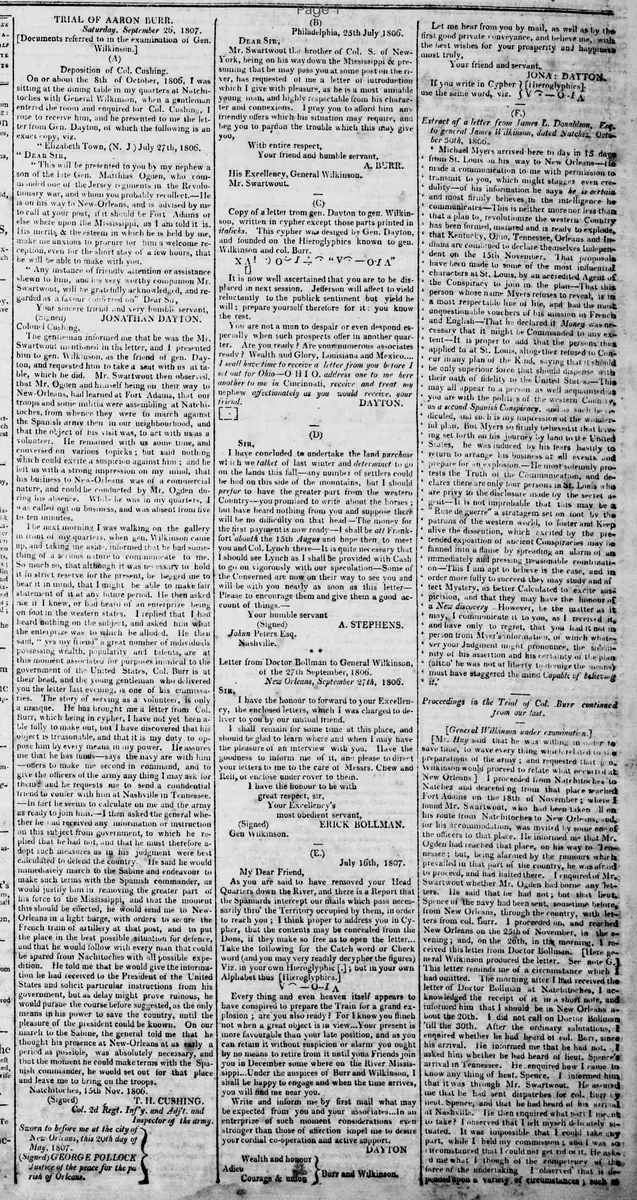
Norfolk Gazette And Publick Ledger
Norfolk, Virginia
What is this article about?
Trial proceedings of Aaron Burr on September 26, 1807, featuring Col. Cushing's deposition on Swartwout's visit and Wilkinson's discovery of Burr's treasonous scheme. Includes ciphered letters from Dayton and others revealing plans for western independence and Mexico invasion; Wilkinson details defensive actions.
Merged-components note: Merged continuation of the Aaron Burr trial story across multiple components and pages into a single logical unit.
Clippings
1 of 2
OCR Quality
Full Text
Saturday, September 26, 1807.
[Documents referred to in the examination of Gen. Wilkinson.]
(A)
Deposition of Col. Cushing.
On or about the 5th of October, 1806, I was sitting at the dining table in my quarters at Natchitoches with General Wilkinson, when a gentleman entered the room and enquired for Col. Cushing. I rose to receive him, and he presented to me the letter from Gen. Dayton, of which the following is an exact copy, viz.
"Elizabeth Town, (N. J.) July 27th, 1806.
"Dear SIR,
"This will be presented to you by my nephew a son of the late Gen. Matthias Ogden, who commanded one of the Jersey regiments in the Revolutionary war, and whom you probably recollect.--He is on his way to New-Orleans, and is advised by me to call at your post, if it should be Fort Adams or elsewhere upon the Mississippi, as I am told it is.
His merits & the esteem in which he is held by me, make me anxious to procure for him a welcome reception, even for the short stay of a few hours, that he will be able to make with you.
"Any instance of friendly attention or assistance shewn to him, and his very worthy companion Mr. Swartwout, will be gratefully acknowledged, and regarded as a favour conferred on "Dear Sir,
Your sincere friend and very humble servant,
(Signed)
JONATHAN DAYTON.
Col. Cushing.
The gentleman informed me that he was the Mr. Swartwout mentioned in the letter, and I presented him to gen. Wilkinson, as the friend of gen. Dayton, and requested him to take a seat with us at table, which he did. Mr. Swartwout then observed, that Mr. Ogden and himself being on their way to New-Orleans, had learned at Fort Adams, that our troops and some militia were assembling at Natchitoches, from whence they were to march against the Spanish army then in our neighbourhood, and that the object of his visit was, to act with us as a volunteer. He remained with us some time, and conversed on various topics; but said nothing which could excite a suspicion against him; and he left us with a strong impression on my mind, that his business to New-Orleans was of a commercial nature, and could be conducted by Mr. Ogden during his absence. While he was in my quarters, I was called out on business, and was absent from five to ten minutes.
The next morning I was walking on the gallery in front of my quarters, when gen. Wilkinson came up, and taking me aside, informed that he had something of a serious nature to communicate to me. So much so, that although it was necessary to hold it in strict reserve for the present, he begged me to bear it in mind, that I might be able to make fair statement of it at any future period. He then asked me if I knew, or had heard of an enterprize being on foot in the western states. I replied that I had heard nothing on the subject, and asked him what the enterprize was to which he alluded. He then said, "yes my friend" a great number of individuals possessing wealth, popularity and talents, are at this moment associated for purposes inimical to the government of the United States, Col. Burr is at their head, and the young gentleman who delivered you the letter last evening, is one of his emissaries.
The story of serving as a volunteer, is only a masque. He has brought me a letter from Col. Burr, which being in cypher, I have not yet been able to fully to make out, but I have discovered that his object is treasonable, and that it is my duty to oppose him by every means in my power. He assures me that he has funds--says the navy are with him --offers to make me second in command, and to give the officers of the army any thing I may ask for them: and he requests me to send a confidential friend to confer with him at Nashville in Tennessee.
--in fact he seems to calculate on me and the army as ready to join him.-I then asked the general whether he had received any information or instruction on this subject from government, to which he replied that he had not, and that he must therefore adopt such measures as in his judgment were best calculated to defend the country. He said he would immediately march to the Sabine and endeavour to make such terms with the Spanish commander, as would justify him in removing the greater part of his force to the Mississippi, and that the moment this should be effected, he would send me to New-Orleans in a light barge, with orders to secure the French train of artillery at that post, and to put the place in the best possible situation for defence.
and that he would follow with every man that could be spared from Natchitoches with all possible expedition. He told me that he would give the information he had received to the President of the United States and solicit particular instructions from his government, but as delay might prove ruinous, he would pursue the course before suggested, as the only means in his power to save the country, until the pleasure of the president could be known. On our march to the Sabine, the general told me that he thought his presence at New-Orleans at as early a period as possible, was absolutely necessary, and that the moment he could make terms with the Spanish commander, he would set out for that place and leave me to bring on the troops.
Natchitoches, 15th Nov. 1806.
(Signed)
T. H. CUSHING.
Col. 2d Regt. Infy. and Adj't. and Inspector of the army
Sworn to before me at the city of New-Orleans, this 20th day of May, 1807.
(Signed) GEORGE POLLOCK
Justice of the peace for the parish of Orleans.
(B)
Philadelphia, 25th July 1806.
Dear Sir,
Mr. Swartwout the brother of Col. S. of New-York, being on his way down the Mississippi & presuming that he may pass you at some post on the river, has requested of me a letter of introduction which I give with pleasure, as he is a most amiable young man, and highly respectable from his character and connexions. I pray you to afford him any friendly offers which his situation may require, and beg you to pardon the trouble which this may give you,
With entire respect,
Your friend and humble servant,
BURR.
His Excellency, General Wilkinson.
Mr. Swartwout.
(C)
Copy of a letter from gen. Dayton to gen. Wilkinson, written in cypher except those parts printed in italics. This cypher was designed by Gen. Dayton, and founded on the Hieroglyphics known to gen. Wilkinson and col. Burr.
XA! )OI:
"V-O-I A"
0]
It is now well ascertained that you are to be displaced in next session. Jefferson will affect to yield reluctantly to the publick sentiment but yield he will; prepare yourself therefore for it: you know the rest.
You are not a man to despair or even despond especially when such prospects offer in another quarter. Are you ready ? Are your numerous associates ready ? Wealth and Glory. Louisiana and Mexico...
I shall have time to receive a letter from you before I set out for Ohio-O H I O. address one to me here another to me in Cincinnati, receive and treat my nephew affectionately as you would receive, your friend.
DAYTON.
[2]
(D)
SIR,
I have concluded to undertake the land purchase which we talked of last winter and determined to go on the lands this fall--any number of settlers could be had on this side of the mountains, but I should prefer to have the greater part from the western Country--you promised to write about the horses ; but have heard nothing from you and suppose there will be no difficulty on that head-The money for the first payment is now ready--I shall be at Frankfort about the 15th August and hope then to meet you and Col. Lynch there--It is quite necessary that I should see Lynch as I shall be provided with Cash to go on vigorously with our speculation--Some of the Concerned are now on their way to see you and will be with you nearly as soon as this letter---
Please to encourage them and give them a good account of things.--
Your humble servant
(Signed)
A. STEPHENS.
John Peters Esq.
Nashville.
$M$
Letter from Doctor Bollman to General Wilkinson, of the 27th September, 1806.
New Orleans, September 27th, 1806.
SIR,
I have the honour to forward to your Excellency, the enclosed letters, which I was charged to deliver to you by our mutual friend.
I shall remain for some time at this place, and should be glad to learn where and when I may have the pleasure of an interview with you. Have the goodness to inform me of it, and please to direct your letters to me to the care of Messrs. Chew and Relf, or enclose under cover to them.
I have the honour to be with great respect, sir,
Your Excellency's most obedient servant,
(Signed)
ERICK BOLLMAN.
Gen Wilkinson.
(E.)
July 16th, 1807.
My Dear Friend,
As you are said to have removed your Head Quarters down the River, and there is a Report that the Spaniards intercept our mails which pass necessarily thro' the Territory occupied by them, in order to reach you ; I think proper to address you in Cypher, that the contents may be concealed from the Dons, if they make so free as to open the letter.
Take the following for the Catch word or Check word (and you may very readily decypher the figures) Viz. in your own Hieroglyphic [.]; but in your own Alphabet thus [Hieroglyphics.]
VO-O-IA
Every thing and even heaven itself appears to have conspired to prepare the Train for a grand explosion ; are you also ready? For I know you flinch not when a great object is in view...Your present is more favourable than your late position, and as you can retain it without suspicion or alarm you ought by no means to retire from it until your Friends join you in December some where on the River Mississippi...Under the auspices of Burr and Wilkinson, I shall be happy to engage and when the time arrives, you will find me near you.
F.I :
Write and inform me by first mail what may be expected from you and your associates...In an enterprize of such moment considerations even stronger than those of affection impel me to desire your cordial co-operation and active support.
DAYTON
Wealth and honour
Adieu
Courage & union
Burr and Wilkinson.
Let me hear from you by mail, as well as by the first good private conveyance, and believe me, with the best wishes for your prosperity and happiness most truly,
Your friend and servant,
JONA: DAYTON.
If you write in Cypher [hieroglyphics] use the same word, viz. SV - O-I A
(F.)
Extract of a letter from James L. Donaldson, Esq to general James Wilkinson, dated Natchez, October 30th, 1806.
: i
Michael Myers arrived here to day in 15 days from St. Louis on his way to New Orleans--He made a communication to me with permission to transmit to you, which might stagger even credulity-of his information he says he is certain and most firmly believes in the intelligence he communicates--This is neither more nor less than that a plan to revolutionise the western Country has been formed, matured and is ready to explode, that Kentucky, Ohio, Tennessee, Orleans and Indiana are combined to declare themselves Independent on the 15th November. That proposals have been made to some of the most influential characters at St. Louis, by an accredited Agent of the Conspiracy to join in the plan-'That this person whose name Myers refuses to reveal, is in a most respectable line of life, and had the most unquestionable vouchers of his mission in French and English--That he declared it Money was necessary that it might be Commanded to any extent--It is proper to add that the persons thus applied to at St. Louis, altogether refused to Concur in any plan of the Kind, saying that it should be only superiour force that should dispense with their oath of fidelity to the United States--This may all appear to a person as well acquainted as you are with the politics of the western Country as a second Spanish Conspiracy, and as such be ridiculed, and such is my impression of the wonderful plan. But Myers so firmly believes that by being set forth on his journey by land to the United States, he was induced by his fears hastily to return to arrange his business at all events. and prepare for an explosion.--He most solemnly protests the Truth of the Communication, and declares there are only four persons in St. Louis who are privy to the disclosure made by the secret agent--It is not improbable that this may be a "Ruse de guerre" a stratagem set on foot by the patrons of the western world, to Foster and Keep alive the dissention, which excited by the pretended exposition of ancient Conspiracies may be fanned into a flame by spreading an alarm of an immediately and pressing treasonable combination-This I am apt to believe is the case, and in order more fully to succeed they may study and affect Mystery, as better Calculated to excite suspicion, and that they may have the honour of a New discovery -However, be the matter as it may, I communicate it to you, as I received it and have only to regret, that you had it not in person from Myers information, or which whatever your Judgment might pronounce. the solemnity of his assertion and his certainty of the plan (altho' he was not at liberty to divulge the means) must have staggered the mind Capable of believing ' it.'
Proceedings in the Trial of Col. Burr continued from our last-
[General Wilkinson under examination.]
Mr. Hay said that he was willing in order to save time, to wave every thing which related to the preparations of the army ; and requested that gen Wilkinson would proceed to relate what occurred at New Orleans ] I proceeded from Natchitoches to Natchez and descending from that place reached Fort Adams on the 18th of November; where I found Mr. Swartwout, who had been taken on his route from Natchitoches to New Orleans, and for his accommodation, was invited by some one of the officers to that place. He informed me that Mr. Ogden had reached that place, on his way to- Tennessee; but, being alarmed by the rumours which prevailed in that part of the country, he was afraid to proceed, and had halted there. I enquired of Mr Swartwout whether Mr, Ogden had borne any letters. He said that he had not: but that lieut Spence of the navy had been sent, some time before from New Orleans, through the country, with letters from col. Burr. I proceeded on, and reached New Orleans on the 25th of November, in the evening; and, on the 20th, in the morning, I received this letter from Doctor Bollman. [Here general Wilkinson produced the letter. See note G.]
This letter reminds me of a circumstance which I had omitted. The morning after I had received the letter of Doctor Bollman at Natchitoches, I acknowledged the receipt of it in a short note, and informed him that I should be in New Orleans about the 20th. I did not call on Doctor Bollman 'till the 30th. After the ordinary salutations, I enquired whether he had heard of col. Burr, since his arrival. He informed me that he had not. I asked him whether he had heard of lieut. Spence's arrival in Tennessee. He enquired how I came to know any thing of lieut. Spence. I informed him that it was through Mr. Swartwout. He assured me that he had sent dispatches for col. Burr by lieut. Spence, and that he had heard of his arrival at Nashville. He then enquired what part I meant to take? I observed that I felt myself delicately situated. It was impossible that I could take any part, while I held my commission; and I was so circumstanced that I could not get rid of it. He asked me what I thought of the competency of the force of the undertaking I observed that it depended upon a variety of circumstances; such winds, weather, composition and appointment of troops, skill in conduct, the resistance of their opponents, and other causes on which the success of military operations depend. But I gave it as my opinion, that I thought the force insufficient. He said that Col. Burr had gone too far to retreat: that he had numerous and powerful friends in the United States, who stood pledged to support him with their fortunes: and that he must succeed. He then enquired of me my opinion as to the state of the magazines of provisions in New Orleans. I observed that, if Col. Burr descended with the force proposed, they would starve, unless he brought provisions along with him: for I had before ascertained precisely the quantity then on hand. He said that it was his opinion, also, that there would be a scarcity of provisions; that he had written to Col. Burr on the subject; and that he expected a supply from New York and Norfolk, where Col. Burr had many friends. He said that he had noticed in the publick prints the sailing of some vessels with flour; and supposed that they might be destined for that place. I did not see Doctor Bollman, afterwards, till the 5th of December, the day after the arrival of the mail: and I called on him to enquire the news. He said that he had seen a letter from Col. Burr, of the 30th of October, in which he stated that he should be at Natchez, on the 20th of December, with two thousand men; to be followed by four thousand more: and that he could have raised or levied twelve thousand men, as easily as six, if he had thought them necessary. I then informed Doctor Bollman, that, if Col. Burr came to New Orleans, I should oppose him. He replied, they must come there for provisions and equipment. He observed that Col. Burr had great confidence in me; but he did not know what had passed between us; and asked, if I could not make such a defence as would cover my reputation, and still permit him to come. I replied in the negative; and we then parted. Some few mornings afterwards, he called at my quarters: there was a gentleman in the room; and I took him in the piazza. He said, that he wanted my determination. I expressed my surprize; and told him that he knew my determination.
Mr. Hay. While you were thus extracting from Doctor Bollman the secrets of his party, were you taking any measures for the security of New Orleans? Ans. Yes. My orders and instructions will shew what measures I deemed it my duty to pursue. For these I am responsible to the president of the United States.
Mr. Martin. Are the cyphered letters filed? Ans. Yes. Q. Are the keys furnished? Ans. Here it is.
[Mr. Botts mentioned the situation of Mr. Tazewell who was summoned as a witness on the part of Col. Burr. He said that Mr. Tazewell had represented the situation of his family to be such as to require his immediate return home. Mr. Botts observed that, although he had introduced the request of Mr. Tazewell to be discharged, he should be compelled to oppose it.]
Mr. Tazewell stated that he had been unexpectedly summoned, he well knew, to answer interrogatories as to certain proceedings before the grand jury; that he had just been informed of an occurrence in his domestic affairs, which made it indispensably necessary for him to return immediately; that there were many gentlemen, in this place and the vicinity, of the grand jury, who were as competent to give evidence on the points to which he should be called upon to depose, as he possibly could be; and who would be subjected to no kind of inconvenience in attending. If he were to be examined at all, he requested that it might be immediately done; for the situation of his family was such that he should be compelled to return.
The Chief Justice said to Mr. Tazewell, that he knew full well that it was not in the power of the court to discharge him. Mr. Botts said it was impossible to examine Mr. Tazewell till Gen. Wilkinson had gone through his testimony. It was not possible to know the importance of his evidence till Gen. Wilkinson was cross-examined.
Mr. Hay observed that it was an unprecedented measure to introduce any member of the grand jury to prove what had passed in the jury room. Mr. Botts. We have not said for what purpose we mean to introduce him. Mr. Hay. I presume that I may be permitted to presume for what purpose.
Mr. Baker said that he meant to speak generally of the propriety and convenience of giving testimony as to what passed in the grand jury room. One good effect, at least, would result from it: that by introducing witnesses to prove what had passed there, it would prevent people from giving information to the grand jury, which they could not support elsewhere.
Mr. Botts called for the key to the cyphered letters of Col. Burr. Gen. Wilkinson handed him a small pocket dictionary, and a paper containing certain hieroglyphics. Mr. Botts. In the duplicate received by Dr. Bollman there is an erasure. Will you be so good as to explain the cause of it?
Gen. Wilkinson. That erasure was made by myself, and the words afterwards introduced by me. I have a deposition which will be more satisfactory than my own explanation. Mr. Botts. Whose deposition? Ans. Mr. Duncan's. [Mr. Wirt read the deposition of Mr. Duncan, for which see note H.] Mr. Botts: When was the erasure made? A. During the sitting of the Legislature in New Orleans. Q. When were the words restored? A. I cannot now state with certainty. Q. Was the letter exhibited to the Legislature? A. It was introduced; but I confined myself to oral communications. Q. What was the occasion of the erasure? A. To put it out of the power of a certain faction in the Legislature, to whom, at that time, I intended to submit the paper; to conceal it from that faction who were opposed to my measures, and who, I believe, were inimical to the true interests of their country, and were labouring to excite suspicions that I was connected with Col. Burr, in order to destroy the publick confidence in me, and thus to defeat my measures. At the head of this faction I considered John Watkins, esq. the Speaker. Having determined not to submit the letter, I restored the words. Q. Did you prepare any translation to submit to the legislature? A. No. I only made notes. Q. Did you make a translation for any other purpose? A. Only a partial and imperfect one. Q. For what purpose? A. To understand it. Q. Was there any other occasion on which a translation was made? A. No. Did you make any translation for the executive? A. No. Q. Were those words, "yours post-marked 13th of May is received," erased? A. Yes. Q. Where is the copy of your letter, covering a copy of that of Col. Burr, and your deposition to the president of the United States? A. It is among my papers. - Mr. Hay. Do I understand you correctly, when I suppose you say, that the translation intended for the legislature of New-Orleans, was sent to the president? A. No.
[Mr. Hay immediately observed that, on recollecting dates, he perceived that he had misunderstood Gen. Wilkinson: that the letter was sent to the President before the session of the legislature of New-Orleans.] Mr. Botts. Do I understand you to say that this was your translation of the letter which was intended for the legislature of New-Orleans? A. No. It was Mr. Duncan's. Mr. Botts. Have you ever sworn that this was a true translation? A. No. Only substantially so. [Gen. Wilkinson. May I be permitted to offer a few words of explanation? When Dr. Bollman was arrested, I will confess to you that I was so little acquainted with judicial proceedings, that I did not know it was necessary to do more than accompany him with a letter of advice. I was about to send him off in this way, when Mr. Duncan suggested to me the propriety of sending forward a deposition to justify his commitment. I put the letter into the hands of Mr. Duncan, with the key; and he made out the interpretation. When Mr. Duncan presented the translation to me, I stated my objections to the omissions. He urged me to sign the deposition. The time was urgent; the express waiting; and I confess that I feared a rescue. This did not give me much time to consult my understanding. If I had, it is probable that I should have resisted the signing of the deposition, with those omissions, notwithstanding my confidence in the judgment and integrity of my counsel. I was, also, at the time, oppressed by domestick afflictions: and my mind was hurried and agitated by the painful and interesting scenes which surrounded me.]
Mr. Botts. Were there variations between this original letter in cypher, and that sent on to the president? A. Yes. Mr. Botts. Were they noticed by you, or by Mr. Duncan in your presence? A. I suppose so: because I objected generally to the omissions. Mr. Botts. How was the cypher formed? A. It consisted of an American edition of Entick's dictionary, and of Hieroglyphics. Mr. Botts. Which was formed first? A. The Dictionary. Mr. Botts. When was that formed? [Here Gen. Wilkinson referred to a letter, without a signature, dated in 1806: and said he presumed it must have been formed about that time.] Mr. Botts. Do you know the time of the year? A. I presume it was October. Mr. Baker. To whom was that letter addressed? A. To myself. Q. By whom was it written? A. By Col. Burr. [Gen. Wilkinson observed that it was a private letter, to which he had referred merely to refresh his memory, the concluding paragraph of which is, "when I receive your cypher and your address, you shall hear from me." Mr. Wickham insisted upon seeing the letter. Gen. Wilkinson refused; but said it was at the disposal of Col. Burr, and handed it to him.]
Mr. Botts. With whom was the cypher formed? A. Col. Burr and myself. Mr. Botts. When were the Hieroglyphicks agreed upon? A. To the best of my recollection, the Hieroglyphicks which refer to the alphabet were formed about the change of the administration, after the induction of the president. The Hieroglyphics are divided into two parts; one part relates to the alphabet and figures, and the other part to arbitrary names or designations. Mr. Botts. When were the arbitrary names established? A. I think in the year 1795 or 1796, but not delivered to Col. Burr at that time. Mr. Botts. Who originally devised the cypher? A. That you hold in your hand (the Hieroglyphicks) was devised partly by myself and partly by Capt. Campbell Smith. Mr. Botts. Are you sure it was in 1796, in which that part was devised? I think I said in 1795 or 1796, but could not ascertain which. But, adverting to the motives which induced me to form it, I think it was in 1794. Mr. Botts. Are there no circumstances which can enable you to ascertain the time? A. I could have proved with certainty, the time, if a witness whom I had summoned had attended. Here is another cypher made by Capt. Smith in 1791; and the Hieroglyphics representing the president and vice-president are the same with those used in the cypher with Col. Burr.
Col. Burr. What was the mode adopted by you of sending round the prisoners? By publick vessels? A. No. My plan was to engage passages on board private vessels, and to lay in a double stock of stores for their accommodation. Col. Burr. When did your dispatches go on board the vessel? Can you ascertain the time? A. Not without recurring to my correspondence. Mr. Wirt. You had been for many years in habits of intimate correspondence with Col. Burr? A. Yes.
(To be continued.)
What sub-type of article is it?
What themes does it cover?
What keywords are associated?
What entities or persons were involved?
Where did it happen?
Story Details
Key Persons
Location
Natchitoches, New Orleans, Natchez, Fort Adams
Event Date
September 26, 1807
Story Details
Deposition of Col. Cushing details Swartwout's visit and Wilkinson's revelation of Burr's treasonous plot. Letters from Burr, Dayton in cipher, Stephens, Bollman, and Donaldson expose conspiracy plans for western independence and invasion of Mexico. Wilkinson testifies on interactions with conspirators and measures to defend New Orleans.