Thank you for visiting SNEWPapers!
Sign up free
Story
January 12, 1905
The Greeley Tribune
Greeley, Weld County, Colorado
What is this article about?
Historical account of 'redemptioners': debtors in Daniel Defoe's era who, to avoid prison, were shipped to Virginia or Maryland as indentured servants, often facing perpetual servitude and charges that trapped them further.
Clipping
OCR Quality
98%
Excellent
Full Text
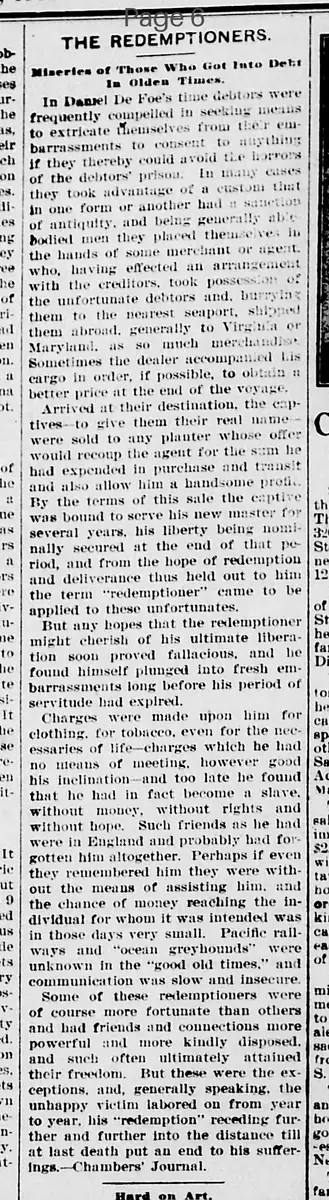
THE REDEMPTIONERS.
Mysteries of Those Who Got Into Debt In Olden Times.
In Daniel De Foe's time debtors were frequently compelled in seeking means to extricate themselves from their embarrassments to consent to anything if they thereby could avoid the horrors of the debtors' prison. In many cases they took advantage of a custom that in one form or another had a savor of antiquity, and being generally able-bodied men they placed themselves in the hands of some merchant or agent, who, having effected an arrangement with the creditors, took possession of the unfortunate debtors and, hurrying them to the nearest seaport, shipped them abroad, generally to Virginia or Maryland, as so much merchandise. Sometimes the dealer accompanied his cargo in order, if possible, to obtain a better price at the end of the voyage.
Arrived at their destination, the captives—to give them their real name—were sold to any planter whose offer would recoup the agent for the sum he had expended in purchase and transit and also allow him a handsome profit. By the terms of this sale the captive was bound to serve his new master for several years, his liberty being nominally secured at the end of that period, and from the hope of redemption and deliverance thus held out to him the term "redemptioner" came to be applied to these unfortunates.
But any hopes that the redemptioner might cherish of his ultimate liberation soon proved fallacious, and he found himself plunged into fresh embarrassments long before his period of servitude had expired. Charges were made upon him for clothing, for tobacco, even for the necessaries of life—charges which he had no means of meeting, however good his inclination—and too late he found that he had in fact become a slave, without money, without rights and without hope. Such friends as he had were in England and probably had forgotten him altogether. Perhaps if even they remembered him they were without the means of assisting him, and the chance of money reaching the individual for whom it was intended was in those days very small. Pacific railways and "ocean greyhounds" were unknown in the "good old times," and communication was slow and insecure.
Some of these redemptioners were of course more fortunate than others and had friends and connections more powerful and more kindly disposed and such often ultimately attained their freedom. But these were the exceptions, and, generally speaking, the unhappy victim labored on from year to year, his "redemption" receding further and further into the distance till at last death put an end to his sufferings.—Chambers' Journal.
Mysteries of Those Who Got Into Debt In Olden Times.
In Daniel De Foe's time debtors were frequently compelled in seeking means to extricate themselves from their embarrassments to consent to anything if they thereby could avoid the horrors of the debtors' prison. In many cases they took advantage of a custom that in one form or another had a savor of antiquity, and being generally able-bodied men they placed themselves in the hands of some merchant or agent, who, having effected an arrangement with the creditors, took possession of the unfortunate debtors and, hurrying them to the nearest seaport, shipped them abroad, generally to Virginia or Maryland, as so much merchandise. Sometimes the dealer accompanied his cargo in order, if possible, to obtain a better price at the end of the voyage.
Arrived at their destination, the captives—to give them their real name—were sold to any planter whose offer would recoup the agent for the sum he had expended in purchase and transit and also allow him a handsome profit. By the terms of this sale the captive was bound to serve his new master for several years, his liberty being nominally secured at the end of that period, and from the hope of redemption and deliverance thus held out to him the term "redemptioner" came to be applied to these unfortunates.
But any hopes that the redemptioner might cherish of his ultimate liberation soon proved fallacious, and he found himself plunged into fresh embarrassments long before his period of servitude had expired. Charges were made upon him for clothing, for tobacco, even for the necessaries of life—charges which he had no means of meeting, however good his inclination—and too late he found that he had in fact become a slave, without money, without rights and without hope. Such friends as he had were in England and probably had forgotten him altogether. Perhaps if even they remembered him they were without the means of assisting him, and the chance of money reaching the individual for whom it was intended was in those days very small. Pacific railways and "ocean greyhounds" were unknown in the "good old times," and communication was slow and insecure.
Some of these redemptioners were of course more fortunate than others and had friends and connections more powerful and more kindly disposed and such often ultimately attained their freedom. But these were the exceptions, and, generally speaking, the unhappy victim labored on from year to year, his "redemption" receding further and further into the distance till at last death put an end to his sufferings.—Chambers' Journal.
What sub-type of article is it?
Historical Event
Curiosity
What themes does it cover?
Misfortune
Fortune Reversal
What keywords are associated?
Redemptioners
Indentured Servitude
Debtors
Colonial America
Servitude
Where did it happen?
Virginia Or Maryland
Story Details
Location
Virginia Or Maryland
Event Date
Daniel De Foe's Time
Story Details
Debtors in England avoided prison by becoming indentured servants shipped to American colonies, sold to planters for years of labor, often trapped in perpetual servitude through additional charges, with rare exceptions gaining freedom.