Thank you for visiting SNEWPapers!
Sign up free
Editorial
June 20, 1873
Nashville Union And American
Nashville, Davidson County, Tennessee
What is this article about?
The editorial critiques the rapid post-Civil War urbanization in the US, particularly among Southern Blacks and Northern Whites, arguing it undermines national health, wealth, and morality by fostering disease, sin, and overcrowding. It advocates for balanced city growth with hygiene reforms and encourages rural living for the unfit.
Clipping
OCR Quality
98%
Excellent
Full Text
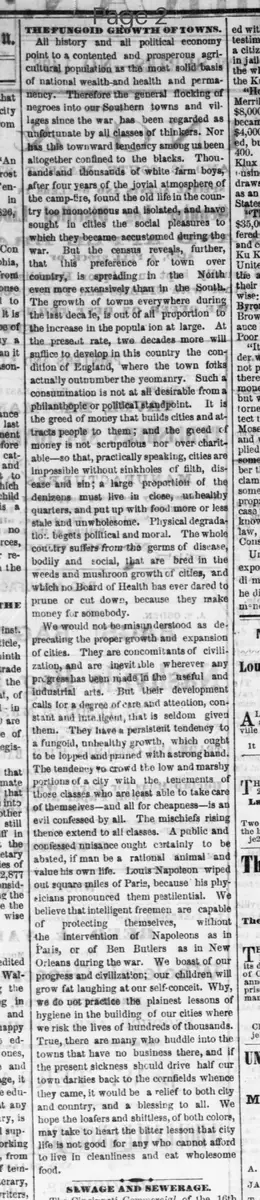
THE FUNGOID GROWTH OF TOWNS.
All history and all political economy point to a contented and prosperous agricultural population as the most solid basis of national wealth-and health and permanency. Therefore the general flocking of negroes into our Southern towns and villages since the war has been regarded as unfortunate by all classes of thinkers. Nor has this townward tendency among us been altogether confined to the blacks. Thousands and thousands of white farm boys, after four years of the jovial atmosphere of the camp-fire, found the old life in the country too monotonous and isolated, and have sought in cities the social pleasures to which they became accustomed during the war. But the census reveals, further, that this preference for town over country, is spreading in the North even more extensively than in the South. The growth of towns everywhere during the last decade, is out of all proportion to the increase in the population at large. At the present rate, two decades more will suffice to develop in this country the condition of England, where the town folks actually outnumber the yeomanry. Such a consummation is not at all desirable from a philanthropic or political standpoint. It is the greed of money that builds cities and attracts people to them; and the greed of money is not scrupulous nor over charitable-so that, practically speaking, cities are impossible without sinkholes of filth, disease and sin; a large proportion of the denizens must live in close, unhealthy quarters, and put up with food more or less stale and unwholesome. Physical degradation begets political and moral. The whole country suffers from the germs of disease bodily and social, that are bred in the weeds and mushroom growth of cities, and which no Board of Health has ever dared to prune or cut down, because they make money for somebody.
We would not be misunderstood as deprecating the proper growth and expansion of cities. They are concomitants of civilization, and are inevitable wherever any progress has been made in the useful and industrial arts. But their development calls for a degree of care and attention, constant and intelligent, that is seldom given them. They have a persistent tendency to a fungoid, unhealthy growth, which ought to be lopped and pruned with a strong hand. The tendency to crowd the low and marshy portions of a city with the tenements of those classes who are least able to take care of themselves-and all for cheapness-is an evil confessed by all. The mischiefs rising thence extend to all classes. A public and confessed nuisance ought certainly to be abated, if man be a rational animal and value his own life. Louis Napoleon wiped out square miles of Paris, because his physicians pronounced them pestilential. We believe that intelligent freemen are capable of protecting themselves, without the intervention of Napoleons as in Paris, or of Ben Butlers as in New Orleans during the war. We boast of our progress and civilization; our children will grow fat laughing at our self-conceit. Why, we do not practice the plainest lessons of hygiene in the building of our cities where we risk the lives of hundreds of thousands. True, there are many who huddle into the towns that have no business there, and if the present sickness should drive half our town darkies back to the cornfields whence they came, it would be a relief to both city and country, and a blessing to all. We hope the loafers and shiftless, of both colors, may take to heart the bitter lesson that city life is not good for any who cannot afford to live in cleanliness and eat wholesome food.
All history and all political economy point to a contented and prosperous agricultural population as the most solid basis of national wealth-and health and permanency. Therefore the general flocking of negroes into our Southern towns and villages since the war has been regarded as unfortunate by all classes of thinkers. Nor has this townward tendency among us been altogether confined to the blacks. Thousands and thousands of white farm boys, after four years of the jovial atmosphere of the camp-fire, found the old life in the country too monotonous and isolated, and have sought in cities the social pleasures to which they became accustomed during the war. But the census reveals, further, that this preference for town over country, is spreading in the North even more extensively than in the South. The growth of towns everywhere during the last decade, is out of all proportion to the increase in the population at large. At the present rate, two decades more will suffice to develop in this country the condition of England, where the town folks actually outnumber the yeomanry. Such a consummation is not at all desirable from a philanthropic or political standpoint. It is the greed of money that builds cities and attracts people to them; and the greed of money is not scrupulous nor over charitable-so that, practically speaking, cities are impossible without sinkholes of filth, disease and sin; a large proportion of the denizens must live in close, unhealthy quarters, and put up with food more or less stale and unwholesome. Physical degradation begets political and moral. The whole country suffers from the germs of disease bodily and social, that are bred in the weeds and mushroom growth of cities, and which no Board of Health has ever dared to prune or cut down, because they make money for somebody.
We would not be misunderstood as deprecating the proper growth and expansion of cities. They are concomitants of civilization, and are inevitable wherever any progress has been made in the useful and industrial arts. But their development calls for a degree of care and attention, constant and intelligent, that is seldom given them. They have a persistent tendency to a fungoid, unhealthy growth, which ought to be lopped and pruned with a strong hand. The tendency to crowd the low and marshy portions of a city with the tenements of those classes who are least able to take care of themselves-and all for cheapness-is an evil confessed by all. The mischiefs rising thence extend to all classes. A public and confessed nuisance ought certainly to be abated, if man be a rational animal and value his own life. Louis Napoleon wiped out square miles of Paris, because his physicians pronounced them pestilential. We believe that intelligent freemen are capable of protecting themselves, without the intervention of Napoleons as in Paris, or of Ben Butlers as in New Orleans during the war. We boast of our progress and civilization; our children will grow fat laughing at our self-conceit. Why, we do not practice the plainest lessons of hygiene in the building of our cities where we risk the lives of hundreds of thousands. True, there are many who huddle into the towns that have no business there, and if the present sickness should drive half our town darkies back to the cornfields whence they came, it would be a relief to both city and country, and a blessing to all. We hope the loafers and shiftless, of both colors, may take to heart the bitter lesson that city life is not good for any who cannot afford to live in cleanliness and eat wholesome food.
What sub-type of article is it?
Agriculture
Social Reform
Moral Or Religious
What keywords are associated?
Urban Growth
Rural Migration
City Health
Post War Urbanization
Agricultural Prosperity
Social Ills
Hygiene Reform
What entities or persons were involved?
Louis Napoleon
Ben Butler
Editorial Details
Primary Topic
Dangers Of Excessive Urban Growth And Benefits Of Rural Life
Stance / Tone
Critical Of Urbanization's Social And Health Ills, Advocating Rural Return And Urban Hygiene Reforms
Key Figures
Louis Napoleon
Ben Butler
Key Arguments
Agricultural Population Is Basis Of National Wealth, Health, Permanency
Post War Migration Of Blacks And Whites To Cities Is Unfortunate
Urban Growth Outpaces Population, Leading To England Like Imbalance
Cities Breed Filth, Disease, Sin Due To Greed
Physical Degradation Causes Moral And Political Decline
Cities Need Pruning Of Unhealthy Growth Like Paris Under Napoleon
Unfit Urban Dwellers Should Return To Farms
City Life Unsuitable Without Means For Cleanliness