Thank you for visiting SNEWPapers!
Sign up free
Story
July 6, 1807
Portland Gazette, And Maine Advertiser
Portland, Cumberland County, Maine
What is this article about?
Account of Aaron Burr's treason trial in Richmond, including defense attorney Botts' speech arguing against compelling witness Willie to incriminate himself, citing risks of persecution, and reports of indictments against Burr, Blennerhassett, and others for high treason and misdemeanor.
Clipping
OCR Quality
88%
Good
Full Text
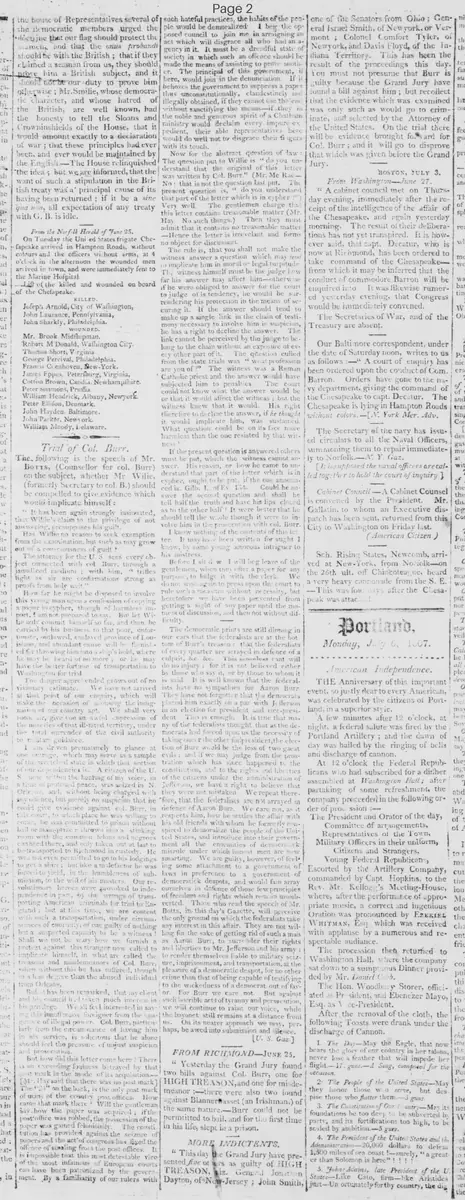
Trial of Col. Burr.
The following is the speech of Mr. Botts, (Counsellor for col. Burr) on the subject, whether Mr. Willie, (formerly Secretary to col B.) should be compelled to give evidence which would implicate himself:
"It has been again strongly insinuated, that Willie's claim to the privilege of not answering, presupposes his guilt. Has Willie no reason to seek exemption from the examination, but such as may grow out of a consciousness of guilt? The attorneys for the U. S. see every object connected with Col. Burr, through a jaundiced medium; with him, "trifles light as air are confirmations strong as proofs from holy writ."
How far he might be disposed to involve this young man upon a confession of copying a paper in cypher, though of harmless import, I am not prepared to say. But let Willie only commit himself so far, and then be carried by his business to that poor, unfortunate, outlawed, enslaved province of Louisiana, and abundant cause will furnish his enemies with a pretext for throwing him into a ship's hold, where he may be heard of no more; or he may have the better fortune of transportation to Washington for trial.
The danger apprehended grows out of no visionary estimate. We have not arrived at that point of our history, which will make the occasion of arousing the indignation of our country apt. We shall very soon, as, give you an awful impression of the mysteries of that ill-fated territory, under the total surrender of the civil authority to military guidance.
A citizen of the U. S. even when the hearing of my voice, in a time of profound peace, was seized in N. Orleans and, without being charged with any offence, but merely on suspicion that he could give evidence against Col. Burr, in this cause, to which place he was willing to come, he was committed to prison without bail or mainprize drawn into a stinking room with the common felons and negroes confined there, and only taken out at last to be transported to Richmond in custody. He was not even permitted to go to his lodgings to get a shirt; but like a malefactor he was forced to yield, in the humbleness of submission, to the will of his masters. Our revolutionary heroes were provoked to independence in part, by the wrongs of transporting American criminals for trial to England. but at this time, we are content with such a transportation, under circumstances of enormity, of one guilty of nothing but a suspected capacity to be a witness.
Shall we not be wary how we furnish a pretext against this stranger now called to implicate himself, in what are called the treasons and misdemeanors of Col Burr, when without this he has suffered, though not to such degree as the abused individual from Orleans.
But as has been remarked, that my client and his council has taken much interest in his privilege We all feel interested in saving this innocent foreigner from the vengeance of illegal power. Col. Burr, particularly from the circumstance of having him in his service, is solicitous that he alone should feel the pressure of unjust suspicion and prosecution.
But how did this letter come here? There is an exceeding foulness betrayed by that post mark in the mode of its acquisition.— (Mr. Hay said that there was no post mark] The "Pa." on the back, is the only post mark of many of the country post offices. How came that mark there Will the gentleman say how the paper was acquired; if the post office was robbed, the possession of the paper was gained feloniously. The constitution has provided against the seizure of papers and the act of congress has fixed the offence of stealing from the post offices. It is impossible that this most detestable vice of the most infamous of European courts can have been patronized by the government. By a familiarity of our rulers with such hateful practices, the habits of the people would be demoralized. I beg the opposed council to join me in arraigning an act which will disgrace all who had an agency in it. It must be a dreadful state of society in which such an offence should be made the means of assisting to prove another. The principal of this government, if here, would join in the denunciation. If it behoves the government to suppress a paper thus unconstitutionally, clandestinely and illegally obtained, if they cannot use them without sanctifying the means—if they in the noble and generous spirit of a Chatham ministry would declaim every impure expedient, their able representatives here would do well not to disgrace their fingers with its touch.
Now for the abstract question of law: The question put to Willie is "do you understand that the original of this letter was written by Col. Burr." (Mr. Mc Rae— No: that is not the question last put. The present question is, "do you understand that part of the letter which is in cypher") Very well. The gentlemen charge that this letter contains treasonable matter (Mr. Hay No such things.) Then they must admit that it contains no treasonable matter -Hence the letter is irrelevant and forms no object for discussion.
The rule is, that you shall not make the witness answer a question which may tend to implicate him in moral or legal turpitude- The witness himself must be the judge I ew far his answer may affect him-other wise if he were obliged to answer for the court to judge of is tendency, he would be surrendering his protection in the means of securing it. If the answer should tend to make up a single link in the chain of testimony necessary to involve him in suspicion, he has a right to decline the answer." The link cannot be perceived by the judge to belong to the chain without an exposure of every other part of it. The question culled from the state trials was "what profession are you of " The witness was a Roman Catholic priest and the answer would have subjected him to penalties. The court could not know what the answer would be or that it would affect the witness; but the witness knew that it would. His right therefore to decline the answer, if he thought it would implicate him, was sustained What question could be on its face more harmless than the one resisted by that witness'
If the present question is answered others must be put, which the witness cannot answer. His reason, or how he came to understand that part of the letter which is in cypher, ought to be put. if the one announced is. Gilb. L of Ev. 1st. Could he answer the second question and shall he tell half the truth and have his lips closed as to the other half' It were better that he should tell the whole though it were to involve him in the prosecution with col. Burr. I know nothing of the contents of this letter It may have been written for aught I know, by some young amorous intriguer to his mistress.
Before I sit down I will beg leave of the gentlemen, when they offer a paper for any purpose, to lodge it with the clerk. We do not wish again to press upon the court to rule such a measure without necessity, but heretofore we have been prevented from getting a sight of any paper until the moment of discussion, and then not without difficulty.
The democratic prints are still dinning in our ears that the federalists are at the bottom of Burr's treason: that the federalists of every quarter are arrayed in defence of a culprit, &c. &c. This senseless cant will do no injury for it is not believed either by those who say it, or by those to whom it is said. It is well known that the federalists have no sympathies for Aaron Burr They have not forgotten that the democrats placed him exactly on a par with Jefferson in an election for president and vice-president This is enough. It is true that many of the federalists thought that as the democrats had forced upon, us the necessity of taking one or the other for president, the election of Burr would be the less of two great evils, and if we may judge from the prostration which has since happened to the constitution, and to the rights and liberties of the citizens under the administration of Jefferson, we have a right to believe that they were not mistaken We repeat therefore, that the federalists are not arrayed in defence of Aaron Burr. We care not, as it respects him, how he settles the affair with his old friends with whom he formerly conspired to demoralize the people of the United States, and introduce into their government all the enormities of democratic misrule under which honest men are now smarting. We are guilty, however, of feeling some attachment to a government of laws in preference to a government of democratic despots, and would fain array ourselves in defence of those few principles of freedom and rights which remain unsubverted. Those who read the speech of Mr. Botts, in this day's Gazette, will perceive the only ground on which the federalists take any interest in this affair. They are not willing for the sake of getting rid of such a man as Aaron Burr, to surrender their rights and liberties to Mr. Jefferson and his army; to render themselves liable to military seizure, imprisonment, and transportation, at the pleasure of a democratic despot, for no other crime than that of being capable of testifying to the wickedness of a democrat out of favor. For Burr we care not. But against such horrible acts of tyranny and persecution, we will continue to raise our voice, while the bayonet still remains at a distance from us. On its nearer approach we may, perhaps, be awed into submission and silence.
[U. S. Gaz.]
FROM RICHMOND—JUNE 25.
"Yesterday the Grand Jury found two bills against Col. Burr, one for HIGH TREASON, and one for misdemeanor;—there were also two found against Blannerhassett (an Irishman,) of the same nature.—Burr could not be permitted to bail, and for the first time in his life, slept in a prison.
MORE INDICTMENTS.
This day the Grand Jury have presented five others as guilty of HIGH TREASON, viz. General Jonathan Dayton, of New-Jersey; John Smith, one of the Senators from Ohio; General Israel Smith, of Newyork, or Vermont; Colonel Comfort Tyler, of Newyork, and Davis Floyd, of the Indiana Territory. This has been the result of the proceedings this day.
You must not presume that Burr is guilty because the Grand Jury have found a bill against him: but recollect that the evidence which was examined was only such as would go to criminate, and selected by the Attorney of the United States. On the trial there will be evidence brought forward for Col. Burr; and it will go to disprove that which was given before the Grand Jury."
The following is the speech of Mr. Botts, (Counsellor for col. Burr) on the subject, whether Mr. Willie, (formerly Secretary to col B.) should be compelled to give evidence which would implicate himself:
"It has been again strongly insinuated, that Willie's claim to the privilege of not answering, presupposes his guilt. Has Willie no reason to seek exemption from the examination, but such as may grow out of a consciousness of guilt? The attorneys for the U. S. see every object connected with Col. Burr, through a jaundiced medium; with him, "trifles light as air are confirmations strong as proofs from holy writ."
How far he might be disposed to involve this young man upon a confession of copying a paper in cypher, though of harmless import, I am not prepared to say. But let Willie only commit himself so far, and then be carried by his business to that poor, unfortunate, outlawed, enslaved province of Louisiana, and abundant cause will furnish his enemies with a pretext for throwing him into a ship's hold, where he may be heard of no more; or he may have the better fortune of transportation to Washington for trial.
The danger apprehended grows out of no visionary estimate. We have not arrived at that point of our history, which will make the occasion of arousing the indignation of our country apt. We shall very soon, as, give you an awful impression of the mysteries of that ill-fated territory, under the total surrender of the civil authority to military guidance.
A citizen of the U. S. even when the hearing of my voice, in a time of profound peace, was seized in N. Orleans and, without being charged with any offence, but merely on suspicion that he could give evidence against Col. Burr, in this cause, to which place he was willing to come, he was committed to prison without bail or mainprize drawn into a stinking room with the common felons and negroes confined there, and only taken out at last to be transported to Richmond in custody. He was not even permitted to go to his lodgings to get a shirt; but like a malefactor he was forced to yield, in the humbleness of submission, to the will of his masters. Our revolutionary heroes were provoked to independence in part, by the wrongs of transporting American criminals for trial to England. but at this time, we are content with such a transportation, under circumstances of enormity, of one guilty of nothing but a suspected capacity to be a witness.
Shall we not be wary how we furnish a pretext against this stranger now called to implicate himself, in what are called the treasons and misdemeanors of Col Burr, when without this he has suffered, though not to such degree as the abused individual from Orleans.
But as has been remarked, that my client and his council has taken much interest in his privilege We all feel interested in saving this innocent foreigner from the vengeance of illegal power. Col. Burr, particularly from the circumstance of having him in his service, is solicitous that he alone should feel the pressure of unjust suspicion and prosecution.
But how did this letter come here? There is an exceeding foulness betrayed by that post mark in the mode of its acquisition.— (Mr. Hay said that there was no post mark] The "Pa." on the back, is the only post mark of many of the country post offices. How came that mark there Will the gentleman say how the paper was acquired; if the post office was robbed, the possession of the paper was gained feloniously. The constitution has provided against the seizure of papers and the act of congress has fixed the offence of stealing from the post offices. It is impossible that this most detestable vice of the most infamous of European courts can have been patronized by the government. By a familiarity of our rulers with such hateful practices, the habits of the people would be demoralized. I beg the opposed council to join me in arraigning an act which will disgrace all who had an agency in it. It must be a dreadful state of society in which such an offence should be made the means of assisting to prove another. The principal of this government, if here, would join in the denunciation. If it behoves the government to suppress a paper thus unconstitutionally, clandestinely and illegally obtained, if they cannot use them without sanctifying the means—if they in the noble and generous spirit of a Chatham ministry would declaim every impure expedient, their able representatives here would do well not to disgrace their fingers with its touch.
Now for the abstract question of law: The question put to Willie is "do you understand that the original of this letter was written by Col. Burr." (Mr. Mc Rae— No: that is not the question last put. The present question is, "do you understand that part of the letter which is in cypher") Very well. The gentlemen charge that this letter contains treasonable matter (Mr. Hay No such things.) Then they must admit that it contains no treasonable matter -Hence the letter is irrelevant and forms no object for discussion.
The rule is, that you shall not make the witness answer a question which may tend to implicate him in moral or legal turpitude- The witness himself must be the judge I ew far his answer may affect him-other wise if he were obliged to answer for the court to judge of is tendency, he would be surrendering his protection in the means of securing it. If the answer should tend to make up a single link in the chain of testimony necessary to involve him in suspicion, he has a right to decline the answer." The link cannot be perceived by the judge to belong to the chain without an exposure of every other part of it. The question culled from the state trials was "what profession are you of " The witness was a Roman Catholic priest and the answer would have subjected him to penalties. The court could not know what the answer would be or that it would affect the witness; but the witness knew that it would. His right therefore to decline the answer, if he thought it would implicate him, was sustained What question could be on its face more harmless than the one resisted by that witness'
If the present question is answered others must be put, which the witness cannot answer. His reason, or how he came to understand that part of the letter which is in cypher, ought to be put. if the one announced is. Gilb. L of Ev. 1st. Could he answer the second question and shall he tell half the truth and have his lips closed as to the other half' It were better that he should tell the whole though it were to involve him in the prosecution with col. Burr. I know nothing of the contents of this letter It may have been written for aught I know, by some young amorous intriguer to his mistress.
Before I sit down I will beg leave of the gentlemen, when they offer a paper for any purpose, to lodge it with the clerk. We do not wish again to press upon the court to rule such a measure without necessity, but heretofore we have been prevented from getting a sight of any paper until the moment of discussion, and then not without difficulty.
The democratic prints are still dinning in our ears that the federalists are at the bottom of Burr's treason: that the federalists of every quarter are arrayed in defence of a culprit, &c. &c. This senseless cant will do no injury for it is not believed either by those who say it, or by those to whom it is said. It is well known that the federalists have no sympathies for Aaron Burr They have not forgotten that the democrats placed him exactly on a par with Jefferson in an election for president and vice-president This is enough. It is true that many of the federalists thought that as the democrats had forced upon, us the necessity of taking one or the other for president, the election of Burr would be the less of two great evils, and if we may judge from the prostration which has since happened to the constitution, and to the rights and liberties of the citizens under the administration of Jefferson, we have a right to believe that they were not mistaken We repeat therefore, that the federalists are not arrayed in defence of Aaron Burr. We care not, as it respects him, how he settles the affair with his old friends with whom he formerly conspired to demoralize the people of the United States, and introduce into their government all the enormities of democratic misrule under which honest men are now smarting. We are guilty, however, of feeling some attachment to a government of laws in preference to a government of democratic despots, and would fain array ourselves in defence of those few principles of freedom and rights which remain unsubverted. Those who read the speech of Mr. Botts, in this day's Gazette, will perceive the only ground on which the federalists take any interest in this affair. They are not willing for the sake of getting rid of such a man as Aaron Burr, to surrender their rights and liberties to Mr. Jefferson and his army; to render themselves liable to military seizure, imprisonment, and transportation, at the pleasure of a democratic despot, for no other crime than that of being capable of testifying to the wickedness of a democrat out of favor. For Burr we care not. But against such horrible acts of tyranny and persecution, we will continue to raise our voice, while the bayonet still remains at a distance from us. On its nearer approach we may, perhaps, be awed into submission and silence.
[U. S. Gaz.]
FROM RICHMOND—JUNE 25.
"Yesterday the Grand Jury found two bills against Col. Burr, one for HIGH TREASON, and one for misdemeanor;—there were also two found against Blannerhassett (an Irishman,) of the same nature.—Burr could not be permitted to bail, and for the first time in his life, slept in a prison.
MORE INDICTMENTS.
This day the Grand Jury have presented five others as guilty of HIGH TREASON, viz. General Jonathan Dayton, of New-Jersey; John Smith, one of the Senators from Ohio; General Israel Smith, of Newyork, or Vermont; Colonel Comfort Tyler, of Newyork, and Davis Floyd, of the Indiana Territory. This has been the result of the proceedings this day.
You must not presume that Burr is guilty because the Grand Jury have found a bill against him: but recollect that the evidence which was examined was only such as would go to criminate, and selected by the Attorney of the United States. On the trial there will be evidence brought forward for Col. Burr; and it will go to disprove that which was given before the Grand Jury."
What sub-type of article is it?
Crime Story
Historical Event
What themes does it cover?
Crime Punishment
Justice
What keywords are associated?
Burr Trial
Treason Indictment
Witness Privilege
Government Tyranny
Grand Jury
Cipher Letter
What entities or persons were involved?
Col. Burr
Mr. Botts
Mr. Willie
Blannerhassett
Jonathan Dayton
John Smith
Israel Smith
Comfort Tyler
Davis Floyd
Where did it happen?
Richmond
Story Details
Key Persons
Col. Burr
Mr. Botts
Mr. Willie
Blannerhassett
Jonathan Dayton
John Smith
Israel Smith
Comfort Tyler
Davis Floyd
Location
Richmond
Event Date
June 25
Story Details
Defense speech by Botts argues against compelling witness Willie to testify on a cipher letter due to self-incrimination risks and government overreach; Grand Jury indicts Burr and others for high treason and misdemeanor.