Thank you for visiting SNEWPapers!
Sign up free
The National Intelligencer And Washington Advertiser
Washington, District Of Columbia
What is this article about?
In the U.S. Senate on April 9, 1807, Mr. Anderson delivers a speech examining evidence against Senator John Smith for involvement in Aaron Burr's conspiracy, supporting adoption of a resolution based on testimonies from Peter Taylor, Elias Glover, and others implicating Smith in Burr's plans to invade Spanish territories.
Merged-components note: Continuous text reporting on Senate proceedings in the case of John Smith related to the Burr conspiracy, spanning pages 1 and 2; relabeled from 'story' and 'editorial' to 'domestic_news' as it is political news coverage.
Clippings
1 of 2
OCR Quality
Full Text
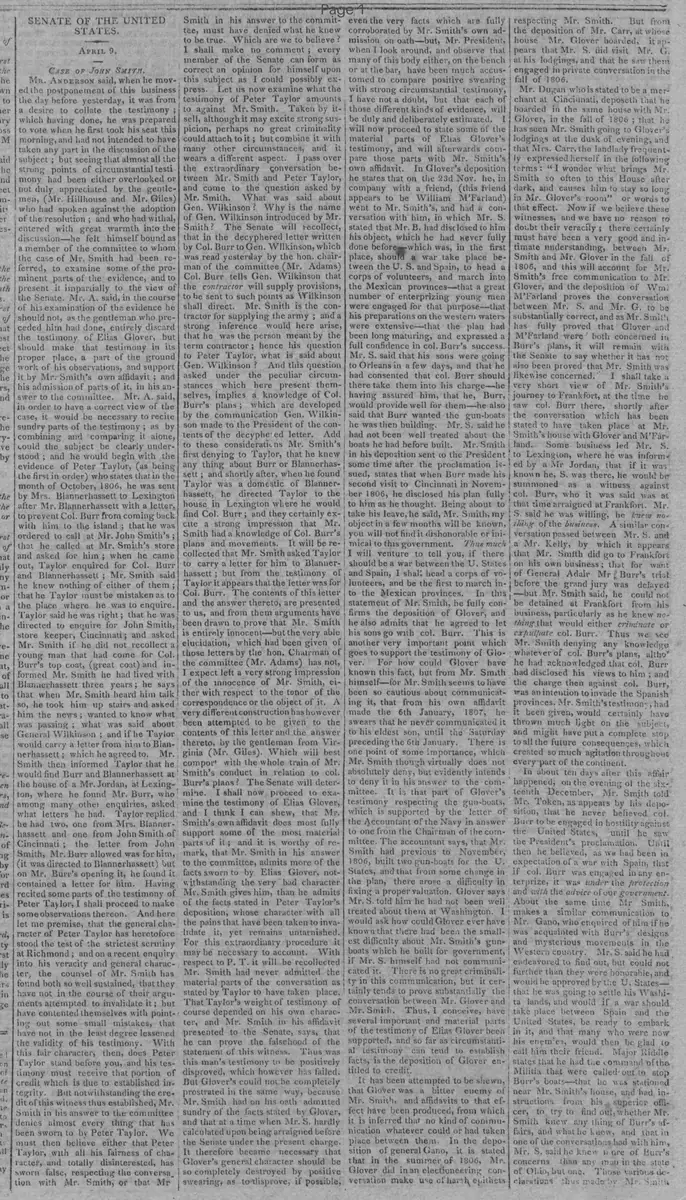
APRIL 9.
CASE OF JOHN SMITH.
MR. Anderson said, when he moved the postponement of this business the day before yesterday, it was from a desire to collate the testimony; which having done, he was prepared to vote when he first took his seat this morning, and had not intended to have taken any part in the discussion of the subject; but seeing that almost all the strong points of circumstantial testimony had been either overlooked or not duly appreciated by the gentlemen, (Mr. Hillhouse and Mr. Giles) who had spoken against the adoption of the resolution; and who had withal, entered with great warmth into the discussion—he felt himself bound as a member of the committee to whom the case of Mr. Smith had been referred, to examine some of the prominent parts of the evidence, and to present it impartially to the view of the Senate. Mr. A. said, in the course of his examination of the evidence he should not, as the gentleman who preceded him had done, entirely discard the testimony of Elias Glover, but should make that testimony in its proper place, a part of the ground work of his observations, and support it by Mr. Smith's own affidavit; and his admission of parts of it, in his answer to the committee. Mr. A. said, in order to have a correct view of the case, it would be necessary to recite sundry parts of the testimony; as by combining and comparing it alone, could the subject be clearly understood; and he would begin with the evidence of Peter Taylor, (as being the first in order) who states that in the month of October, 1806, he was sent by Mrs. Blannerhassett to Lexington after Mr. Blannerhassett with a letter, to prevent Col. Burr from coming back with him to the island; that he was ordered to call at Mr. John Smith's; that he called at Mr. Smith's store and asked for him; when he came out, Taylor enquired for Col. Burr and Blannerhassett; Mr. Smith said he knew nothing of either of them; that he Taylor must be mistaken as to the place where he was to enquire. Taylor said he was right; that he was directed to enquire for John Smith, store keeper, Cincinnati; and asked Mr. Smith if he did not recollect a young man that had come for Col. Burr's top coat, (great coat) and informed Mr. Smith he had lived with Blannerhassett three years; he says that when Mr. Smith heard him talk so, he took him up stairs and asked him the news; wanted to know what was passing; what was said about General Wilkinson; and if he Taylor would carry a letter from him to Blannerhassett; which he agreed to. Mr. Smith then informed Taylor that he would find Burr and Blannerhassett at the house of a Mr. Jordan, at Lexington, where he found Mr. Burr, who among many other enquiries, asked what letters he had. Taylor replied he had two, one from Mrs. Blannerhassett and one from John Smith of Cincinnati; the letter from John Smith, Mr. Burr allowed was for him, (it was directed to Blannerhassett) but on Mr. Burr's opening it, he found it contained a letter for him. Having recited some parts of the testimony of Peter Taylor, I shall proceed to make some observations thereon. -And here let me premise, that the general character of Peter Taylor has heretofore stood the test of the strictest scrutiny at Richmond; and on a recent enquiry into his veracity and general character, the counsel of Mr. Smith has found both so well sustained, that they have not in the course of their arguments attempted to invalidate it; but have contented themselves with pointing out some small mistakes, that have not in the least degree lessened the validity of his testimony. With this fair character, then, does Peter Taylor stand before you, and his testimony must receive that portion of credit which is due to established integrity. But notwithstanding the credit of this witness thus established, Mr. Smith in his answer to the committee denies almost every thing that has been sworn to by Peter Taylor. We must then believe either that Peter Taylor, with all his fairness of character, and totally disinterested, has sworn false, respecting the conversation with Mr. Smith, or that Mr. Smith in his answer to the committee, must have denied what he knew to be true. Which are we to believe? I shall make no comment; every member of the Senate can form as correct an opinion for himself upon this subject as I could possibly express. Let us now examine what the testimony of Peter Taylor amounts to against Mr. Smith. Taken by itself, although it may excite strong suspicion, perhaps no great criminality could attach to it; but combine it with many other circumstances, and it wears a different aspect. I pass over the extraordinary conversation between Mr. Smith and Peter Taylor and come to the question asked by Mr. Smith. What was said about Gen. Wilkinson? Why is the name of Gen. Wilkinson introduced by Mr. Smith? The Senate will recollect, that in the decyphered letter written by Col. Burr to Gen. Wilkinson, which was read yesterday by the hon. chairman of the committee (Mr. Adams) Col. Burr tells Gen. Wilkinson that the contractor will supply provisions, to be sent to such points as Wilkinson shall direct. Mr. Smith is the contractor for supplying the army; and a strong inference would here arise, that he was the person meant by the term contractor; hence his question to Peter Taylor, what is said about Gen. Wilkinson? And this question asked under the peculiar circumstances which here present themselves, implies a knowledge of Col. Burr's plans; which are developed by the communication Gen. Wilkinson made to the President of the contents of the decyphered letter. Add to these considerations Mr. Smith's first denying to Taylor, that he knew any thing about Burr or Blannerhassett; and shortly after, when he found Taylor was a domestic of Blannerhassett, he directed Taylor to the house in Lexington where he would find Col. Burr; and they certainly excite a strong impression that Mr. Smith had a knowledge of Col. Burr's plans and movements. It will be recollected that Mr. Smith asked Taylor to carry a letter for him to Blannerhassett; but from the testimony of Taylor it appears that the letter was for Col. Burr. The contents of this letter and the answer thereto, are presented to us, and from them arguments have been drawn to prove that Mr. Smith is entirely innocent—but the very able elucidation, which had been given of those letters by the hon. Chairman of the committee (Mr. Adams) has not, I expect left a very strong impression of the innocence of Mr. Smith, either with respect to the tenor of the correspondence or the object of it. A very different construction has however been attempted to be given to the contents of this letter and the answer thereto, by the gentleman from Virginia (Mr. Giles). Which will best comport with the whole train of Mr. Smith's conduct in relation to col. Burr's plans? The Senate will determine. I shall now proceed to examine the testimony of Elias Glover, and I think I can shew, that Mr. Smith's own affidavit does most fully support some of the most material parts of it; and it is worthy of remark, that Mr. Smith in his answer to the committee, admits more of the facts sworn to by Elias Glover, notwithstanding the very bad character Mr. Smith gives him, than he admits of the facts stated in Peter Taylor's deposition, whose character with all the pains that have been taken to invalidate it, yet remains untarnished. For this extraordinary procedure it may be necessary to account. With respect to P. T. it will be recollected Mr. Smith had never admitted the material parts of the conversation as stated by Taylor to have taken place. That Taylor's weight of testimony of course depended on his own character, and Mr. Smith in his affidavit presented to the Senate, says, that he can prove the falsehood of the statement of this witness. Thus was this man's testimony to be positively disproved, which however has failed. But Glover's could not be completely prostrated in the same way, because Mr. Smith had on his oath admitted sundry of the facts stated by Glover. and that at a time when Mr. S. hardly calculated upon being arraigned before the Senate under the present charge. It therefore became necessary that Glover's general character should be so completely destroyed by positive swearing, as to disprove, if possible every facts which he had corroborated by Mr. Smith's own admission on oath but, Mr. President, when I look around, and observe that many of this body either, on the bench or at the bar, have been much accustomed to compare positive swearing with strong circumstantial testimony, I have not a doubt, but that each of those different kinds of evidence, will be duly and deliberately estimated, I will now proceed to state some of the material parts of Elias Glover's testimony, and will afterwards compare those parts with Mr. Smith's own affidavit. In Glover's deposition he states that on the 23d Nov. he, in company with a friend, (this friend appears to be William M'Farland) went to Mr. Smith's, and had a conversation with him, in which Mr. S. stated that Mr. B. had disclosed to him his object, which he had never fully done before—which was, in the first place, should a war take place between the U. S. and Spain, to head a corps of volunteers, and march into the Mexican provinces—that a great number of enterprizing young men were engaged for that purpose—that his preparations on the western waters were extensive—that the plan had been long maturing, and expressed a full confidence in col. Burr's success. Mr. S. said that his sons were going to Orleans in a few days, and that he had consented that col. Burr should there take them into his charge—he having assured him, that he, Burr, would provide well for them—he also said that Burr wanted the gun-boats he was then building. Mr. S. said he had not been well treated about the boats he had before built. Mr. Smith in his deposition sent to the President some time after the proclamation issued, states that when Burr made his second visit to Cincinnati in November 1806, he disclosed his plan fully to him as he thought. Being about to take his leave, he said, Mr. Smith, my object in a few months will be known, you will not find it dishonorable or inimical to this government. Thus much I will venture to tell you, if there should be a war between the U. States and Spain, I shall head a corps of volunteers, and be the first to march into the Mexican provinces. In this statement of Mr. Smith, he fully confirms the deposition of Glover, and he also admits that he agreed to let his sons go with col. Burr. This is another very important point which goes to support the testimony of Glover. For how could Glover have known this fact, but from Mr. Smith himself for Mr. Smith seems to have been so cautious about communicating it, that from his own affidavit made the 6th January, 1807, he swears that he never communicated it to his eldest son, until the Saturday preceding the 6th January. There is one point of some importance, which Mr. Smith though virtually does not absolutely deny, but evidently intends to deny it in his answer to the committee. It is that part of Glover's testimony respecting the gun-boats, which is supported by the letter of the Accountant of the Navy in answer to one from the Chairman of the committee. The accountant says, that Mr. Smith had previous to November, 1806, built two gun-boats for the U. States, and that from some change in the plan, there arose a difficulty in fixing a proper valuation. Glover says Mr. S. told him he had not been well treated about them at Washington. I would ask how could Glover ever have known that there had been the smallest difficulty about Mr. Smith's gun-boats which he built for government, if Mr. S. himself had not communicated it. There is no great criminality in this communication, but it certainly tends to prove substantially the conversation between Mr. Glover and Mr. Smith. Thus, I conceive, have several important and material parts of the testimony of Elias Glover been supported, and so far as circumstantial testimony can tend to establish facts, is the deposition of Glover entitled to credit.
It has been attempted to be shewn, that Glover was a bitter enemy of Mr. Smith, and affidavits to that effect have been produced, from which it is inferred that no kind of communication whatever could or had taken place between them. In the deposition of general Gano, it is stated that in the summer of 1806, Mr. Glover did in an electioneering conversation make use of harsh epithets respecting Mr. Smith. But from the deposition of Mr. Carr, at whose house Mr. Glover boarded, it appears that Mr. S. did visit Mr. G. at his lodgings, and that he saw them engaged in private conversation in the fall of 1806. Mr. Dugan who is stated to be a merchant at Cincinnati, deposeth that he boarded in the same house with Mr. Glover, in the fall of 1806; that he has seen Mr. Smith going to Glover's lodgings at the dusk of evening, and that Mrs. Carr, the landlady frequently expressed herself in the following terms: "I wonder what brings Mr. Smith so often to this House after dark, and causes him to stay so long in Mr. Glover's room" or words to that effect. Now if we believe these witnesses, and we have no reason to doubt their veracity; there certainly must have been a very good and intimate understanding, between Mr. Smith and Mr. Glover in the fall of 1806, and this will account for Mr. Smith's free communication to Mr. Glover, and the deposition of Wm. M'Farland proves the conversation between Mr. S. and Mr. G. to be substantially correct, and as Mr. Smith has fully proved that Glover and M'Farland were both concerned in Burr's plans, it will remain with the Senate to say whether it has not also been proved that Mr. Smith was likewise concerned. I shall take a very short view of Mr. Smith's journey to Frankfort, at the time he saw col. Burr there, shortly after the conversation which has been stated to have taken place at Mr. Smith's house with Glover and M'Farland. Some business led Mr. S. to Lexington, where he was informed by a Mr Jordan, that if it was known he, S. was there, he would be summoned as a witness against col. Burr, who it was said was at that time arraigned at Frankfort. Mr. S. said he was willing, he knew nothing of the business. A similar conversation passed between Mr. S. and a Mr. Kelly, by which it appears that Mr. Smith did go to Frankfort on his own business; that for want of General Adair Mr Burr's trial before the grand jury was delayed—but Mr. Smith said, he could not be detained at Frankfort from his business, particularly as he knew nothing that would either criminate or exculpate col. Burr. Thus we see Mr. Smith denying any knowledge whatever of col. Burr's plans, altho he had acknowledged that col. Burr had disclosed his views to him; and the charge then against col. Burr, was an intention to invade the Spanish provinces. Mr. Smith's testimony, had it been given, would certainly have thrown much light on the subject, and might have put a complete stop to all the future consequences, which created so much agitation throughout every part of the continent.
In about ten days after this affair happened, on the evening of the sixteenth December, Mr. Smith told Mr. Token, as appears by his deposition, that he never believed col. Burr to be engaged in hostility against the United States, until he saw the President's proclamation. Until then he believed, as we had been in expectation of a war with Spain, that if col. Burr was engaged in any enterprize, it was under the protection and with the advice of our government. About the same time Mr Smith, makes a similar communication to Mr. Gano, who enquired of him if he was acquainted with Burr's designs and mysterious movements in the Western country. Mr. S. said he had endeavored to find out, but could not further than they were honorable, and would be approved by the U. States—that he was going to settle his Washington lands, and would if a war should take place between Spain and the United States, be ready to embark in it, and that many who were now his enemies, would then be glad to call him their friend. Major Riddle states that he had the command of the Militia that were called out to stop Burr's boats—that he was stationed near Mr. Smith's house, and had instructions from his superior officer, to try to find out, whether Mr. Smith knew any thing of Burr's affairs, and what he knew, and that in one of the conversations had with him, Mr. S. said he knew no more of Burr's concerns than any man in the state of Ohio, but one. Those various declarations thus made by Mr. Smith
At several different times and under different circumstances appear to be entirely inconsistent with one another. We see by the testimony of Jordan and Kelly, that Mr. S. declared he knew nothing about Mr. Burr's business, and nothing that could criminate or exculpate him. We have seen what Glover stated Mr. S. communicated to him; we have seen that statement confirmed by Mr. Smith's own affidavit sent to the President, and we now see what Mr. S. has declared to Mr. Tichenor and Mr. Gano - to the former he says that if Burr was engaged in any enterprise, it was under the protection and with the advice of our government; this was the very language Mr. Burr himself held out to induce the unwary and unsuspecting to join him. To Mr. Gano, Mr. Smith says he had endeavored to find out Burr's plans but could not, further than they were honorable, and would be approved by the United States; and to Major Riddle he says he knew more of Burr's plans than any man, in the state of Ohio but one. These three last conversations took place about ten days after Mr. Smith, had declared to Jordan and Kelly, that he knew nothing of Burr's business, or anything that could criminate or exculpate him. How are these various declarations of Mr. S. to be reconciled? At one time, he says he knows nothing of Burr's affairs-ten days after he says, he knew more of his concerns than any man in the state of Ohio but one-and goes so far as to say, that if Burr was engaged in any enterprise, it was under the protection and with the advice of our government and all this after Mr. Burr had told him that he had been persecuted in this government, shamefully persecuted, and that in it all private confidence between man and man seemed to be nearly destroyed. Could or did Mr. Smith believe that the government countenanced any of the plans of Mr. Burr; it appears to me impossible. What then could induce him to make such a declaration and at different times? Did Mr. S. believe that the government would give its sanction to an illegal act-or as a member of the national Legislature, he must have known it was not authorised by law, and that the President would not dare in violation of the constitution even if he had ever so great an inclination) to countenance an enterprise that would inevitably involve our country in war? And did Mr. S. believe, that the administration had such unbounded confidence in Mr. Burr as to intrust him with so important an expedition at that critical period? Yet these things we must believe, if we believe Mr. Smith sincere in his declaration-and if we do believe him sincere in saying that if Mr. Burr was engaged in any enterprise, it was under the protection and with the advice of our government, we must believe that he was conversant with Mr. Burr's plans, which must have been very plausibly impressed upon him indeed, to have induced him to have formed so extraordinary an opinion. I shall now proceed to the testimony of Col. James Taylor; who in answer to a question put by the committee, makes the following statement: That a piece signed Querist, published at Marietta, in the fall of 1806, excited a good deal of agitation at Cincinnati; that he was anxious to see the piece, and expressed himself to this effect to Mr. John Smith of that place. Mr. Smith promised to procure the paper, which he did. In a few days after Col. Taylor fell in company with Mr. Smith and Gen. Findley, in Cincinnati, when the conversation turned upon the subject of a separation of the union. Mr. Smith advanced as his opinion many of the arguments in the Querist; spoke as to the difference of interest between the western and Atlantic states; observed that although the doctrine was unpleasant at that time, in less than two years it would become orthodox. Mr. Taylor says one of the arguments made use of was, that we derived very little advantage from the great expence of foreign ministers and consuls, and the navy; he observed, that a few British ships or armed vessels at the mouth of the Mississippi could block up our trade effectually. This conversation abstractedly considered, (though peculiarly improper in a Senator or member of the national government) might not of itself be considered criminal; but combine it with Col. Burr's conversation with General Morgan and his sons, as stated in their depositions, to the very same purport. Add thereto the time at which the piece signed Querist was published; which was immediately on Col. Burr's arriving in that country; supporting the same doctrine, and considering the separation of the union as a part of Colonel Burr's great plan, and connect this communication of Mr. Smith's with the several conversations herein before detailed, and the information which Mr. Smith himself acknowledges to have received from Col. Burr; and it appears to me almost impossible not to believe, that Mr. Smith was concerned in Col. Burr's projects. Some attempt has been made by Mr. Smith to explain away or to invalidate the testimony of Col. Taylor; but the stern integrity of his character is such, blended with the very candid manner; the great reluctance with which he gave in his evidence before the committee; the extreme tenderness he evinced towards Mr. Smith and his family, were so conspicuous, that the evidence which has been presented to countervail the effect of Col. Taylor's testimony, has not made the smallest impression upon my mind; and the very circumstance of Mr. Smith not obtaining the deposition of General Findley, who Col. Taylor says was present, confirms me in the belief. that if that testimony was produced, it would fully accord with Col. Taylor's. I have now discharged my duty as a member of the committee, and whatever may be the determination of the Senate, I shall rest satisfied. The duty that the committee had assigned them in the case of Mr. Smith, has been an extremely unpleasant one; but they have deemed it their duty, uninfluenced by personal feeling or public opinion, to observe an undeviating course, and to endeavor to bring fairly and fully to the view of the Senate, the whole merits of the Case; upon which I am constrained to pronounce, however painfully, that in my opinion the resolution ought to be adopted.
What sub-type of article is it?
What keywords are associated?
What entities or persons were involved?
Where did it happen?
Domestic News Details
Primary Location
United States Senate
Event Date
April 9, 1807
Key Persons
Outcome
mr. anderson argues that circumstantial evidence from multiple testimonies supports adopting the resolution against john smith for involvement in burr's conspiracy; no final senate decision stated.
Event Details
Mr. Anderson, a Senate committee member, speaks in defense of evidence against Senator John Smith, reciting and analyzing testimonies from Peter Taylor, Elias Glover, Col. James Taylor, and others, highlighting inconsistencies in Smith's statements and his knowledge of Burr's plans to invade Spanish Mexico, supporting the resolution's adoption.