Thank you for visiting SNEWPapers!
Sign up free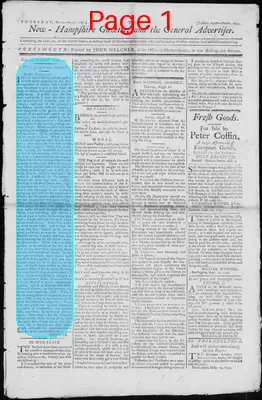
Letter to Editor
October 27, 1791
The New Hampshire Gazette And General Advertiser
Portsmouth, Rockingham County, New Hampshire
What is this article about?
An anonymous letter signed 'Observer' uses the nautical phrase 'going to the leeward' as a metaphor to critique signs of mismanagement in finances, farming, and daily rural life, warning against behaviors leading to ruin.
Clipping
OCR Quality
95%
Excellent
Full Text
From the Farmer's Journal.
"He is going to the leeward."
Messrs. PRINTERS,
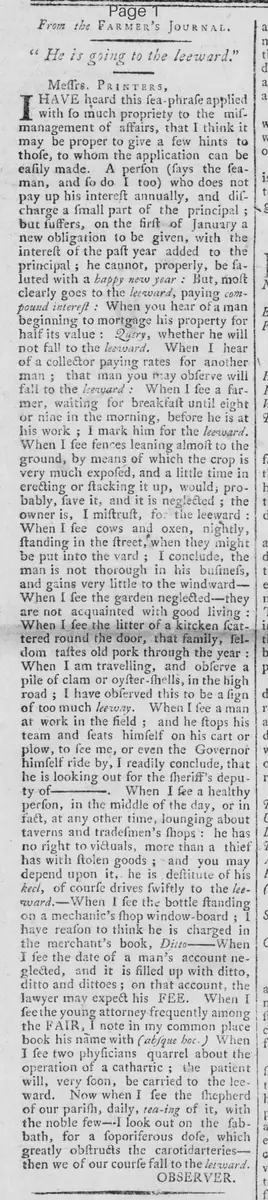
I have heard this sea-phrase applied with so much propriety to the mis-management of affairs, that I think it may be proper to give a few hints to those, to whom the application can be easily made. A person (says the sea-man, and so do I too) who does not pay up his interest annually, and discharge a small part of the principal; but suffers, on the first of January a new obligation to be given, with the interest of the past year added to the principal; he cannot, properly, be saluted with a happy new year: But, most clearly goes to the leeward, paying compound interest: When you hear of a man beginning to mortgage his property for half its value: Query, whether he will not fall to the leeward. When I hear of a collector paying rates for another man; that man you may observe will fall to the leeward: When I see a farmer, waiting for breakfast until eight or nine in the morning, before he is at his work; I mark him for the leeward. When I see fences leaning almost to the ground, by means of which the crop is very much exposed, and a little time in erecting or tacking it up, would, probably, save it, and it is neglected; the owner is, I mistrust, so the leeward: When I see cows and oxen, nightly, standing in the street, when they might be put into the yard; I conclude, the man is not thorough in his business, and gains very little to the windward- When I see the garden neglected--they are not acquainted with good living: When I see the litter of a kitchen scattered round the door, that family, seldom tastes old pork through the year: When I am travelling, and observe a pile of clam or oyster-shells, in the high road; I have observed this to be a sign of too much leeway. When I see a man at work in the field; and he stops his team and seats himself on his cart or plow, to see me, or even the Governor himself ride by, I readily conclude, that he is looking out for the sheriff's deputy of- When I see a healthy person, in the middle of the day, or in fact, at any other time, lounging about taverns and tradesmen's shops: he has no right to victuals, more than a thief has with stolen goods; and you may depend upon it, he is destitute of his keel, of course drives swiftly to the leeward. When I see the bottle standing on a mechanic's shop window-board; I have reason to think he is charged in the merchant's book, Ditto--When I see the date of a man's account neglected, and it is filled up with ditto, ditto and dittoes; on that account, the lawyer may expect his FEE. When I see the young attorney frequently among the FAIR, I note in my common place book his name with (absque hoc.) When I see two physicians quarrel about the operation of a cathartic; the patient will, very soon, be carried to the leeward. Now when I see the shepherd of our parish, daily, teasing of it, with the noble few--I look out on the sabbath, for a soporiferous dose, which greatly obstructs the carotid arteries- then we of our course fall to the leeward.
OBSERVER.
"He is going to the leeward."
Messrs. PRINTERS,
I have heard this sea-phrase applied with so much propriety to the mis-management of affairs, that I think it may be proper to give a few hints to those, to whom the application can be easily made. A person (says the sea-man, and so do I too) who does not pay up his interest annually, and discharge a small part of the principal; but suffers, on the first of January a new obligation to be given, with the interest of the past year added to the principal; he cannot, properly, be saluted with a happy new year: But, most clearly goes to the leeward, paying compound interest: When you hear of a man beginning to mortgage his property for half its value: Query, whether he will not fall to the leeward. When I hear of a collector paying rates for another man; that man you may observe will fall to the leeward: When I see a farmer, waiting for breakfast until eight or nine in the morning, before he is at his work; I mark him for the leeward. When I see fences leaning almost to the ground, by means of which the crop is very much exposed, and a little time in erecting or tacking it up, would, probably, save it, and it is neglected; the owner is, I mistrust, so the leeward: When I see cows and oxen, nightly, standing in the street, when they might be put into the yard; I conclude, the man is not thorough in his business, and gains very little to the windward- When I see the garden neglected--they are not acquainted with good living: When I see the litter of a kitchen scattered round the door, that family, seldom tastes old pork through the year: When I am travelling, and observe a pile of clam or oyster-shells, in the high road; I have observed this to be a sign of too much leeway. When I see a man at work in the field; and he stops his team and seats himself on his cart or plow, to see me, or even the Governor himself ride by, I readily conclude, that he is looking out for the sheriff's deputy of- When I see a healthy person, in the middle of the day, or in fact, at any other time, lounging about taverns and tradesmen's shops: he has no right to victuals, more than a thief has with stolen goods; and you may depend upon it, he is destitute of his keel, of course drives swiftly to the leeward. When I see the bottle standing on a mechanic's shop window-board; I have reason to think he is charged in the merchant's book, Ditto--When I see the date of a man's account neglected, and it is filled up with ditto, ditto and dittoes; on that account, the lawyer may expect his FEE. When I see the young attorney frequently among the FAIR, I note in my common place book his name with (absque hoc.) When I see two physicians quarrel about the operation of a cathartic; the patient will, very soon, be carried to the leeward. Now when I see the shepherd of our parish, daily, teasing of it, with the noble few--I look out on the sabbath, for a soporiferous dose, which greatly obstructs the carotid arteries- then we of our course fall to the leeward.
OBSERVER.
What sub-type of article is it?
Satirical
Social Critique
What themes does it cover?
Agriculture
Morality
Social Issues
What keywords are associated?
Leeward Metaphor
Mismanagement
Rural Life
Farming Habits
Financial Ruin
Moral Critique
What entities or persons were involved?
Observer.
Messrs. Printers,
Letter to Editor Details
Author
Observer.
Recipient
Messrs. Printers,
Main Argument
the phrase 'going to the leeward' metaphorically describes various signs of personal, financial, and agricultural mismanagement that lead to ruin, urging better habits in rural life.
Notable Details
Nautical Metaphor For Mismanagement
Examples Include Compound Interest, Neglected Fences, Lounging At Taverns
Critique Of Farmers, Mechanics, Attorneys, Physicians, And Clergy