Thank you for visiting SNEWPapers!
Sign up free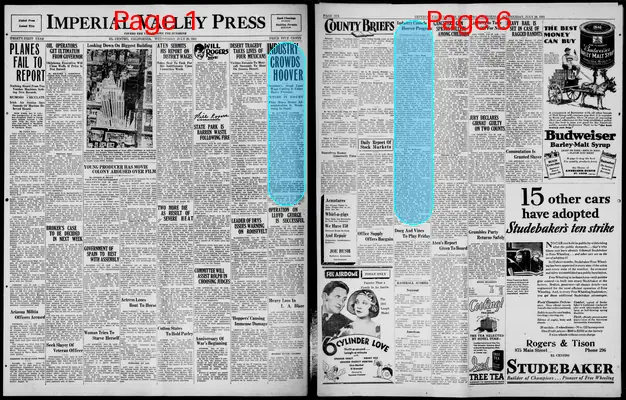
Imperial Valley Press
El Centro, Imperial County, California
What is this article about?
In 1931, President Hoover faces mounting pressure from industries like U.S. Steel to allow wage cuts amid the ongoing depression, despite his efforts to maintain wages and consumer buying power. Officials deny weakening, but private concerns grow over business deficits.
Merged-components note: Continuation of article on industry pressuring Hoover from page 1 to page 6.
Clippings
1 of 2
OCR Quality
Full Text
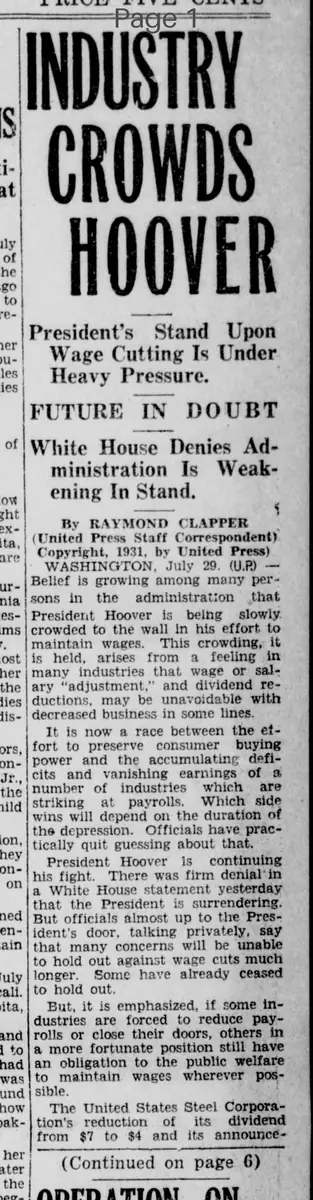
President's Stand Upon Wage Cutting Is Under Heavy Pressure.
FUTURE IN DOUBT
White House Denies Administration Is Weakening In Stand.
By RAYMOND CLAPPER
(United Press Staff Correspondent)
Copyright, 1931, by United Press
WASHINGTON, July 29. (U.P.) Belief is growing among many persons in the administration that President Hoover is being slowly crowded to the wall in his effort to maintain wages. This crowding, it is held, arises from a feeling in many industries that wage or salary "adjustment," and dividend reductions, may be unavoidable with decreased business in some lines.
It is now a race between the effort to preserve consumer buying power and the accumulating deficits and vanishing earnings of a number of industries which are striking at payrolls. Which side wins will depend on the duration of the depression. Officials have practically quit guessing about that.
President Hoover is continuing his fight. There was firm denial in a White House statement yesterday that the President is surrendering.
But officials almost up to the President's door, talking privately, say that many concerns will be unable to hold out against wage cuts much longer. Some have already ceased to hold out.
But, it is emphasized, if some industries are forced to reduce payrolls or close their doors, others in a more fortunate position still have an obligation to the public welfare to maintain wages wherever possible.
The United States Steel Corporation's reduction of its dividend from $7 to $4 and its announcement that salaries of officers and other salaried employees were to be "adjusted" bring some elements in the situation out into the open.
(Continued on page 6)
Industry Crowds Hoover Program (Continued from page 1)
United States Steel is the nation's industrial pace maker which makes its action important for psychological reasons.
"Too Early," Says Doak
Officials were hesitant to discuss the action. Secretary of Labor William N. Doak said it was too early to comment. One informed official said that if only large salaries were to be cut, no serious harm could come but that if wholesale wage slashes were contemplated it was something else again. The White House was silent. Some officials said President Hoover had personally intervened with the steel industry seeking to ward off general wage cuts. The White House declined to comment on this.
The American Federation of Labor officials likewise declined to discuss the steel corporation action. Recently President William Green said labor would strike rather than accept wage cuts. The federation executive committee will consider the wage situation at a meeting in Atlantic City August 6. Green recently blamed bankers for a drive against wages. He was supported in this contention by Doak.
Railroad labor executives sounded a warning against turning any failure of the railroads to get their 15 per cent freight rate increase into a drive on wages.
Railroad employees are not only prepared to "resist" such a move the labor officials said in a statement but "they are also fortified with the solemn agreement between representatives of employers and employees and the government of the United States not to permit the pressure of a business depression to be used as the excuse for breaking down the American standard of living and compelling men to labor for less than just compensation for their services."
Up To Railroads
To which in effect, Senator George Moses, Republican, New Hampshire, countered: "What are the railroads going to do if they fail to get the increase? Are the roads going to ask for a subsidy as the shipping lines did? In November, 1929, Mr. Hoover brought together a group of the nation's biggest industrialists who said they would do everything they could to maintain wages. Labor on its side promised to avoid strikes. That had been regarded as a pledge.
Now Secretary of Commerce Lamont has just said that this was not exactly a pledge, as the executives were without authority to bind their companies. But few question Mr. Hoover's efforts maintained a strong public psychology in favor of preserving buying power and stiffened the backbone of industrial executives who otherwise might have yielded before this to stockholders who were worrying over shrinking dividends. In this depression there has been a tendency to shove wages in ahead of dividends and give them greater sanctity than ever before, in the opinion of many economists.
Now it is a question of how long the depression will last. No official here thought, in November, 1929, that it would continue as long as this.
What sub-type of article is it?
What themes does it cover?
What keywords are associated?
What entities or persons were involved?
Where did it happen?
Story Details
Key Persons
Location
Washington
Event Date
July 29, 1931
Story Details
Growing belief in the administration that Hoover is being pressured to allow wage cuts due to industrial deficits during the depression; U.S. Steel reduces dividends and adjusts salaries; officials deny surrender but note challenges; labor resists cuts citing 1929 pledges.