Thank you for visiting SNEWPapers!
Sign up free
Editorial
April 24, 1805
Virginia Argus
Richmond, Virginia
What is this article about?
An editorial by W. F. AST defends the Mutual Insurance of Virginia against critics promoting private companies like the Phænix office. It argues that mutual insurance is cheaper and more philanthropic, using examples of premiums, quotas, and historical losses to counter falsehoods about its ruin.
Clipping
OCR Quality
95%
Excellent
Full Text
Mutual Insurance of Virginia.
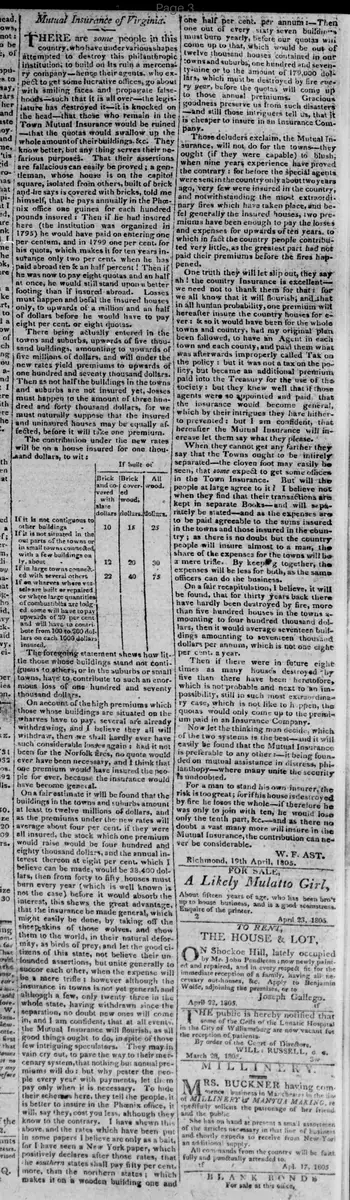
THERE are some people in this country, who have under various shapes attempted to destroy this philanthropic institution; to build on its ruin a mercenary company--hence their agents, who expect to get some lucrative offices, go about with smiling faces and propagate falsehoods--such that it is all over--the legislature has destroyed it--it is knocked on the head--that, those who remain in the Town Mutual Insurance would be ruined --that their quotas would swallow up the whole amount of their buildings. &c: They know better, but any thing serves their nefarious purposes. That their assertions are fallacious can easily be proved ; a gentleman, whose house is on the capitol square, isolated from others, built of brick and--he says is covered with bricks, told me himself, that he pays annually in the Phænix office one guinea for each hundred pounds insured : Then if he had insured here (the institution was organized in 1795) he would have paid on entering one per centum, and in 1799 one per cent. for his quota, which makes it for ten years insurance only two per cent. when he has paid abroad ten & an half per cent! Then if he was now to pay eight quotas and an half at once, he would still stand upon a better footing than if insured--abroad. Losses must happen and befall the insured houses only, to upwards of a million and an half of dollars before he would have to pay eight per cent. or eight quotas.
There being actually entered in the towns and suburbs, upwards of five thousand buildings, amounting to upwards of five millions of dollars, and will under the new rates yield premiums to upwards of one hundred and seventy thousand dollars. Then as not half the buildings in the towns and suburbs are not insured yet, losses must happen to the amount of three hundred and forty thousand dollars, for we must naturally suppose that the insured and uninsured houses may be equally affected, before it will take one premium.
The contribution under the new rates will be on a house insured for one thousand dollars, to wit :
The foregoing statement shews how little those whose buildings stand not contiguous to others, or in the suburbs or small towns, have to contribute to such an enormous loss of one-hundred and seventy thousand dollars.
On account of the high premiums which those whose buildings are situated on the wharves have to pay, several are already withdrawing, and I believe they all will withdraw, then we shall hardly ever have such considerable losses again : had it not been for the Norfolk fires, no quota would ever have been necessary, and I think that one premium would have insured the people for ever, because the insurance would have become general.
On a fair estimate it will be found that the buildings in the towns and suburbs amount at least to twelve millions of dollars, and as the premiums under the new rates will average about four per cent. if they were all insured, the stock which one premium would raise would be four hundred and eighty thousand dollars, and the annual interest thereon at eight per cent. which I believe can be made, would be 38,400 dollars, then from forty to fifty houses must burn every year (which is well known is not the case) before it would absorb the interest, this shews the great advantage, that the insurance be made general, which might easily be done, by taking off the sheep-skins of those wolves, and shew them to the world, in their natural deformity, as birds of prey, and let the good citizens of this state, not believe their unfounded assertions, but unite generally to succor each other, when the expense will be a mere trifle: however although the insurance in towns is not yet general, and although a few, only twenty three in the whole state, having withdrawn since the separation, no doubt new ones will come in, and I am confident, that at all events, the Mutual Insurance will flourish, as all good things ought to do, in-spite of those few intriguing speculators. They may in vain cry out, to pave the way to their mercenary system, that nothing but annual premiums will do: but why pester the people every year with payments, let them pay only when it is necessary. To hide their schemes here, they tell the people, it is better to insure in the Phœnix office, it will, say they, cost you less, although they know to the contrary, I have shewn this above, and the rates which have been put in some papers I believe are only as a bait, for I have seen a New York paper, which positively declares after those rates, that the southern states shall pay fifty per cent. more, than the northern states; which makes it on a wooden building one and one half per cent. per annum:--Then one out of every sixty seven buildings must burn yearly, before our quotas will come up to that, which would be out of twelve thousand houses contained in our towns and suburbs, one hundred and seventy nine or to the amount of 179,000 dollars, which must be destroyed by fire every year, before the quotas will come up to those annual premiums. Gracious goodness preserve us from such disasters and still those intriguers tell us, that it is cheaper to insure in an Insurance Company.
Those deluders exclaim, the Mutual Insurance, will not, do for the towns--they ought (if they were capable) to Blush; when nine years experience have proved the contrary : or before the special agents were sent in the country only about two years ago, very few were insured in the country, and notwithstanding the most extraordinary fires which have taken place, and befel generally the insured houses, two premiums have been enough to pay the losses and expenses or upwards of ten years. to which in fact the country people contributed very little, as the greatest part had not paid their premiums before the fires happened.
One truth they will let slip out, they say ah! the country Insurance is excellent--we need not to thank them for that: for we all know that it will flourish, and that in all human probability, one premium will hereafter insure the country houses for ever : & so it would have been for the whole towns and country, had my original plan been followed, to have an Agent in each town and each county, and paid them what was afterwards improperly called Tax on the policy : but it was not a tax on the policy, but became an additional premium paid into the Treasury for the use of the society: but they knew well that if those agents were so appointed and paid that the insurance would become general, which by their intrigues they have hitherto prevented: but I am confident, that hereafter the Mutual Insurance will increase let them say what they please.
When they cannot get any farther they say that the Towns ought to be intirely separated--the cloven foot may easily be seen, that some expect to get some offices in the Town Insurance. But will the people at large agree to it ? I believe not when they find that their transactions are kept in separate Books--and will separately be stated--and as the expenses are to be paid agreeable to the sums insured in the towns and those insured in the country ; as there is no doubt but the country people will insure almost to a man, the share of the expenses for the towns will be a mere trifle. By keeping together, tho expenses will be less for both, as the same officers can do the business.
On a fair recapitulation, I believe, it will be found, that for thirty years back there have hardly been destroyed by fire, more than five hundred houses in the towns amounting to four hundred thousand dollars, then it would average seventeen buildings amounting to seventeen thousand dollars per annum, which is not one eight per cent. a year.
Then if there were in future eight times as many houses destroyed by fire than there have been heretofore, which is not probable and next to an impossibility, still in such most extraordinary case, which is not like to happen, the quotas would only come up to the premium paid in an Insurance Company.
Now let the thinking man decide, which of the two systems is the best--and it will easily be found that the Mutual Insurance is preferable to any other :-it being founded on mutual assistance in distress, philanthropy--where many unite the security is undoubted.
For a man to stand his own insurer, the risk is too great; or if his house is destroyed by fire he loses the whole -if therefore he was only to join with ten, he would lose only the tenth part, &c.--and as there no doubt a vast many more will insure in the Mutual Insurance, the contribution can never be considerable.
W. F. AST.
Richmond, 19th April, 1805.
THERE are some people in this country, who have under various shapes attempted to destroy this philanthropic institution; to build on its ruin a mercenary company--hence their agents, who expect to get some lucrative offices, go about with smiling faces and propagate falsehoods--such that it is all over--the legislature has destroyed it--it is knocked on the head--that, those who remain in the Town Mutual Insurance would be ruined --that their quotas would swallow up the whole amount of their buildings. &c: They know better, but any thing serves their nefarious purposes. That their assertions are fallacious can easily be proved ; a gentleman, whose house is on the capitol square, isolated from others, built of brick and--he says is covered with bricks, told me himself, that he pays annually in the Phænix office one guinea for each hundred pounds insured : Then if he had insured here (the institution was organized in 1795) he would have paid on entering one per centum, and in 1799 one per cent. for his quota, which makes it for ten years insurance only two per cent. when he has paid abroad ten & an half per cent! Then if he was now to pay eight quotas and an half at once, he would still stand upon a better footing than if insured--abroad. Losses must happen and befall the insured houses only, to upwards of a million and an half of dollars before he would have to pay eight per cent. or eight quotas.
There being actually entered in the towns and suburbs, upwards of five thousand buildings, amounting to upwards of five millions of dollars, and will under the new rates yield premiums to upwards of one hundred and seventy thousand dollars. Then as not half the buildings in the towns and suburbs are not insured yet, losses must happen to the amount of three hundred and forty thousand dollars, for we must naturally suppose that the insured and uninsured houses may be equally affected, before it will take one premium.
The contribution under the new rates will be on a house insured for one thousand dollars, to wit :
The foregoing statement shews how little those whose buildings stand not contiguous to others, or in the suburbs or small towns, have to contribute to such an enormous loss of one-hundred and seventy thousand dollars.
On account of the high premiums which those whose buildings are situated on the wharves have to pay, several are already withdrawing, and I believe they all will withdraw, then we shall hardly ever have such considerable losses again : had it not been for the Norfolk fires, no quota would ever have been necessary, and I think that one premium would have insured the people for ever, because the insurance would have become general.
On a fair estimate it will be found that the buildings in the towns and suburbs amount at least to twelve millions of dollars, and as the premiums under the new rates will average about four per cent. if they were all insured, the stock which one premium would raise would be four hundred and eighty thousand dollars, and the annual interest thereon at eight per cent. which I believe can be made, would be 38,400 dollars, then from forty to fifty houses must burn every year (which is well known is not the case) before it would absorb the interest, this shews the great advantage, that the insurance be made general, which might easily be done, by taking off the sheep-skins of those wolves, and shew them to the world, in their natural deformity, as birds of prey, and let the good citizens of this state, not believe their unfounded assertions, but unite generally to succor each other, when the expense will be a mere trifle: however although the insurance in towns is not yet general, and although a few, only twenty three in the whole state, having withdrawn since the separation, no doubt new ones will come in, and I am confident, that at all events, the Mutual Insurance will flourish, as all good things ought to do, in-spite of those few intriguing speculators. They may in vain cry out, to pave the way to their mercenary system, that nothing but annual premiums will do: but why pester the people every year with payments, let them pay only when it is necessary. To hide their schemes here, they tell the people, it is better to insure in the Phœnix office, it will, say they, cost you less, although they know to the contrary, I have shewn this above, and the rates which have been put in some papers I believe are only as a bait, for I have seen a New York paper, which positively declares after those rates, that the southern states shall pay fifty per cent. more, than the northern states; which makes it on a wooden building one and one half per cent. per annum:--Then one out of every sixty seven buildings must burn yearly, before our quotas will come up to that, which would be out of twelve thousand houses contained in our towns and suburbs, one hundred and seventy nine or to the amount of 179,000 dollars, which must be destroyed by fire every year, before the quotas will come up to those annual premiums. Gracious goodness preserve us from such disasters and still those intriguers tell us, that it is cheaper to insure in an Insurance Company.
Those deluders exclaim, the Mutual Insurance, will not, do for the towns--they ought (if they were capable) to Blush; when nine years experience have proved the contrary : or before the special agents were sent in the country only about two years ago, very few were insured in the country, and notwithstanding the most extraordinary fires which have taken place, and befel generally the insured houses, two premiums have been enough to pay the losses and expenses or upwards of ten years. to which in fact the country people contributed very little, as the greatest part had not paid their premiums before the fires happened.
One truth they will let slip out, they say ah! the country Insurance is excellent--we need not to thank them for that: for we all know that it will flourish, and that in all human probability, one premium will hereafter insure the country houses for ever : & so it would have been for the whole towns and country, had my original plan been followed, to have an Agent in each town and each county, and paid them what was afterwards improperly called Tax on the policy : but it was not a tax on the policy, but became an additional premium paid into the Treasury for the use of the society: but they knew well that if those agents were so appointed and paid that the insurance would become general, which by their intrigues they have hitherto prevented: but I am confident, that hereafter the Mutual Insurance will increase let them say what they please.
When they cannot get any farther they say that the Towns ought to be intirely separated--the cloven foot may easily be seen, that some expect to get some offices in the Town Insurance. But will the people at large agree to it ? I believe not when they find that their transactions are kept in separate Books--and will separately be stated--and as the expenses are to be paid agreeable to the sums insured in the towns and those insured in the country ; as there is no doubt but the country people will insure almost to a man, the share of the expenses for the towns will be a mere trifle. By keeping together, tho expenses will be less for both, as the same officers can do the business.
On a fair recapitulation, I believe, it will be found, that for thirty years back there have hardly been destroyed by fire, more than five hundred houses in the towns amounting to four hundred thousand dollars, then it would average seventeen buildings amounting to seventeen thousand dollars per annum, which is not one eight per cent. a year.
Then if there were in future eight times as many houses destroyed by fire than there have been heretofore, which is not probable and next to an impossibility, still in such most extraordinary case, which is not like to happen, the quotas would only come up to the premium paid in an Insurance Company.
Now let the thinking man decide, which of the two systems is the best--and it will easily be found that the Mutual Insurance is preferable to any other :-it being founded on mutual assistance in distress, philanthropy--where many unite the security is undoubted.
For a man to stand his own insurer, the risk is too great; or if his house is destroyed by fire he loses the whole -if therefore he was only to join with ten, he would lose only the tenth part, &c.--and as there no doubt a vast many more will insure in the Mutual Insurance, the contribution can never be considerable.
W. F. AST.
Richmond, 19th April, 1805.
What sub-type of article is it?
Economic Policy
Social Reform
What keywords are associated?
Mutual Insurance
Virginia
Premiums
Quotas
Phoenix Office
Norfolk Fires
Philanthropy
Insurance Reform
What entities or persons were involved?
Mutual Insurance Of Virginia
Phænix Office
Legislature
Norfolk Fires
W. F. Ast
Editorial Details
Primary Topic
Defense Of Mutual Insurance Of Virginia
Stance / Tone
Strongly Supportive Of Mutual Insurance, Critical Of Private Companies And Intriguers
Key Figures
Mutual Insurance Of Virginia
Phænix Office
Legislature
Norfolk Fires
W. F. Ast
Key Arguments
Critics Propagate Falsehoods Claiming The Institution Is Destroyed And Participants Ruined By Quotas.
Mutual Insurance Premiums And Quotas Are Cheaper Than Private Offices Like Phænix Over Time.
Losses Must Exceed Millions Before Quotas Match Private Premiums.
General Insurance Would Yield Ample Funds With Low Annual Risk.
Nine Years Experience Proves Mutual System Works For Towns And Country.
Opponents Seek Lucrative Offices In Mercenary Companies.
Mutual Aid Is Philanthropic And Secure Through Collective Participation.