Thank you for visiting SNEWPapers!
Sign up free
Story
August 20, 1804
The National Intelligencer And Washington Advertiser
Washington, District Of Columbia
What is this article about?
In London's Court of King's Bench on May 26, Irish Solicitor General Plunkett sued publisher William Cobbett for libel in his Weekly Political Register, criticizing Plunkett's prosecution of Robert Emmett. Erskine argued for the plaintiff, Adam for the defense. Jury awarded Plunkett £500 damages.
Clipping
OCR Quality
95%
Excellent
Full Text
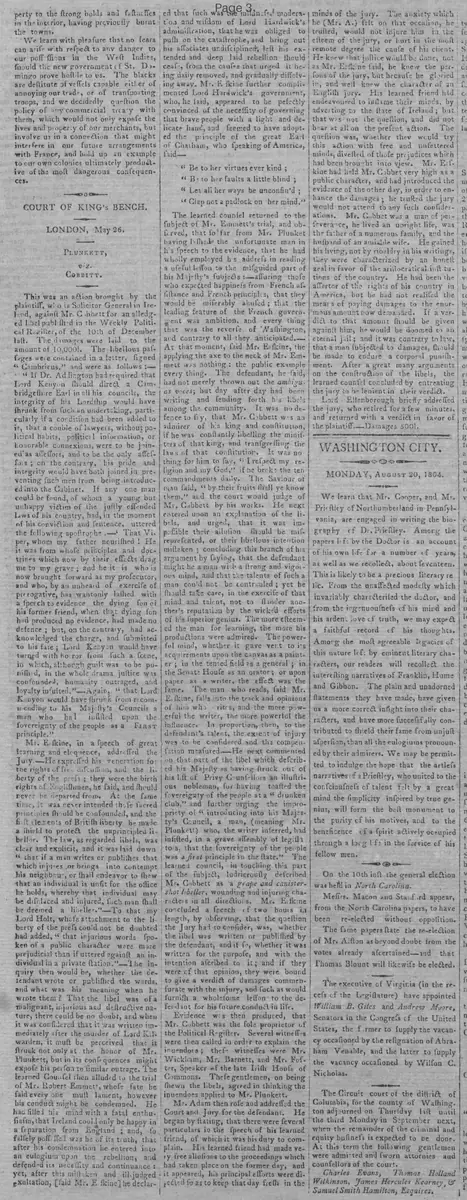
COURT OF KING's BENCH.
LONDON, May 26.
PLUNKETT, viz. COBBETT.
This was an action brought by the plaintiff, who is Solicitor General in Ireland, against Mr. Cobbett for an alleged libel published in the Weekly Political Register, of the 10th of December last. The damages were laid to the amount of 10,000l. The libellous passages were contained in a letter, signed "Cambricus." and were as follows: -
"If Dr. Addington had required that Lord Kenyon should direct a Cambridge-shire Earl in all his councils, the integrity of his Lordship would have shrunk from such an undertaking. particularly if a condition had been added to it, that a couple of lawyers, without political habits, political information, or honorable connexions, were to be joined as assessors, and to be the only assessors; on the contrary. his pride and integrity would have both joined in preventing such men from being introduced into the Cabinet. If any one man could be found, of whom a young but unhappy victim of the justly offended laws of his country, had, in the moment of his conviction and sentence, uttered the following apostrophe : 'That Viper, whom my father nourished ! He it was from whose principles and doctrines which now by their effects drag me to my grave; and he it is who is now brought forward as my prosecutor, and who, by an unheard of exercise of prerogative, has wantonly lashed with a speech to evidence the dying son of his former friend, when that dying son had produced no evidence, had made no defence ; but, on the contrary, had acknowledged the charge, and submitted to his fate; Lord Kenyon would have turned with horror from such a scene, in which, although guilt was to be punished, in the whole drama justice was confounded, humanity outraged, and loyalty insulted.'-Again, 'that Lord Kenyon would have shrunk from recommending to his Majesty's Councils a man who had insisted upon the sovereignty of the people as a First principle.'
Mr. Erskine, in a speech of great learning and eloquence, addressed the Jury.-He expressed his veneration for the rights of free discussion, and the liberty of the press ; they were the birth rights of Englishmen, he said, and should never be departed from. At the same time. it was never intended these sacred principles should be confounded, and the first settlements of British liberty be made a shield to protect the unprincipled libeller. The law, as regarded libels, was clear and explicit, and it was laid down "that if a man writes or publishes that which injures or brings into Contempt his neighbour, or shall endeavor to shew that an individual is unfit for the office he holds, whereby that individual may be displaced and injured, such man shall be deemed a libeller."To that my Lord Holt, whose attachment to the liberty of the press could not be doubted had added, "that injurious words spoken of a public character were more prejudicial than if uttered against an individual in a private station."-The inquiry then would be, whether the defendant wrote or published the words, and what was his meaning when he wrote them ? That the libel was of a malignant, injurious and destructive nature, there could be no doubt, and when it was considered that it was written immediately after the murder of Lord Kilwarden, it must be perceived that it struck not only at the honor of Mr. Plunkett, but in its consequences might expose his person to similar outrage. The learned Counsel then alluded to the trial of Mr. Robert Emmett, whose fate he said every one must lament, however his conduct might be condemned. He had filled his mind with a fatal enthusiasm, that Ireland could only be happy in a separation from England ; and, so falsely possessed was he of its truth, that after his condemnation he entered into an eulogium upon the rebellion, and defended its necessity and continuance : yet, after this mistaken and ill-judged exultation, said Mr. Erskine he declared- ed that such was the mildness, moderation and wisdom of Lord Hardwicke's administration, that he was obliged to push on the catastrophe, and bring out his associates undisciplined, lest his extended and deep laid rebellion should cease, from the causes that urged it being daily removed, and gradually dissolving away. Mr. Erskine further complimented Lord Hardwicke's government, who, he said, appeared to be perfectly convinced of the necessity of governing that brave people with a light and delicate hand, and seemed to have adopted the principle of the great Earl of Chatham, who speaking of America, said-
"Be to her virtues ever kind ;
"Be to her faults a little blind ;
"Let all her ways be unconfin'd ;
"Clap not a padlock on her mind."
The learned counsel returned to the subject of Mr. Emmett's trial, and observed, that so far from Mr. Plunkett having lashed the unfortunate man in his speech to the evidence, that he had wholly employed his address in reading a useful lesson to the misguided part of his Majesty's subjects :-assuring those who expected happiness from French assistance and French principles, that they would be miserably abused; that the leading feature of the French government was ambition. and every thing that was the reverse of Washington, and contrary to all they anticipated.-- At that moment, said Mr. Erskine, the applying the axe to the neck of Mr. Emmett was nothing : the public example every thing. The defendant, he said, had not merely thrown out the ambiguous voces; but day after day had been writing and sending forth his libels among the community. It was no defence to say, that Mr. Cobbett was an admirer of his king and constitution, if he was constantly libelling the ministers of that king, and transgressing the laws of that constitution. It was no thing for him to say, "I respect my religion and my God," if he broke the ten commandments daily. The Saviour of man said, "by their fruits shall ye know them," and the court would judge of Mr. Cobbett by his works. He next entered upon an explanation of the libels, and urged, that it was impossible their allusion should be misrepresented, or their libellous intention mistaken : concluding this branch of his argument by saying, that the defendant might be a man with a strong and vigorous mind, and that the talents of such a man could not be controlled; yet he should take care, in the exercise of that mind and talent, not to slander another's reputation by the wicked efforts of his superior genius. The more esteemed the man for learning, the more his productions were admired. The powerful mind, whether it gave vent to its acquirements upon the canvas as a painter : in the tented field as a general ; in the Senate House as an orator; or upon paper as a writer, the effect was the same. The man who reads, said Mr. Erskine, falls into the track and opinions of him who writes, and the more powerful the writer, the more powerful the influence. In proportion, then, to the defendant's talent, the extent of injury was to be considered and the compensation measured.-He next commented on that part of the libel which described his Majesty as having struck out of his List of Privy Councillors an illustrious nobleman, for having toasted the sovereignty of the people at a "drunken club," and further urging the impropriety of "introducing into his Majesty's Council, a man, (meaning Mr. Plunkett who, the writer inferred. had insisted, in a grave assembly of legislators, that the sovereignty of the people was a first principle in the state." The learned counsel, in touching this part of the subject, ludicrously described Mr. Cobbett as a grape and canister-shot libeller, wounding and injuring characters in all directions. Mr. Erskine concluded a speech of two hours in length, by observing, that the question the Jury had to consider, was, whether the libel was written or published by the defendant, and if , whether it was written for the purpose, and with the intention ascribed to it; and if they were of that opinion, they were bound to give a verdict of damages commensurate with the injury, and such as would furnish a wholesome lesson to the defendant for his future,conduct in life.
Evidence was then produced, that Mr. Cobbett was the sole proprietor of the Political Register. Several witnesses were then called in order to explain the innuendoes; the witnesses were Mr. William, Mr. Barnett, and Mr. Foster, Speaker of the late Irish House of Commons. These gentlemen, on being shewn the libels, agreed in thinking the innuendoes applied to Mr. Plunkett.
Mr. Adam then rose and addressed the Court and Jury for the defendant. He began by stating, that there were several particulars in the speech of his learned friend, of which it was his duty to complain. His learned friend had made very free allusions to the proceedings which had taken place on the former day, and it appeared, his principal efforts were directed so as to keep that day fresh in the minds of the jury. The anxiety which he (Mr. A.) felt on that occasion, he trusted, would not injure him in the esteem of the jury, or hurt in the most remote degree the cause of his client. He knew that justice would be done, not as Mr. Erskine said, he knew the persons of the jury, but because he gloried in, and well knew the character of an English jury. His learned friend had endeavoured to inflame their minds, by adverting to the state of Ireland; but that was not the question, and did not bear at all on the present action. The question was, whether they would try this action with free and unfettered minds, divested of those prejudices which had been brought into view. Mr. Erskine had held Mr. Cobbett very high as a public character, and had introduced the evidence of the other day, in order to enhance the damages: he trusted the jury would not attend to any such considerations. Mr. Cobbett was a man of perseverance, he lived an upright life, was the father of a numerous family, and the husband of an amiable wife. He gained his living, not by ribaldry in his writings, they were characterized by an honest zeal in favor of the aristocratical institutions of the country. He had been the assertor of the rights of his country in America, but he had not realized the means of paying damages to the enormous amount now demanded. If a verdict to that amount should be given against him, be would be doomed to an eternal jail; and it was contrary to law, that a man subjected to damages, should be made to endure a corporal punishment. After a great many arguments on the construction of the libels, the learned counsel concluded by entreating the jury to be lenient in their verdict.
Lord Ellenborough briefly addressed the jury, who retired for a few minutes, and returned with a verdict in favor of the plaintiff.-Damages 500l.
LONDON, May 26.
PLUNKETT, viz. COBBETT.
This was an action brought by the plaintiff, who is Solicitor General in Ireland, against Mr. Cobbett for an alleged libel published in the Weekly Political Register, of the 10th of December last. The damages were laid to the amount of 10,000l. The libellous passages were contained in a letter, signed "Cambricus." and were as follows: -
"If Dr. Addington had required that Lord Kenyon should direct a Cambridge-shire Earl in all his councils, the integrity of his Lordship would have shrunk from such an undertaking. particularly if a condition had been added to it, that a couple of lawyers, without political habits, political information, or honorable connexions, were to be joined as assessors, and to be the only assessors; on the contrary. his pride and integrity would have both joined in preventing such men from being introduced into the Cabinet. If any one man could be found, of whom a young but unhappy victim of the justly offended laws of his country, had, in the moment of his conviction and sentence, uttered the following apostrophe : 'That Viper, whom my father nourished ! He it was from whose principles and doctrines which now by their effects drag me to my grave; and he it is who is now brought forward as my prosecutor, and who, by an unheard of exercise of prerogative, has wantonly lashed with a speech to evidence the dying son of his former friend, when that dying son had produced no evidence, had made no defence ; but, on the contrary, had acknowledged the charge, and submitted to his fate; Lord Kenyon would have turned with horror from such a scene, in which, although guilt was to be punished, in the whole drama justice was confounded, humanity outraged, and loyalty insulted.'-Again, 'that Lord Kenyon would have shrunk from recommending to his Majesty's Councils a man who had insisted upon the sovereignty of the people as a First principle.'
Mr. Erskine, in a speech of great learning and eloquence, addressed the Jury.-He expressed his veneration for the rights of free discussion, and the liberty of the press ; they were the birth rights of Englishmen, he said, and should never be departed from. At the same time. it was never intended these sacred principles should be confounded, and the first settlements of British liberty be made a shield to protect the unprincipled libeller. The law, as regarded libels, was clear and explicit, and it was laid down "that if a man writes or publishes that which injures or brings into Contempt his neighbour, or shall endeavor to shew that an individual is unfit for the office he holds, whereby that individual may be displaced and injured, such man shall be deemed a libeller."To that my Lord Holt, whose attachment to the liberty of the press could not be doubted had added, "that injurious words spoken of a public character were more prejudicial than if uttered against an individual in a private station."-The inquiry then would be, whether the defendant wrote or published the words, and what was his meaning when he wrote them ? That the libel was of a malignant, injurious and destructive nature, there could be no doubt, and when it was considered that it was written immediately after the murder of Lord Kilwarden, it must be perceived that it struck not only at the honor of Mr. Plunkett, but in its consequences might expose his person to similar outrage. The learned Counsel then alluded to the trial of Mr. Robert Emmett, whose fate he said every one must lament, however his conduct might be condemned. He had filled his mind with a fatal enthusiasm, that Ireland could only be happy in a separation from England ; and, so falsely possessed was he of its truth, that after his condemnation he entered into an eulogium upon the rebellion, and defended its necessity and continuance : yet, after this mistaken and ill-judged exultation, said Mr. Erskine he declared- ed that such was the mildness, moderation and wisdom of Lord Hardwicke's administration, that he was obliged to push on the catastrophe, and bring out his associates undisciplined, lest his extended and deep laid rebellion should cease, from the causes that urged it being daily removed, and gradually dissolving away. Mr. Erskine further complimented Lord Hardwicke's government, who, he said, appeared to be perfectly convinced of the necessity of governing that brave people with a light and delicate hand, and seemed to have adopted the principle of the great Earl of Chatham, who speaking of America, said-
"Be to her virtues ever kind ;
"Be to her faults a little blind ;
"Let all her ways be unconfin'd ;
"Clap not a padlock on her mind."
The learned counsel returned to the subject of Mr. Emmett's trial, and observed, that so far from Mr. Plunkett having lashed the unfortunate man in his speech to the evidence, that he had wholly employed his address in reading a useful lesson to the misguided part of his Majesty's subjects :-assuring those who expected happiness from French assistance and French principles, that they would be miserably abused; that the leading feature of the French government was ambition. and every thing that was the reverse of Washington, and contrary to all they anticipated.-- At that moment, said Mr. Erskine, the applying the axe to the neck of Mr. Emmett was nothing : the public example every thing. The defendant, he said, had not merely thrown out the ambiguous voces; but day after day had been writing and sending forth his libels among the community. It was no defence to say, that Mr. Cobbett was an admirer of his king and constitution, if he was constantly libelling the ministers of that king, and transgressing the laws of that constitution. It was no thing for him to say, "I respect my religion and my God," if he broke the ten commandments daily. The Saviour of man said, "by their fruits shall ye know them," and the court would judge of Mr. Cobbett by his works. He next entered upon an explanation of the libels, and urged, that it was impossible their allusion should be misrepresented, or their libellous intention mistaken : concluding this branch of his argument by saying, that the defendant might be a man with a strong and vigorous mind, and that the talents of such a man could not be controlled; yet he should take care, in the exercise of that mind and talent, not to slander another's reputation by the wicked efforts of his superior genius. The more esteemed the man for learning, the more his productions were admired. The powerful mind, whether it gave vent to its acquirements upon the canvas as a painter : in the tented field as a general ; in the Senate House as an orator; or upon paper as a writer, the effect was the same. The man who reads, said Mr. Erskine, falls into the track and opinions of him who writes, and the more powerful the writer, the more powerful the influence. In proportion, then, to the defendant's talent, the extent of injury was to be considered and the compensation measured.-He next commented on that part of the libel which described his Majesty as having struck out of his List of Privy Councillors an illustrious nobleman, for having toasted the sovereignty of the people at a "drunken club," and further urging the impropriety of "introducing into his Majesty's Council, a man, (meaning Mr. Plunkett who, the writer inferred. had insisted, in a grave assembly of legislators, that the sovereignty of the people was a first principle in the state." The learned counsel, in touching this part of the subject, ludicrously described Mr. Cobbett as a grape and canister-shot libeller, wounding and injuring characters in all directions. Mr. Erskine concluded a speech of two hours in length, by observing, that the question the Jury had to consider, was, whether the libel was written or published by the defendant, and if , whether it was written for the purpose, and with the intention ascribed to it; and if they were of that opinion, they were bound to give a verdict of damages commensurate with the injury, and such as would furnish a wholesome lesson to the defendant for his future,conduct in life.
Evidence was then produced, that Mr. Cobbett was the sole proprietor of the Political Register. Several witnesses were then called in order to explain the innuendoes; the witnesses were Mr. William, Mr. Barnett, and Mr. Foster, Speaker of the late Irish House of Commons. These gentlemen, on being shewn the libels, agreed in thinking the innuendoes applied to Mr. Plunkett.
Mr. Adam then rose and addressed the Court and Jury for the defendant. He began by stating, that there were several particulars in the speech of his learned friend, of which it was his duty to complain. His learned friend had made very free allusions to the proceedings which had taken place on the former day, and it appeared, his principal efforts were directed so as to keep that day fresh in the minds of the jury. The anxiety which he (Mr. A.) felt on that occasion, he trusted, would not injure him in the esteem of the jury, or hurt in the most remote degree the cause of his client. He knew that justice would be done, not as Mr. Erskine said, he knew the persons of the jury, but because he gloried in, and well knew the character of an English jury. His learned friend had endeavoured to inflame their minds, by adverting to the state of Ireland; but that was not the question, and did not bear at all on the present action. The question was, whether they would try this action with free and unfettered minds, divested of those prejudices which had been brought into view. Mr. Erskine had held Mr. Cobbett very high as a public character, and had introduced the evidence of the other day, in order to enhance the damages: he trusted the jury would not attend to any such considerations. Mr. Cobbett was a man of perseverance, he lived an upright life, was the father of a numerous family, and the husband of an amiable wife. He gained his living, not by ribaldry in his writings, they were characterized by an honest zeal in favor of the aristocratical institutions of the country. He had been the assertor of the rights of his country in America, but he had not realized the means of paying damages to the enormous amount now demanded. If a verdict to that amount should be given against him, be would be doomed to an eternal jail; and it was contrary to law, that a man subjected to damages, should be made to endure a corporal punishment. After a great many arguments on the construction of the libels, the learned counsel concluded by entreating the jury to be lenient in their verdict.
Lord Ellenborough briefly addressed the jury, who retired for a few minutes, and returned with a verdict in favor of the plaintiff.-Damages 500l.
What sub-type of article is it?
Crime Story
Historical Event
What themes does it cover?
Justice
Crime Punishment
Deception
What keywords are associated?
Libel Trial
Cobbett
Plunkett
Robert Emmett
Kings Bench
Damages
What entities or persons were involved?
Plunkett
Cobbett
Erskine
Adam
Robert Emmett
Lord Ellenborough
Where did it happen?
London, Court Of King's Bench
Story Details
Key Persons
Plunkett
Cobbett
Erskine
Adam
Robert Emmett
Lord Ellenborough
Location
London, Court Of King's Bench
Event Date
May 26
Story Details
Plunkett sued Cobbett for libelous article in Political Register criticizing his prosecution of Emmett; Erskine prosecuted emphasizing harm to reputation and public safety; Adam defended portraying Cobbett as upright; jury awarded £500 damages to Plunkett.