Thank you for visiting SNEWPapers!
Sign up free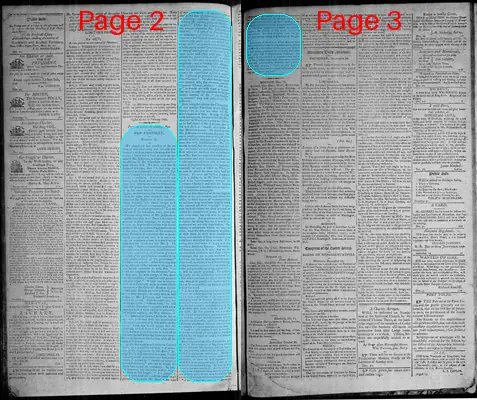
Alexandria Daily Advertiser
Alexandria, Virginia
What is this article about?
This editorial from the New-York Evening Post reviews a pamphlet criticizing Governor Clinton's unfavorable opinions of Thomas Jefferson as a statesman and republican, and Aaron Burr's character, highlighting Republican hypocrisy in supporting them. It also attacks Ambrose Spencer's political opportunism and ferocity.
Merged-components note: This is a clear continuation of the political pamphlet review from page 2 to page 3, forming a single coherent editorial piece.
Clippings
1 of 2
OCR Quality
Full Text
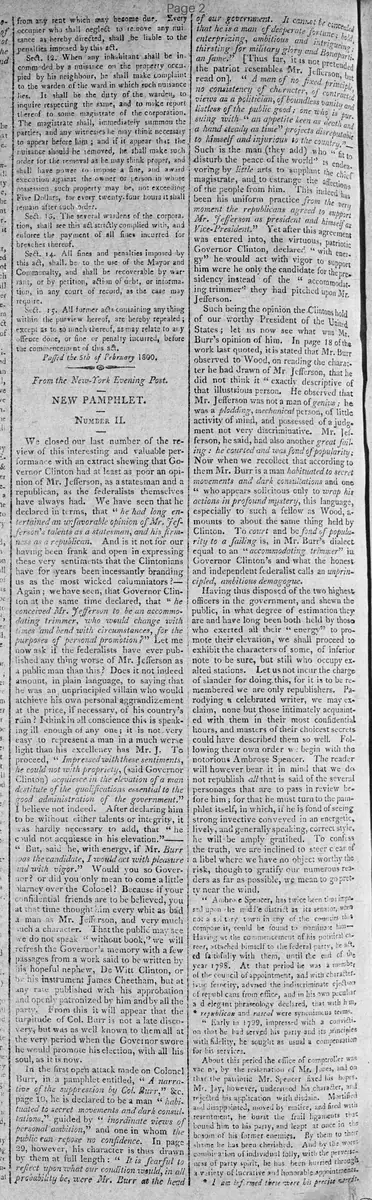
NEW PAMPHLET.
NUMBER II.
We closed our last number of the review of this interesting and valuable performance with an extract shewing that Governor Clinton had at least as poor an opinion of Mr. Jefferson, as a statesman and a republican, as the federalists themselves have always had. We have seen that he declared in terms, that "he had long entertained an unfavorable opinion of Mr. Jefferson's talents as a statesman, and his firmness as a republican. And is it not for our having been frank and open in expressing these very sentiments that the Clintonians have for years been incessantly branding us as the most wicked calumniators?
Again; we have seen, that Governor Clinton at the same time declared, that "he conceived Mr. Jefferson to be an accommodating trimmer, who would change with times and bend with circumstances, for the purposes of personal promotion?" Let me now ask if the federalists have ever published any thing worse of Mr. Jefferson as a public man than this? Does it not indeed amount, in plain language, to saying that he was an unprincipled villain who would achieve his own personal aggrandizement at the price, if necessary, of his country's ruin? I think in all conscience this is speaking ill enough of any one; it is not very easy to represent a man in a much worse light than his excellency has Mr. J.
To proceed, "Impressed with these sentiments, he could not with propriety, (said Governor Clinton) acquiesce in the elevation of a man destitute of the qualifications essential to the good administration of the government."
I believe not indeed. After declaring him to be without either talents or integrity, it was hardly necessary to add, that "he could not acquiesce in his elevation." ...
"But, said he, with energy, if Mr. Burr was the candidate, I would act with pleasure and with vigor." Would you so Governor? or did you only mean to come a little blarney over the Colonel? Because if your confidential friends are to be believed, you at that time thought him every whit as bad a man as Mr. Jefferson, and very much such a character. That the public may see we do not speak "without book," we will refresh the Governor's memory with a few passages from a work said to be written by his hopeful nephew, De Witt Clinton, or by his instrument James Cheetham, but at any rate published with his approbation and openly patronized by him and by all the party. From this it will appear that the turpitude of Col. Burr is not a late discovery, but was as well known to them all at the very period when the Governor swore he would promote his election, with all his soul, as it is now.
In the first open attack made on Colonel Burr, in a pamphlet entitled, "A narrative of the suppression by Col. Burr," &c. page 10, he is declared to be a man "habituated to secret movements and dark consultations," guided by "inordinate views of personal ambition," and one in whom the public can repose no confidence. In page 29, however, his character is thus drawn by them at full length: "It is fearful to reflect upon what our condition would, in all probability be, were Mr. Burr at the head of our government. It cannot be concealed that he is a man of desperate enterprising ambitious and intriguing thirsting for glory or military glory and the patriot resembles a man of character far from that of Mr. Jefferson of contracted pretended principle but views as a politician, of boundless vanity and listless with of the public an appetite good keen one as who death is and a hand steady as time projects disreputable to himself and injurious to the country."
Such is the man (they add) who "fit to disturb the peace of the world" is endeavoring by little arts to supplant the chief magistrate the people and from to him estrange This the indeed affections has been his uniform practice from the very moment the republicans agreed to support Mr. Jefferson as president and himself as Vice-President." Yet after this agreement was entered into, the virtuous, patriotic Governor Clinton, declared "with energy" he would act with vigor to support him were he only the candidate for the presidency instead of the "accommodating trimmer" they had pitched upon Mr. Jefferson.
Such being the opinion the Clintons hold of our worthy President of the United States; let us now see what was Mr. Burr's opinion of him. In page 18 of the work last quoted, it is stated that Mr. Burr observed to Wood, on reading the character he had drawn of Mr. Jefferson, that he did not think it "exactly descriptive of that illustrious person. He observed that Mr. Jefferson was not a man of genius; he was a plodding, mechanical person, of little activity of mind, and possessed of a judgment not very discriminate. Mr. Jefferson, he said, had also another great failing: he courted and was fond of popularity;
Now when we recollect that according to them Mr. Burr is a man habituated to secret movements and dark consultations and one "who appears solicitous only to wrap his actions in profound mystery, this language, especially to such a fellow as Wood, amounts to about the same thing held by Clinton. To court and be fond of popularity to a failing is, in Mr. Burr's dialect equal to an "accommodating trimmer" in Governor Clinton's and what the honest and independent federalist calls an unprincipled, ambitious demagogue.
Having thus disposed of the two highest officers in the government, and shewn the public, in what degree of estimation they are and have long been both held by those who exerted all their "energy" to promote their elevation, we shall proceed to exhibit the characters of some, of inferior note to be sure, but still who occupy exalted stations. Let us not incur the charge of slander for doing this, for it is to be remembered we are only republishers. Parodying a celebrated writer, we may exclaim, none but those intimately acquainted with them in their most confidential hours, and masters of their choicest secrets could have described them so well. Following their own order we begin with the notorious Ambrose Spencer. The reader will however bear it in mind that we do not republish all that is said of the several personages that are to pass in review before him: for that he must turn to the pamphlet itself, in which, if he is fond of seeing strong invective conveyed in an energetic, lively, and generally speaking, correct style, he will be amply gratified. To confess the truth, we are inclined to steer clear of a libel where we have no object worthy the risk, though to gratify our numerous readers as far as possible, we mean to go pretty near the wind.
"Ambrose Spencer, has twice been thus imposed upon the middle district as its senator, when not a solitary town in any of the counties that compose it, could be found to nominate him-- Having at the commencement of his political career, attached himself to the federal party, he acted faithfully with them, until the end of the year 1798. At that period he was a member of the council of appointment, and with characteristic ferocity, advised the indiscriminate ejection of republicans from office, and in his own peculiar and elegant phraseology declared, that with him, republican and rascal were synonymous terms.*
Early in 1799, impressed with a conviction that he had served his party and its principles with fidelity, he sought as usual a compensation for his services.
About this period the office of comptroller was vacant, by the resignation of Mr. Jones, and on that the patriotic Mr. Spencer fixed his hopes. Mr. Jay, however, understood his character, and rejected his application with disdain. Mortified and disappointed, moved by malice, and fired with resentment, he burst the frail ligaments that bound him to his party, and leapt at once in the bosom of his former enemies. By them to their shame he has been cherished. And by the worst combination of individual folly, with the perverseness of party spirit, he has been hurried through a variety of lucrative and honorable appointments.
* I am informed there were his precise words."
Without the aid of genius, or a single stream which the reputation of the party has been held. He has been raised to an elevated station, by lessly endangered, its honor degraded and betrayed. For what purposes this insult has been offered to the dignity of the state, cannot be conjectured. For none certainly that can justify this outrage upon the feelings of the public."
Such is one of the men at whose disposal those who called themselves the republican party, placed the office and emoluments of this state, and who, it is well known, exercised his authority with what they aptly call "characteristic ferocity;" but which it is too, too well remembered they also at that time, before they found themselves excluded from any participation, defended and justified.
Truly may we say, "Their mischief hath returned upon their own head, and their violent dealings upon their own pate."
(To be Continued.)
What sub-type of article is it?
What keywords are associated?
What entities or persons were involved?
Editorial Details
Primary Topic
Critique Of Clinton's Opinions On Jefferson And Burr And Republican Hypocrisy
Stance / Tone
Strongly Anti Republican, Mocking And Critical
Key Figures
Key Arguments