Thank you for visiting SNEWPapers!
Sign up free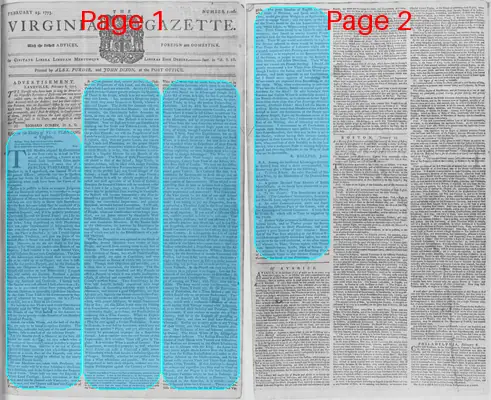
The Virginia Gazette
Richmond, Williamsburg, Richmond County, Virginia
What is this article about?
An 18th-century essay by R. Bolling, Jr., advocating for expanded public vineyards in Virginia to produce wine, reduce imports from Madeira and West Indies, boost economy on poorer lands, benefit the poor, and increase colonial prosperity. References 1769 government measure and Horace epigraph.
Merged-components note: This merges the essay on the utility of vine planting in Virginia, which continues seamlessly from page 1 to page 2, signed by R. Bolling, Jr. The original label for the second part was letter_to_editor, but it is part of the same literary essay.
Clippings
1 of 2
OCR Quality
Full Text
Nullam, Vare, sacra vite prius severis arborem,
Circa mihi solum Tiburis et moenia Catili.
Siccis omnia nam dura Deus proposuit.
Hor.
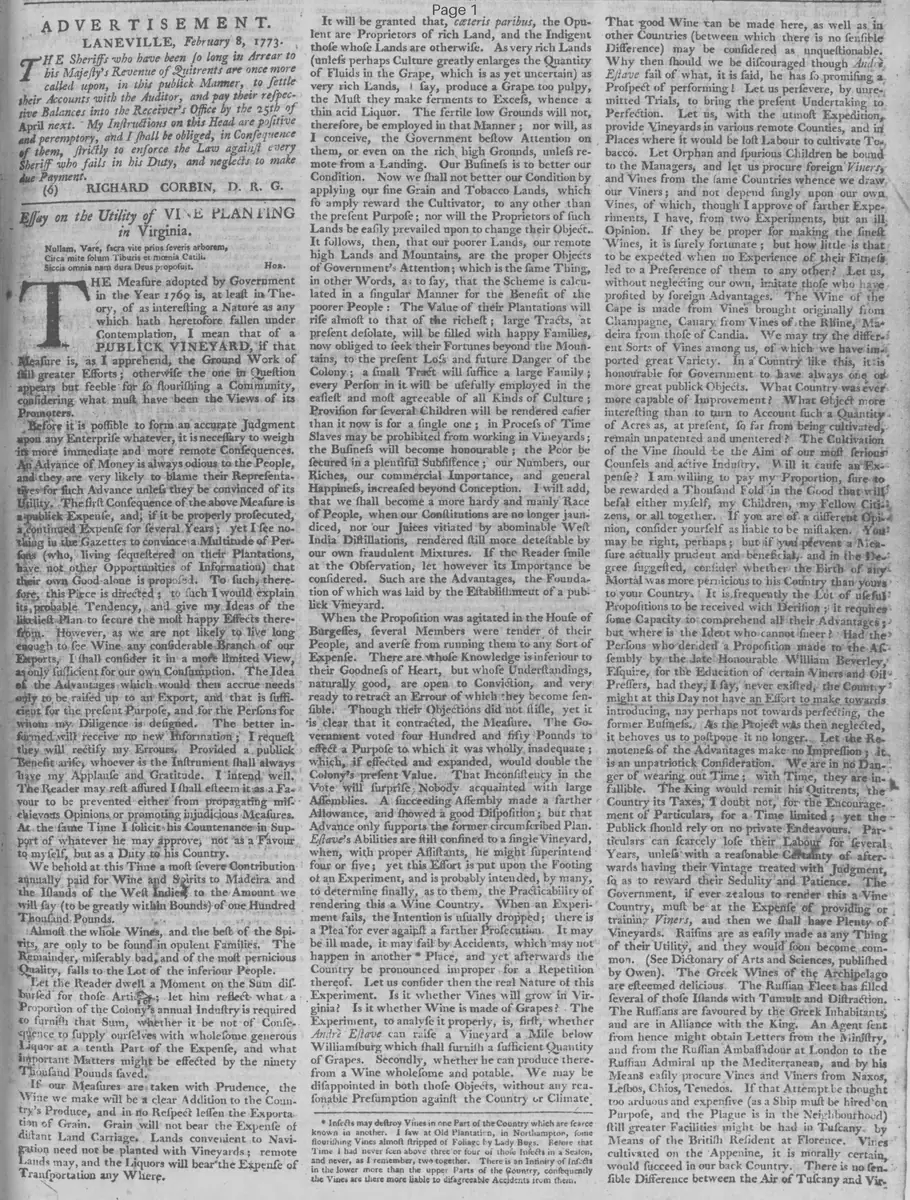
The Measure adopted by Government in the Year 1769 is, at least in Theory, of as interesting a Nature as any which hath heretofore fallen under Contemplation, I mean that of a PUBLICK VINEYARD, if that Measure is, as I apprehend, the Ground Work of still greater Efforts; otherwise the one in Question appears but feeble for so flourishing a Community, considering what must have been the Views of its Promoters.
Before it is possible to form an accurate Judgment upon any Enterprise whatever, it is necessary to weigh its more immediate and more remote Consequences. An Advance of Money is always odious to the People, and they are very likely to blame their Representatives for such Advance unless they be convinced of its Utility. The first Consequence of the above Measure is a publick Expence, and; if it be properly prosecuted, a continued Expence for several Years; yet I see nothing in the Gazettes to convince a Multitude of Persons (who, living sequestered on their Plantations, have not other Opportunities of Information) that their own Good alone is proposed. To such, therefore, this Piece is directed ; to such I would explain its probable Tendency, and give my Ideas of the likeliest Plan to secure the most happy Effects therefrom. However, as we are not likely to live long enough to see Wine any considerable Branch of our Exports, I shall consider it in a more limited View, as only sufficient for our own Consumption. The Idea of the Advantages which would then accrue needs only to be raised up to an Export, and that is sufficient for the present Purpose, and for the Persons for whom my Diligence is designed. The better informed will receive no new Information ; I request they will rectify my Errors. Provided a publick Benefit arise, whoever is the Instrument shall always have my Applause and Gratitude. I intend well. The Reader may rest assured I shall esteem it as a Favour to be prevented either from propagating mischievous Opinions or promoting injudicious Measures. At the Same Time I solicit his Countenance in Support of whatever he may approve, not as a Favour to myself, but as a Duty to his Country.
We behold at this Time a most severe Contribution annually paid for Wine and Spirits to Madeira and the Islands of the West Indies to the Amount we will say (to be greatly within Bounds) of one Hundred Thousand Pounds. Almost the whole Wines, and the best of the Spirits, are only to be found in opulent Families. The Remainder, miserably bad, and of the most pernicious Quality, falls to the Lot of the inferiour People. Let the Reader dwell a Moment on the Sum disbursed for those Articles; let him reflect what a Proportion of the Colony's annual Industry is required to furnish that Sum, whether it be not of Consequence to supply ourselves with wholesome generous Liquor at a tenth Part of the Expense, and what important Matters might be effected by the ninety Thousand Pounds saved.
If our Measures are taken with Prudence, the Wine we make will be a clear Addition to the Country's Produce, and in no Respect lessen the Exportation of Grain. Grain will not bear the Expence of distant Land Carriage. Lands convenient to Navigation need not be planted with Vineyards; remote Lands may, and the Liquors will bear the Expence of Transportation any Where.
It will be granted that, cæteris paribus, the Opulent are Proprietors of rich Land, and the Indigent those whose Lands are otherwise. As very rich Lands (unless perhaps Culture greatly enlarges the Quantity of Fluids in the Grape, which is as yet uncertain) as very rich Lands, I say, produce a Grape too pulpy, the Must they make ferments to Excess, whence a thin acid Liquor. The fertile low Grounds will not, therefore, be employed in that Manner ; nor will, as I conceive, the Government bestow Attention on them, or even on the rich high Grounds, unless remote from a Landing. Our Business is to better our Condition. Now we shall not better our Condition by applying our fine Grain and Tobacco Lands, which so amply reward the Cultivator, to any other than the present Purpose; nor will the Proprietors of such Lands be easily prevailed upon to change their Object. It follows, then, that our poorer Lands, our remote high Lands and Mountains, are the proper Objects of Government's Attention; which is the same Thing, in other Words, as to say, that the Scheme is calculated in a singular Manner for the Benefit of the poorer People : The Value of their Plantations will rise almost to that of the richest ; large Tracts, at present desolate, will be filled with happy Families, now obliged to seek their Fortunes beyond the Mountains, to the present Loss and future Danger of the Colony; a small Tract will suffice a large Family ; every Person in it will be usefully employed in the easiest and most agreeable of all Kinds of Culture ; Provision for several Children will be rendered easier than it now is for a single one : in Process of Time Slaves may be prohibited from working in Vineyards ; the Business will become honourable: the Poor be secured in a plentiful Subsistence ; our Numbers, our Riches, our commercial Importance, and general Happiness, increased beyond Conception. I will add, that we shall become a more hardy and manly Race of People, when our Constitutions are no longer jaundiced, nor our Juices vitiated by abominable West India Distillations, rendered still more detestable by our own fraudulent Mixtures. If the Reader smile at the Observation, let however its Importance be considered. Such are the Advantages, the Foundation of which was laid by the Establishment of a publick Vineyard.
When the Proposition was agitated in the House of Burgesses, several Members were tender of their People, and averse from running them to any Sort of Expence. There are whose Knowledge is inferior to their Goodness of Heart, but whose Understandings, naturally good, are open to Conviction, and very ready to retract an Error of which they become sensible. Though their Objections did not stifle, yet it is clear that it contracted, the Measure. The Government voted four Hundred and fifty Pounds to effect a Purpose to which it was wholly inadequate ; which if effected and expanded, would double the Colony's present Value. That Inconsistency in the Vote will surprise, Nobody acquainted with large Assemblies. Succeeding Assembly made a farther Allowance, and showed a good Disposition; but that Advance only supports the former circumscribed Plan. Etave's Abilities are still confined to a single Vineyard, when, with proper Assistants, he might superintend four or five; yet this Effort is put upon the Footing of an Experiment, and is probably intended, by many, to determine finally, as to them, the Practicability of rendering this a Wine Country. When an Experiment fails, the Intention is usually dropped; there is a Plea for ever against a farther Prosecution. It may be ill made, it may fail by Accidents, which may not happen in another Place, and yet afterwards the Country be pronounced improper for a Repetition thereof. Let us consider then the real Nature of this Experiment. Is it whether Vines will grow in Virginia? Is it whether Wine is made of Grapes? The Experiment, to analyse it properly, is, first, whether Andre Etave can raise a Vineyard a Mile below Williamsburg which shall furnish a sufficient Quantity of Grapes. Secondly, whether he can produce therefrom a Wine wholesome and potable. We may be disappointed in both those Objects, without any reasonable Presumption against the Country or Climate.
Insects may destroy Vines in one Part of the Country which are scarce known in another. I saw at Old Plantation, in Northampton, some flourishing Vines almost stripped of Foliage by Lady Bugs. Before that Time I had never seen above three or four of those Insects in a Season, and never, as I remember, two together. There is an Infinity of Insects in the lower more than the upper Parts of the Country, consequently the Vines are there more liable to disagreeable Accidents from them.
That good Wine can be made here, as well as in other Countries (between which there is no sensible Difference) may be considered as unquestionable. Why then should we be discouraged though Andre Estave fail of what, it is said, he has so promising a Prospect of performing ! Let us persevere, by unremitted Trials, to bring the present Undertaking to Perfection. Let us, with the utmost Expedition, provide Vineyards in various remote Counties, and in Places where it would be lost Labour to cultivate Tobacco. Let Orphan and spurious Children be bound to the Managers, and let us procure foreign Viners, and Vines from the same Countries whence we draw our Viners; and not depend singly upon our own Vines, of which, though I approve of farther Experiments, I have, from two Experiments, but an ill Opinion. If they be proper for making the inest Wines, it is surely fortunate ; but how little is that to be expected when no Experience of their Fitness led to a Preference of them to any other? Let us, without neglecting our own, imitate those who have profited by foreign Advantages. The Wine of the Cape is made from Vines brought originally from Champagne, Canary from Vines of the Rhine, Madeira from those of Candia. We may try the different Sorts of Vines among us, of which we have imported great Variety. In a Country like this, it is honourable for Government to have always one or more great publick Objects. What Country was ever more capable of Improvement? What Object more interesting than to turn to Account such a Quantity of Acres as, at present, so far from being cultivated, remain unpatented and unentered? The Cultivation of the Vine should be the Aim of our most serious Counsels and active Industry. Will it cause an Expence? I am willing to pay my Proportion, sure to be rewarded a Thousand Fold in the Good that will befall either myself, my Children, my Fellow Citizens, or all together. If you are of a different Opinion, consider yourself as liable to be mistaken. You may be right, perhaps; but if you prevent a Measure actually prudent and beneficial, and in the Degree suggested, consider whether the Birth of any Mortal was more pernicious to his Country than yours to your Country. It is frequently the Lot of new Propositions to be received with Derision ; it requires some Capacity to comprehend all their Advantages ; but where is the Idiot who cannot sneer ? Had the Persons who derided a Proposition made to the Assembly by the late Honourable William Beverley, Esquire, for the Education of certain Viners and Oil Pressers, had they, I say, never existed, the Country might at this Day not have an Effort to make towards introducing, nay perhaps not towards perfecting, the former Business. As the Project was then neglected, it behoves us to postpone it no longer. Let the Remoteness of the Advantages make no Impression ; it is an unpatriotick Consideration. We are in no Danger of wearing out Time; with Time, they are infallible. The King would remit his Quitrents, the Country its Taxes, I doubt not, for the Encouragement of Particulars, for a Time limited ; yet the Publick should rely on no private Endeavours. Particulars can scarcely lose their Labour for several Years, unless with a reasonable Certainty of afterwards having their Vintage treated with Judgment, so as to reward their Sedulity and Patience. The Government, if ever zealous to render this a Vine Country, must be at the Expence of providing or training Viners, and then we shall have Plenty of Vineyards. Raisins are as easily made as any Thing of their Utility, and they would soon become common. (See Dictionary of Arts and Sciences, published by Owen). The Greek Wines of the Archipelago are esteemed delicious. The Russian Fleet has filled several of those Islands with Tumult and Distraction. The Russians are favoured by the Greek Inhabitants, and are in Alliance with the King. An Agent sent from hence might obtain Letters from the Ministry, and from the Russian Ambassador at London to the Russian Admiral in the Mediterranean, and by his Means easily procure Vines and Viners from Naxos, Lesbos, Chios, Tenedos. If that Attempt be thought too arduous and expensive (as a Ship must be hired on Purpose, and the Plague is in the Neighbourhood) still greater Facilities might be had in Tuscany, by Means of the British Resident at Florence. Vines cultivated on the Appenine, it is morally certain, would succeed in our back Country. There is no sensible Difference between the Air of Tuscany and Virginia.
Virginia. The great Number of English Gentlemen who reside at Florence, and spend much Money there, would give great Weight to an Application for Leave to engage Vignerons; and the more, as the Loss of the Vignerons would be the sole Inconvenience Tuscany would sustain, no Wines coming thence to America. Those Vignerons should by no Means be mere Adventurers, they should be worthy Country People, qualified each for the Superintendence of four Vineyards. Their Wages would undoubtedly be high, as the Service referred to them would be important. Four Times the Number of Labourers might also be engaged, acquainted with Pruning and other Branches of Culture; to be employed at the Recommendation of the former, as proper to carry on the Business in their Absence, and follow Directions. Their Wages need not exceed ten Pounds Sterling. I should also greatly recommend a few Vignerons from Champagne, though I believe the Italian and Greek Wines more pleasant, and more agreeable to our Constitutions; but I should never approve of introducing those Wines which are exported from Bourdeaux, or any like them. Why, when endeavouring to introduce Wine into the Country, should we depend upon mere Accident for the Kind? Or why introduce those Guienne and Gascon Wines so universally decried by the French themselves, as to obtain no better Appellation from them than that d'un Breuvage detestable, namely, detestable Drink? Here I rest the Matter at present. Having heard that Members of the Assembly desired to know the Sentiments of the People upon the above Subject, I give my Sentiments as one of the Number; at the Same Time I endeavour to fulfil the End of my Writing, that of informing my retired Countrymen. I recommend to all Freeholders to explain their Sentiments upon publick Vineyards to their Representatives, that they may be free to act in the Matter, without having their virtuous Conduct arraigned in their Counties by a Set of officious Fellows, who, conscious of their Inability to do the least Service, take a malignant Pride in exciting Suspicions against and throwing Obstacles in the Way of those who can be serviceable.
R. BOLLING, Junior.
P. S. Among the incidental Advantages that may be derived from what is above recommended, the Reader may give a Glance to the following :
1. To Great Britain. An easier Purchase of Madeira Wine, by the Diminution of the Demand from America.
2. A greater Demand from America of British Manufactures, as we should have wherewith to purchase in greater Plenty.
3. To this Country. The Introduction of Glass Houses. [The Counties of Northampton, Accomack, and Princess Anne, might supply Kelp in Abundance.]
4. An easier Communication, north and south, between the different Parts of the Colony, with all the Advantages of internal Commerce. A ready Sale of Grain, &c. which will in Time be neglected by the Vignerons.
5. Greater Value to remote indifferent and mountainous Lands, and to Timber proper for Staves. Easier Sustenance on small Plantations, and consequently a great Increase of their Number : Detention of the Poor from migrating to the Western Waters (Advantages chiefly mentioned before, but which can never be too well considered, or too often repeated) whence, in Time, Towns replete with Tradesmen, Manufacturers, Artisans, Men of Science, &c. &c. whence, in fine, a great and flourishing People of inestimable Value to the Mother Country, and therefore the surest of her Protection.
What sub-type of article is it?
What themes does it cover?
What keywords are associated?
What entities or persons were involved?
Literary Details
Title
Essay On The Utility Of Vine Planning In Virginia.
Author
R. Bolling, Junior.
Subject
Advocacy For Public Vineyards And Viticulture In Virginia Following 1769 Government Measure.
Form / Style
Argumentative Prose Essay With Epigraph.
Key Lines