Thank you for visiting SNEWPapers!
Sign up free
Republican Herald
Providence, Providence County, Rhode Island
What is this article about?
A Whig criticizes Joseph L. Tillinghast for inviting non-members to a private 1834 Rhode Island convention to undermine Tristam Burges's Senate candidacy, detailing subsequent political maneuvers favoring Nehemiah R. Knight. The writer also opposes Robert B. Cranston for Congress due to his votes permitting British invasion of Maine and overlooking dueling without investigation.
Clipping
OCR Quality
Full Text
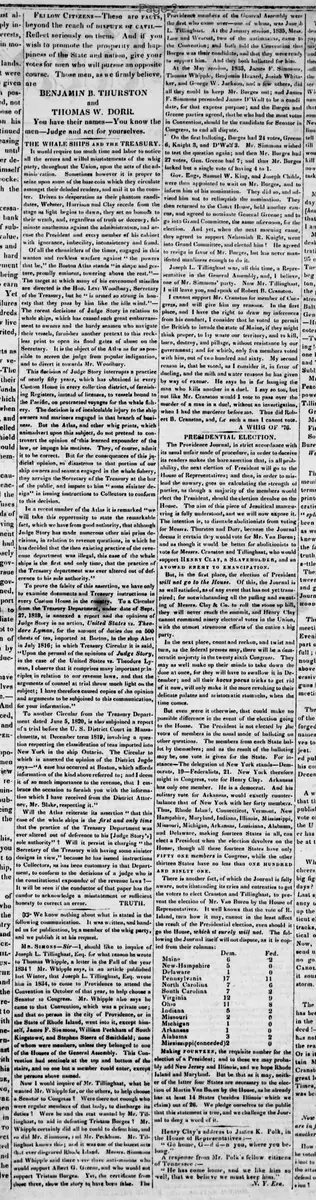
Mr. Simons—Sir—I should like to inquire of Joseph L. Tillinghast, Esq. for what reason he wrote to Thomas Whipple, a letter in the Fall of the year 1834? Mr. Whipple says, in an article published last Winter, that Joseph L. Tillinghast, Esq. wrote him in 1834, to come to Providence to attend the Convention in October of that year, to help choose a Senator to Congress. Mr. Whipple also says he came to that Convention, which was a private one; and that no person in the city of Providence, or in the State of Rhode Island, went into it, except himself, James F. Simmons, William Peckham of South Kingstown; and Stephen Steere of Smithfield; none of whom were members, unless they belonged to one of the Houses of the General Assembly. This Convention had sentinels at the top and bottom of the stairs, and no one but a member could enter, except the persons above named.
Now I would inquire of Mr. Tillinghast, what he wanted Mr. Whipple for, or the others, to help choose a Senator to Congress? Were there not enough who were regular members of that body, to discharge its duties? Were he and the rest wanted by Mr. Tillinghast, to aid in defeating Tristam Burges? Mr. Whipple certainly did all he could to defeat him, and so did Mr. Simmons, & and Mr. Peckham. Mr. Tillinghast knows this; and it was one of the basest acts that ever disgraced Rhode Island. Messrs. Simmons and Whipple said there were three anti-masons who would support Albert G. Greene, and who would not support Tristam Burges. Yet, the certificate from those three, show the story to have been false. The Providence members of the General Assembly were the first who came over—one of whom, was Joseph L. Tillinghast. At the January session, 1835, Mess. Low and Wescott, two of the anti-masons, came to the Convention; and both told the Convention that Burges was their candidate, and that they were ready to support him. And they both ballotted for him.
At the May session, 1835, James F. Simmons, Thomas Whipple, Benjamin Hazard, Josiah Whittaker, and George W. Jackson, and a few others, did all they could to keep Mr. Burges out; and James F. Simmons persuaded James D'Wolf to be a candidate, for that express purpose; and the Burges and Greene parties agreed, that he who had the most votes in Convention, should be the candidate for Senator in Congress, to end all dispute.
On the first balloting, Burges had 24 votes, Greene 6, Knight 3, and D'Wolf 3. Mr. Simmons wished to test the question again; and then Mr. Burges had 27 votes, Gen. Greene had 7; and thus Mr. Burges lacked but a single vote of having 4 to 1.
Gov. Engs, Samuel W. King, and Joseph Childs, were then appointed to wait on Mr. Burges, and to inform him of his nomination. They did so, and advised him not to relinquish the nomination. They then returned to the Court House, held another caucus, and agreed to nominate General Greene; and to go into Grand Committee, the same afternoon, for the election. And yet, when the next morning came, they agreed to support Nehemiah R. Knight, went into Grand Committee, and elected him! He agreed to resign in favor of Mr. Burges, but has never manifested manliness enough to do it.
Joseph L. Tillinghast was, all this time, a Representative in the General Assembly, and, I believe, one of Mr. Simmons' party. Now Mr. Tillinghast, I will leave you, and speak of Robert B. Cranston. I cannot support Mr. Cranston for member of Congress, and will give him my reasons. In the first place, and I have the right to draw my inferences from his conduct, I consider that he voted to permit the British to invade the state of Maine, if they might think proper, to lay waste our territory, and to kill, burn, destroy, and pillage, without resistance by our government; and for which, only five members voted with him, out of two hundred and sixty. My second reason is, that he voted, as I consider it, in favor of dueling, and the milk and water reasons he has given by way of excuse. He says he is for hanging the man who kills another in a duel. I say so too, but not like Mr. Cranston would I vote to pass over the murder of a man in a duel, without an investigation, when I had the murderer before me. Thus did Robert B. Cranston, and, for such a man I cannot vote.
A WHIG OF '76.
What sub-type of article is it?
What themes does it cover?
What keywords are associated?
What entities or persons were involved?
Letter to Editor Details
Author
A Whig Of '76
Recipient
Mr. Simons
Main Argument
joseph l. tillinghast improperly invited non-members to a private 1834 convention to defeat tristam burges's senate nomination through deceitful maneuvers; robert b. cranston is unfit for congress due to votes allowing british invasion of maine and excusing dueling without investigation.
Notable Details