Thank you for visiting SNEWPapers!
Sign up free
Literary
October 1, 1798
The Gazette
Portland, Cumberland County, Maine
What is this article about?
An allegorical essay portraying the Republic of Letters as an ancient, global society of scholars, artists, and intellectuals across nations and ranks, extolling its freedoms and eloquence while critiquing divisions, vices like vanity, plagiarism, and tyrannical critics.
Clipping
OCR Quality
95%
Excellent
Full Text
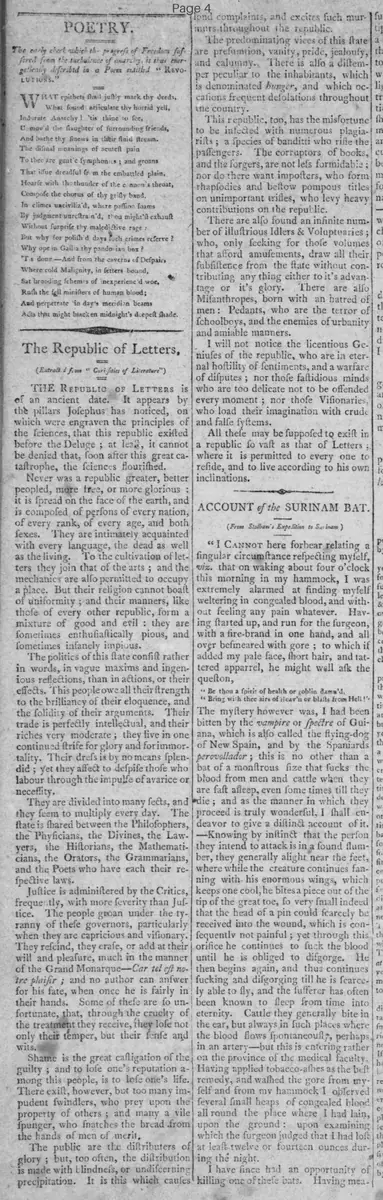
The Republic of Letters,
(Extracted from "Curiosities of Literature")
The Republic of Letters is of an ancient date. It appears by the pillars Josephus has noticed, on which were engraven the principles of the sciences, that this republic existed before the Deluge; at least, it cannot be denied that, soon after this great catastrophe, the sciences flourished.
Never was a republic greater, better peopled, more free, or more glorious: it is spread on the face of the earth, and is composed of persons of every nation, of every rank, of every age, and both sexes. They are intimately acquainted with every language, the dead as well as the living. To the cultivation of letters they join that of the arts; and the mechanics are also permitted to occupy a place. But their religion cannot boast of uniformity; and their manners, like those of every other republic, form a mixture of good and evil: they are sometimes enthusiastically pious, and sometimes insanely impious.
The politics of this state consist rather in words, in vague maxims and ingenious reflections, than in actions, or their effects. This people owe all their strength to the brilliancy of their eloquence, and the solidity of their arguments. Their trade is perfectly intellectual, and their riches very moderate; they live in one continued strife for glory and for immortality. Their dress is by no means splendid; yet they affect to despise those who labour through the impulse of avarice or necessity.
They are divided into many sects, and they seem to multiply every day. The state is shared between the Philosophers, the Physicians, the Divines, the Lawyers, the Historians, the Mathematicians, the Orators, the Grammarians, and the Poets who have each their respective laws.
Justice is administered by the Critics, frequently, with more severity than Justice. The people groan under the tyranny of these governors, particularly when they are capricious and visionary. They rescind, they erase, or add at their will and pleasure, much in the manner of the Grand Monarque—Car tel est notre plaisir; and no author can answer for his fate, when once he is fairly in their hands. Some of these are so unfortunate, that, through the cruelty of the treatment they receive, they lose not only their temper, but their sense and wits.
Shame is the great castigation of the guilty; and to lose one's reputation among this people, is to lose one's life. There exist, however, but too many impudent swindlers, who prey upon the property of others; and many a vile plunderer, who snatches the bread from the hands of men of merit.
The public are the distributors of glory; but, too often, the distribution is made with blindness, or undicerning precipitation. It is this which causes loud complaints, and excites such murmurs throughout the republic.
The predominating vices of this state are presumption, vanity, pride, jealousy, and calumny. There is also a distemper peculiar to the inhabitants, which is denominated hunger, and which occasions frequent desolations throughout the country.
This republic, too, has the misfortune to be infected with numerous plagiarists; a species of banditti who rifle the passengers. The corruptors of books, and the forgers, are not less formidable: nor do there want imposters, who form rhapsodies and bestow pompous titles on unimportant trifles, who levy heavy contributions on the republic.
There are also found an infinite number of illustrious Idlers & Voluptuaries; who, only seeking for those volumes that afford amusements, draw all their subsistence from the state without contributing any thing either to it's advantage or it's glory. There are also Misanthropes, born with an hatred of men: Pedants, who are the terror of schoolboys, and the enemies of urbanity and amiable manners.
I will not notice the licentious Geniuses of the republic, who are in eternal hostility of sentiments, and a warfare of disputes; nor those fastidious minds who are too delicate not to be offended every moment; nor those Visionaries, who load their imagination with crude and false systems.
All these may be supposed to exist in a republic so vast as that of Letters; where it is permitted to every one to reside, and to live according to his own inclinations.
(Extracted from "Curiosities of Literature")
The Republic of Letters is of an ancient date. It appears by the pillars Josephus has noticed, on which were engraven the principles of the sciences, that this republic existed before the Deluge; at least, it cannot be denied that, soon after this great catastrophe, the sciences flourished.
Never was a republic greater, better peopled, more free, or more glorious: it is spread on the face of the earth, and is composed of persons of every nation, of every rank, of every age, and both sexes. They are intimately acquainted with every language, the dead as well as the living. To the cultivation of letters they join that of the arts; and the mechanics are also permitted to occupy a place. But their religion cannot boast of uniformity; and their manners, like those of every other republic, form a mixture of good and evil: they are sometimes enthusiastically pious, and sometimes insanely impious.
The politics of this state consist rather in words, in vague maxims and ingenious reflections, than in actions, or their effects. This people owe all their strength to the brilliancy of their eloquence, and the solidity of their arguments. Their trade is perfectly intellectual, and their riches very moderate; they live in one continued strife for glory and for immortality. Their dress is by no means splendid; yet they affect to despise those who labour through the impulse of avarice or necessity.
They are divided into many sects, and they seem to multiply every day. The state is shared between the Philosophers, the Physicians, the Divines, the Lawyers, the Historians, the Mathematicians, the Orators, the Grammarians, and the Poets who have each their respective laws.
Justice is administered by the Critics, frequently, with more severity than Justice. The people groan under the tyranny of these governors, particularly when they are capricious and visionary. They rescind, they erase, or add at their will and pleasure, much in the manner of the Grand Monarque—Car tel est notre plaisir; and no author can answer for his fate, when once he is fairly in their hands. Some of these are so unfortunate, that, through the cruelty of the treatment they receive, they lose not only their temper, but their sense and wits.
Shame is the great castigation of the guilty; and to lose one's reputation among this people, is to lose one's life. There exist, however, but too many impudent swindlers, who prey upon the property of others; and many a vile plunderer, who snatches the bread from the hands of men of merit.
The public are the distributors of glory; but, too often, the distribution is made with blindness, or undicerning precipitation. It is this which causes loud complaints, and excites such murmurs throughout the republic.
The predominating vices of this state are presumption, vanity, pride, jealousy, and calumny. There is also a distemper peculiar to the inhabitants, which is denominated hunger, and which occasions frequent desolations throughout the country.
This republic, too, has the misfortune to be infected with numerous plagiarists; a species of banditti who rifle the passengers. The corruptors of books, and the forgers, are not less formidable: nor do there want imposters, who form rhapsodies and bestow pompous titles on unimportant trifles, who levy heavy contributions on the republic.
There are also found an infinite number of illustrious Idlers & Voluptuaries; who, only seeking for those volumes that afford amusements, draw all their subsistence from the state without contributing any thing either to it's advantage or it's glory. There are also Misanthropes, born with an hatred of men: Pedants, who are the terror of schoolboys, and the enemies of urbanity and amiable manners.
I will not notice the licentious Geniuses of the republic, who are in eternal hostility of sentiments, and a warfare of disputes; nor those fastidious minds who are too delicate not to be offended every moment; nor those Visionaries, who load their imagination with crude and false systems.
All these may be supposed to exist in a republic so vast as that of Letters; where it is permitted to every one to reside, and to live according to his own inclinations.
What sub-type of article is it?
Essay
Satire
What themes does it cover?
Political
Social Manners
Moral Virtue
What keywords are associated?
Republic Of Letters
Intellectual Society
Literary Vices
Critics Tyranny
Plagiarism Banditti
What entities or persons were involved?
Extracted From "Curiosities Of Literature"
Literary Details
Title
The Republic Of Letters
Author
Extracted From "Curiosities Of Literature"
Key Lines
Never Was A Republic Greater, Better Peopled, More Free, Or More Glorious: It Is Spread On The Face Of The Earth, And Is Composed Of Persons Of Every Nation, Of Every Rank, Of Every Age, And Both Sexes.
Justice Is Administered By The Critics, Frequently, With More Severity Than Justice.
The Predominating Vices Of This State Are Presumption, Vanity, Pride, Jealousy, And Calumny.
This Republic, Too, Has The Misfortune To Be Infected With Numerous Plagiarists; A Species Of Banditti Who Rifle The Passengers.