Thank you for visiting SNEWPapers!
Sign up free
Editorial
October 14, 1920
The Laramie Republican
Laramie, Albany County, Wyoming
What is this article about?
Editorial presents reasons from prominent figures like Crowell, Atherton, Hoover, and Abbott for voting Republican in 1920, criticizing Democratic failures and arguing Harding better ensures efficient government and League of Nations with reservations.
Clipping
OCR Quality
95%
Excellent
Full Text
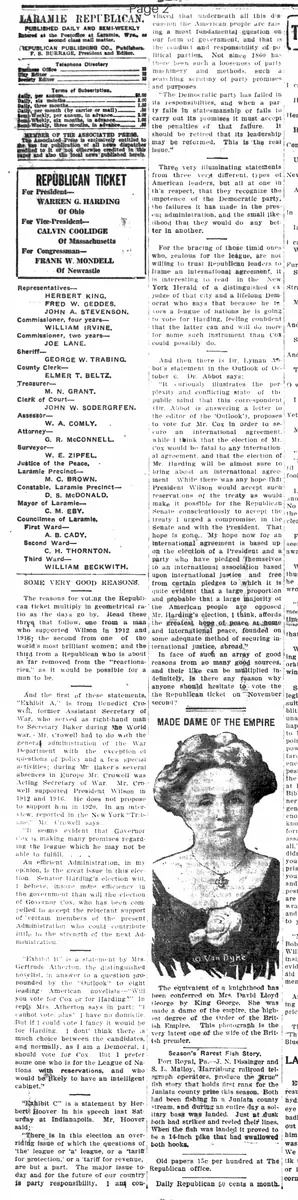
SOME VERY GOOD REASONS.
The reasons for voting the Republican ticket multiply in geometrical ratio as the days go by. Read these three that follow, one from a man who supported Wilson in 1912 and 1916; the second from one of the world's most brilliant women; and the third from a Republican who is about as far removed from the "reactionaries," as it would be possible for a man to be.
And the first of these statements, "Exhibit A," is from Benedict Crowell, former Assistant Secretary of War, who served as right-hand man to Secretary Baker during the World war. Mr. Crowell had to do with the general administration of the War Department with the exception of questions of policy and a few special activities; during Mr. Baker's several absences in Europe Mr. Crowell was Acting Secretary of War. Mr. Crowell supported President Wilson in 1912 and 1916. He does not propose to support him in 1920. In an interview, reported in the New York "Tribune," Mr. Crowell says:
"It seems evident that Governor Cox is making many promises regarding the league which he may not be able to fulfill. . .
An efficient Administration, in my opinion, is the great issue in this election. Senator Harding's election will, I believe, insure more efficiency in the government than will the election of Governor Cox, who has been compelled to accept the reluctant support of certain members of the present Administration who could contribute little to the strength of the next Administration.
"Exhibit B" is a statement by Mrs. Gertrude Atherton, the distinguished novelist, in answer to a question propounded by the "Outlook" to eight leading American novelists—"Will you vote for Cox or for Harding?" In reply Mrs. Atherton says in part: "I cannot vote, alas! I have no domicile. But if I could vote I fancy it would be for Harding. I don't think there is much choice between the candidates, and normally, as I am a Democrat, I should vote for Cox. But I prefer some one who is for the League of Nations with reservations, and who would be likely to have an intelligent cabinet."
"Exhibit C" is a statement by Herbert Hoover in his speech last Saturday at Indianapolis. Mr. Hoover said:
"There is in this election an overriding issue of which the questions of the league or a league, or a tariff for protection, or a tariff for revenue, are but a part. The major issue today and for the future of our country is party responsibility. I am convinced that underneath all this discussion the American people are raising a most fundamental question on our form of government, and that is the conduct and responsibility of political parties. Not since 1860 has there been such a looseness of party machinery and methods, such a searching scrutiny of party promises and purposes.
"The Democratic party has failed in its responsibilities, and when a party fails in statesmanship or fails to carry out its promises it must accept the penalties of that failure. It should be retired that its leadership may be reformed. This is the real issue."
Three very illuminating statements from three very different types of American leaders, but all at one in this respect, that they recognize the impotence of the Democratic party, the failures it has made in the present administration, and the small likelihood that they would do any better in another.
For the bracing of those timid ones who, zealous for the league, are not willing to trust Republican leaders to frame an international agreement, it is interesting to read in the New York Herald of a distinguished ex-judge of that city and a lifelong Democrat who says that because he favors a league of nations he is going to vote for Harding, feeling confident that the latter can and will do more for some such instrument than Cox could possibly do.
And then there is Dr. Lyman Abbott's statement in the Outlook of October 9. Dr. Abbott says:
"It curiously illustrates the perplexity and conflicting state of the public mind that this correspondent (Dr. Abbott is answering a letter to the editor of the Outlook), proposes to vote for Mr. Cox in order to secure an international agreement, while I think that the election of Mr. Cox would be fatal to any international agreement, and that the election of Mr. Harding will be almost sure to bring about an international agreement. While there was any hope that President Wilson would accept such reservations of the treaty as would make it possible for the Republican Senate conscientiously to accept the treaty I urged a compromise, in the Senate and with the President. That hope is gone. My hope now for an international agreement is based upon the election of a President and a party who have pledged themselves to an international association based upon international justice and free from certain pledges to which it is quite evident that a large proportion and probable that a large majority of the American people are opposed.
Mr. Harding's election, I think, affords the greatest hope of peace at home and international peace, founded on some adequate method of securing international justice, abroad."
In face of such an array of good reasons from so many good sources, and their like can be multiplied indefinitely, is there any reason why anyone should hesitate to vote the Republican ticket on November second?
The reasons for voting the Republican ticket multiply in geometrical ratio as the days go by. Read these three that follow, one from a man who supported Wilson in 1912 and 1916; the second from one of the world's most brilliant women; and the third from a Republican who is about as far removed from the "reactionaries," as it would be possible for a man to be.
And the first of these statements, "Exhibit A," is from Benedict Crowell, former Assistant Secretary of War, who served as right-hand man to Secretary Baker during the World war. Mr. Crowell had to do with the general administration of the War Department with the exception of questions of policy and a few special activities; during Mr. Baker's several absences in Europe Mr. Crowell was Acting Secretary of War. Mr. Crowell supported President Wilson in 1912 and 1916. He does not propose to support him in 1920. In an interview, reported in the New York "Tribune," Mr. Crowell says:
"It seems evident that Governor Cox is making many promises regarding the league which he may not be able to fulfill. . .
An efficient Administration, in my opinion, is the great issue in this election. Senator Harding's election will, I believe, insure more efficiency in the government than will the election of Governor Cox, who has been compelled to accept the reluctant support of certain members of the present Administration who could contribute little to the strength of the next Administration.
"Exhibit B" is a statement by Mrs. Gertrude Atherton, the distinguished novelist, in answer to a question propounded by the "Outlook" to eight leading American novelists—"Will you vote for Cox or for Harding?" In reply Mrs. Atherton says in part: "I cannot vote, alas! I have no domicile. But if I could vote I fancy it would be for Harding. I don't think there is much choice between the candidates, and normally, as I am a Democrat, I should vote for Cox. But I prefer some one who is for the League of Nations with reservations, and who would be likely to have an intelligent cabinet."
"Exhibit C" is a statement by Herbert Hoover in his speech last Saturday at Indianapolis. Mr. Hoover said:
"There is in this election an overriding issue of which the questions of the league or a league, or a tariff for protection, or a tariff for revenue, are but a part. The major issue today and for the future of our country is party responsibility. I am convinced that underneath all this discussion the American people are raising a most fundamental question on our form of government, and that is the conduct and responsibility of political parties. Not since 1860 has there been such a looseness of party machinery and methods, such a searching scrutiny of party promises and purposes.
"The Democratic party has failed in its responsibilities, and when a party fails in statesmanship or fails to carry out its promises it must accept the penalties of that failure. It should be retired that its leadership may be reformed. This is the real issue."
Three very illuminating statements from three very different types of American leaders, but all at one in this respect, that they recognize the impotence of the Democratic party, the failures it has made in the present administration, and the small likelihood that they would do any better in another.
For the bracing of those timid ones who, zealous for the league, are not willing to trust Republican leaders to frame an international agreement, it is interesting to read in the New York Herald of a distinguished ex-judge of that city and a lifelong Democrat who says that because he favors a league of nations he is going to vote for Harding, feeling confident that the latter can and will do more for some such instrument than Cox could possibly do.
And then there is Dr. Lyman Abbott's statement in the Outlook of October 9. Dr. Abbott says:
"It curiously illustrates the perplexity and conflicting state of the public mind that this correspondent (Dr. Abbott is answering a letter to the editor of the Outlook), proposes to vote for Mr. Cox in order to secure an international agreement, while I think that the election of Mr. Cox would be fatal to any international agreement, and that the election of Mr. Harding will be almost sure to bring about an international agreement. While there was any hope that President Wilson would accept such reservations of the treaty as would make it possible for the Republican Senate conscientiously to accept the treaty I urged a compromise, in the Senate and with the President. That hope is gone. My hope now for an international agreement is based upon the election of a President and a party who have pledged themselves to an international association based upon international justice and free from certain pledges to which it is quite evident that a large proportion and probable that a large majority of the American people are opposed.
Mr. Harding's election, I think, affords the greatest hope of peace at home and international peace, founded on some adequate method of securing international justice, abroad."
In face of such an array of good reasons from so many good sources, and their like can be multiplied indefinitely, is there any reason why anyone should hesitate to vote the Republican ticket on November second?
What sub-type of article is it?
Partisan Politics
Foreign Affairs
What keywords are associated?
1920 Election
Republican Ticket
League Of Nations
Party Responsibility
Democratic Failure
Harding Support
Wilson Administration
What entities or persons were involved?
Benedict Crowell
Gertrude Atherton
Herbert Hoover
Governor Cox
Senator Harding
President Wilson
Dr. Lyman Abbott
Editorial Details
Primary Topic
Reasons To Vote Republican Ticket In 1920 Election
Stance / Tone
Strongly Pro Republican And Anti Democratic Administration
Key Figures
Benedict Crowell
Gertrude Atherton
Herbert Hoover
Governor Cox
Senator Harding
President Wilson
Dr. Lyman Abbott
Key Arguments
Governor Cox's Promises On The League May Not Be Fulfillable
Harding's Election Ensures More Efficient Government
Preference For Harding Due To Support For League With Reservations And Intelligent Cabinet
Overriding Issue Is Party Responsibility; Democrats Have Failed
Democratic Party Must Be Retired For Reform
Harding Can Achieve International Agreement Better Than Cox
Election Of Harding Affords Greatest Hope For Peace Based On International Justice