Thank you for visiting SNEWPapers!
Sign up free
Story
May 26, 1868
The Carson Daily Appeal
Carson City, Ormsby County, Carson City County, Nevada
What is this article about?
Congressman Ignatius Donnelly of Minnesota delivers a scathing, sarcastic speech in the House against Elihu Washburne of Illinois over a political quarrel involving a railroad bill and personal attacks, mocking Washburne's ambitions tied to Ulysses S. Grant.
Clipping
OCR Quality
96%
Excellent
Full Text
DONNELLY ON WASHBURNE.
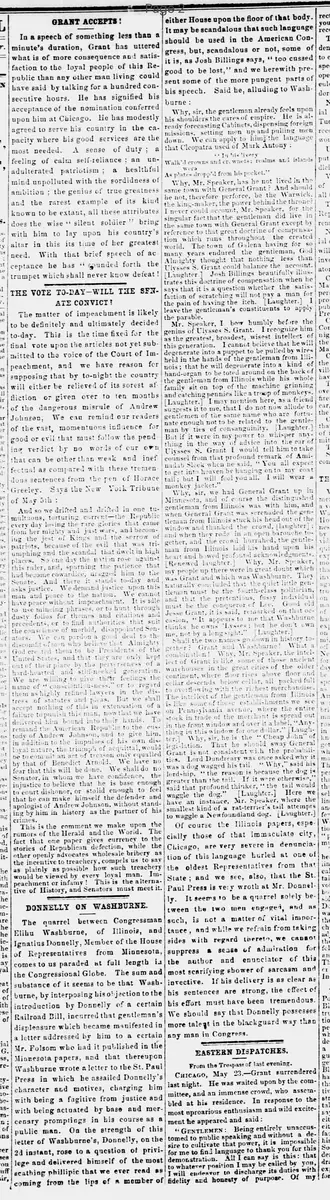
The quarrel between Congressman Elihu Washburne, of Illinois, and Ignatius Donnelly, Member of the House of Representatives from Minnesota, comes to us paraded at full length in the Congressional Globe. The sum and substance of it seems to be that Washburne, by interposing his objection to the introduction by Donnelly of a certain Railroad Bill, incurred that gentleman's displeasure which became manifested in a letter addressed by him to a certain Mr. Folsom who had it published in the Minnesota papers, and that thereupon Washburne wrote a letter to the St. Paul Press in which he assailed Donnelly's character and motives, charging him with being a fugitive from justice and with being actuated by base and mercenary promptings in his course as a public man. On the strength of this letter of Washburne's, Donnelly, on the 2d instant, rose to a question of privilege and delivered himself of the most scathing philippic that we ever read as coming from the lips of a member of either House upon the floor of that body.
It may be scandalous that such language should be used in the American Congress, but, scandalous or not, some of it is, as Josh Billings says, "too cussed good to be lost," and we herewith present some of the more pungent parts of his speech. Said he, alluding to Washburne:
Why, sir, the gentleman already feels upon his shoulders the cares of empire. He is already forecasting Cabinets, dispensing foreign missions, setting men up and pulling men down. We can apply to him the language that Cleopatra used of Mark Antony:
"In his livery
Walk'd crowns and crownets: realms and islands
As plates dropp'd from his pocket."
Why, Mr. Speaker, has he not lived in the same town with General Grant? And should he not, therefore perforce, be the Warwick, the king-maker, the power behind the throne? I never could account, Mr. Speaker, for the singular fact that the gentleman did live in the same town with General Grant except by reference to that great doctrine of compensation which runs throughout the created world. The town of Galena having for so many years endured the gentleman, God Almighty thought that nothing less than Ulysses S. Grant could balance the account. [Laughter.] Josh Billings beautifully illustrates this doctrine of compensation when he says that it is a question whether the satisfaction of scratching will not pay a man for the pain of having the itch. [Laughter.] I leave the gentleman's constituents to apply the parable.
Mr. Speaker, I bow humbly before the genius of Ulysses S. Grant. I recognize him as the greatest, broadest, wisest intellect of this generation. I cannot believe that he will degenerate into a puppet to be pulled by wires held in the hands of the gentleman from Illinois; that he will degenerate into a kind of hand-organ to be toted around on the back of the gentleman from Illinois while his whole family sit on top of the machine grinning and catching pennies like a troop of monkeys. [Laughter.] I may mention here, as a friend suggests it to me, that I do not now allude to gentlemen of the same name who are fortunate enough not to be related to the gentleman by ties of consanguinity. [Laughter.]
But if it were in my power to whisper anything in the way of advice into the ear of Ulysses S. Grant I would tell him to take counsel from that profound remark of Aminadib Sleek when he said, "You all expect to get into heaven by hanging onto my coat tail; but I will fool you all." I will wear a monkey jacket."
Why, sir, we had General Grant up in Minnesota, and of course the distinguished gentleman from Illinois was with him, and when General Grant was serenaded the gentleman from Illinois stuck his head out of the window and thanked the crowd, [laughter]: and when they rode in an open barouche together, and the crowd hurrahed, the gentleman from Illinois laid his hand upon his heart and bowed profound acknowledgments. [Renewed laughter.] Why, Mr. Speaker, my people up there were in great doubt which was Grant and which was Washburne. They naturally concluded that the quiet little gentleman must be the fourth-class politician, and that the pretentious, fussy individual must be the conqueror of Lee. Good old Jesse Grant, it is said, remarked on that occasion, "It appears to me that Washburne thinks he owns Ulysses; but he don't own me, not by a long sight." [Laughter.]
Shall the two names go down in history together? Grant and Washburne! What a combination! Why, Mr. Speaker, the intellect of Grant is like some of those ancient warehouses in the great cities of the older continent, where floor rises above floor and cellar descends below cellar, all packed full to overflowing with the richest merchandise. The intellect of the gentleman from Illinois is like some of those establishments we see on Pennsylvania avenue, where the entire stock in trade of the merchant is spread out in the front window and over it a label, "Anything in this window for one dollar." [Laughter.] Why, sir, he is the "Cheap John" of legislation. That he should sway General Grant is not consistent with the probabilities. Lord Dundreary was once asked why it was a dog wagged his tail. "Why," said his lordship, "the reason is because the dog is greater than the tail. If it were otherwise," said that profound thinker, "the tail would waggle the dog." [Laughter.] Here we have an instance, Mr. Speaker, where the smallest kind of a rat-terrier's tail attempts to waggle a Newfoundland dog. [Laughter.]
Of course the Illinois papers, especially those of that immaculate city, Chicago, are very severe in denunciation of this language hurled at one of the oldest Representatives from that State; and we see, also, that the St. Paul Press is very wroth at Mr. Donnelly. It seems to be a quarrel solely between the two men engaged, and as such, is not a matter of vital importance, and while we refrain from taking sides with regard thereto, we cannot suppress a sense of admiration for the author and enunciator of this most scarifying shower of sarcasm and invective. If his delivery is as clear as his sentences are strong, the effect of his effort must have been tremendous. We should say that Donnelly possesses more talent in the blackguard way than any man in Congress.
The quarrel between Congressman Elihu Washburne, of Illinois, and Ignatius Donnelly, Member of the House of Representatives from Minnesota, comes to us paraded at full length in the Congressional Globe. The sum and substance of it seems to be that Washburne, by interposing his objection to the introduction by Donnelly of a certain Railroad Bill, incurred that gentleman's displeasure which became manifested in a letter addressed by him to a certain Mr. Folsom who had it published in the Minnesota papers, and that thereupon Washburne wrote a letter to the St. Paul Press in which he assailed Donnelly's character and motives, charging him with being a fugitive from justice and with being actuated by base and mercenary promptings in his course as a public man. On the strength of this letter of Washburne's, Donnelly, on the 2d instant, rose to a question of privilege and delivered himself of the most scathing philippic that we ever read as coming from the lips of a member of either House upon the floor of that body.
It may be scandalous that such language should be used in the American Congress, but, scandalous or not, some of it is, as Josh Billings says, "too cussed good to be lost," and we herewith present some of the more pungent parts of his speech. Said he, alluding to Washburne:
Why, sir, the gentleman already feels upon his shoulders the cares of empire. He is already forecasting Cabinets, dispensing foreign missions, setting men up and pulling men down. We can apply to him the language that Cleopatra used of Mark Antony:
"In his livery
Walk'd crowns and crownets: realms and islands
As plates dropp'd from his pocket."
Why, Mr. Speaker, has he not lived in the same town with General Grant? And should he not, therefore perforce, be the Warwick, the king-maker, the power behind the throne? I never could account, Mr. Speaker, for the singular fact that the gentleman did live in the same town with General Grant except by reference to that great doctrine of compensation which runs throughout the created world. The town of Galena having for so many years endured the gentleman, God Almighty thought that nothing less than Ulysses S. Grant could balance the account. [Laughter.] Josh Billings beautifully illustrates this doctrine of compensation when he says that it is a question whether the satisfaction of scratching will not pay a man for the pain of having the itch. [Laughter.] I leave the gentleman's constituents to apply the parable.
Mr. Speaker, I bow humbly before the genius of Ulysses S. Grant. I recognize him as the greatest, broadest, wisest intellect of this generation. I cannot believe that he will degenerate into a puppet to be pulled by wires held in the hands of the gentleman from Illinois; that he will degenerate into a kind of hand-organ to be toted around on the back of the gentleman from Illinois while his whole family sit on top of the machine grinning and catching pennies like a troop of monkeys. [Laughter.] I may mention here, as a friend suggests it to me, that I do not now allude to gentlemen of the same name who are fortunate enough not to be related to the gentleman by ties of consanguinity. [Laughter.]
But if it were in my power to whisper anything in the way of advice into the ear of Ulysses S. Grant I would tell him to take counsel from that profound remark of Aminadib Sleek when he said, "You all expect to get into heaven by hanging onto my coat tail; but I will fool you all." I will wear a monkey jacket."
Why, sir, we had General Grant up in Minnesota, and of course the distinguished gentleman from Illinois was with him, and when General Grant was serenaded the gentleman from Illinois stuck his head out of the window and thanked the crowd, [laughter]: and when they rode in an open barouche together, and the crowd hurrahed, the gentleman from Illinois laid his hand upon his heart and bowed profound acknowledgments. [Renewed laughter.] Why, Mr. Speaker, my people up there were in great doubt which was Grant and which was Washburne. They naturally concluded that the quiet little gentleman must be the fourth-class politician, and that the pretentious, fussy individual must be the conqueror of Lee. Good old Jesse Grant, it is said, remarked on that occasion, "It appears to me that Washburne thinks he owns Ulysses; but he don't own me, not by a long sight." [Laughter.]
Shall the two names go down in history together? Grant and Washburne! What a combination! Why, Mr. Speaker, the intellect of Grant is like some of those ancient warehouses in the great cities of the older continent, where floor rises above floor and cellar descends below cellar, all packed full to overflowing with the richest merchandise. The intellect of the gentleman from Illinois is like some of those establishments we see on Pennsylvania avenue, where the entire stock in trade of the merchant is spread out in the front window and over it a label, "Anything in this window for one dollar." [Laughter.] Why, sir, he is the "Cheap John" of legislation. That he should sway General Grant is not consistent with the probabilities. Lord Dundreary was once asked why it was a dog wagged his tail. "Why," said his lordship, "the reason is because the dog is greater than the tail. If it were otherwise," said that profound thinker, "the tail would waggle the dog." [Laughter.] Here we have an instance, Mr. Speaker, where the smallest kind of a rat-terrier's tail attempts to waggle a Newfoundland dog. [Laughter.]
Of course the Illinois papers, especially those of that immaculate city, Chicago, are very severe in denunciation of this language hurled at one of the oldest Representatives from that State; and we see, also, that the St. Paul Press is very wroth at Mr. Donnelly. It seems to be a quarrel solely between the two men engaged, and as such, is not a matter of vital importance, and while we refrain from taking sides with regard thereto, we cannot suppress a sense of admiration for the author and enunciator of this most scarifying shower of sarcasm and invective. If his delivery is as clear as his sentences are strong, the effect of his effort must have been tremendous. We should say that Donnelly possesses more talent in the blackguard way than any man in Congress.
What sub-type of article is it?
Historical Event
What themes does it cover?
Social Manners
Triumph
What keywords are associated?
Congressional Quarrel
Political Speech
Sarcasm
Railroad Bill
Washburne
Donnelly
Grant
What entities or persons were involved?
Elihu Washburne
Ignatius Donnelly
Ulysses S. Grant
Where did it happen?
House Of Representatives
Story Details
Key Persons
Elihu Washburne
Ignatius Donnelly
Ulysses S. Grant
Location
House Of Representatives
Event Date
2d Instant
Story Details
Washburne objects to Donnelly's railroad bill, leading to mutual letters of attack; Donnelly responds with a sarcastic speech mocking Washburne's ambitions and connection to Grant.