Thank you for visiting SNEWPapers!
Sign up free
The Princeton Union
Princeton, Mille Lacs County, Minnesota
What is this article about?
Moral article for youth warning against dishonesty in trades and promises, using examples of 'tricky' boy Fred Wilson who misrepresents items and breaks promises, and another boy who stole to become a convict, emphasizing the need for honesty to avoid becoming unreliable businessmen.
Clipping
OCR Quality
Full Text
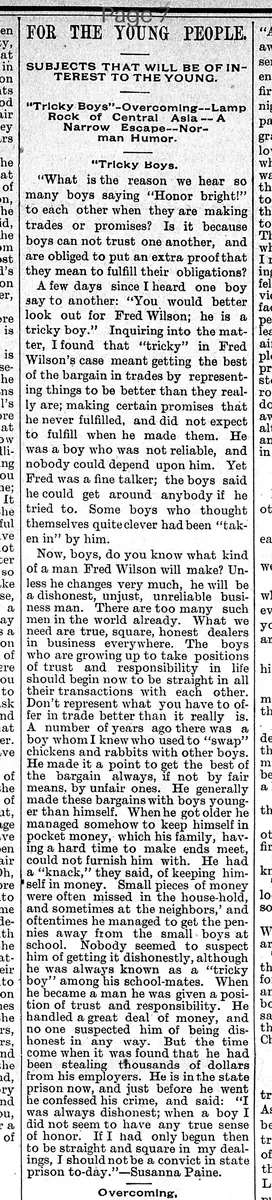
SUBJECTS THAT WILL BE OF INTEREST TO THE YOUNG.
'Tricky Boys'—Overcoming—Lamp Rock of Central Asia—A Narrow Escape—Norman Humor.
'Tricky Boys.'
'What is the reason we hear so many boys saying "Honor bright!" to each other when they are making trades or promises? Is it because boys can not trust one another, and are obliged to put an extra proof that they mean to fulfill their obligations?
A few days since I heard one boy say to another: 'You would better look out for Fred Wilson; he is a tricky boy.' Inquiring into the matter, I found that "tricky" in Fred Wilson's case meant getting the best of the bargain in trades by representing things to be better than they really are; making certain promises that he never fulfilled, and did not expect to fulfill when he made them. He was a boy who was not reliable, and nobody could depend upon him. Yet Fred was a fine talker; the boys said he could get around anybody if he tried to. Some boys who thought themselves quite clever had been "taken in" by him.
Now, boys, do you know what kind of a man Fred Wilson will make? Unless he changes very much, he will be a dishonest, unjust, unreliable business man. There are too many such men in the world already. What we need are true, square, honest dealers in business everywhere. The boys who are growing up to take positions of trust and responsibility in life should begin now to be straight in all their transactions with each other. Don't represent what you have to offer in trade better than it really is.
A number of years ago there was a boy whom I knew who used to "swap" chickens and rabbits with other boys. He made it a point to get the best of the bargain always, if not by fair means, by unfair ones. He generally made these bargains with boys younger than himself. When he got older he managed somehow to keep himself in pocket money, which his family, having a hard time to make ends meet, could not furnish him with. He had a "knack," they said, of keeping himself in money. Small pieces of money were often missed in the household, and sometimes at the neighbors,' and oftentimes he managed to get the pennies away from the small boys at school. Nobody seemed to suspect him of getting it dishonestly, although he was always known as a "tricky boy" among his school-mates. When he became a man he was given a position of trust and responsibility. He handled a great deal of money, and no one suspected him of being dishonest in any way. But the time came when it was found that he had been stealing thousands of dollars from his employers. He is in the state prison now, and just before he went he confessed his crime, and said: "I was always dishonest; when a boy I did not seem to have any true sense of honor. If I had only begun then to be straight and square in my dealings, I should not be a convict in state prison to-day."
—Susanna Paine.
What sub-type of article is it?
What themes does it cover?
What keywords are associated?
What entities or persons were involved?
Story Details
Key Persons
Event Date
A Number Of Years Ago
Story Details
Article discusses why boys use 'Honor bright' in promises due to distrust, exemplified by tricky boy Fred Wilson who misrepresents trades and breaks promises, predicting he will become dishonest; recounts another boy who swapped unfairly, stole small amounts, and later embezzled thousands, confessing his lifelong dishonesty led to prison.