Thank you for visiting SNEWPapers!
Sign up free
Editorial
November 19, 1802
Alexandria Advertiser And Commercial Intelligencer
Alexandria, Virginia
What is this article about?
This editorial, 'Lessons from History,' draws parallels from ancient Rome and the French Revolution to warn that demagogues use the rabble and immigrants to undermine the middling class, property rights, and liberty in America. It criticizes Jacobins and revolutionaries as threats to true liberty and virtue.
Clipping
OCR Quality
98%
Excellent
Full Text
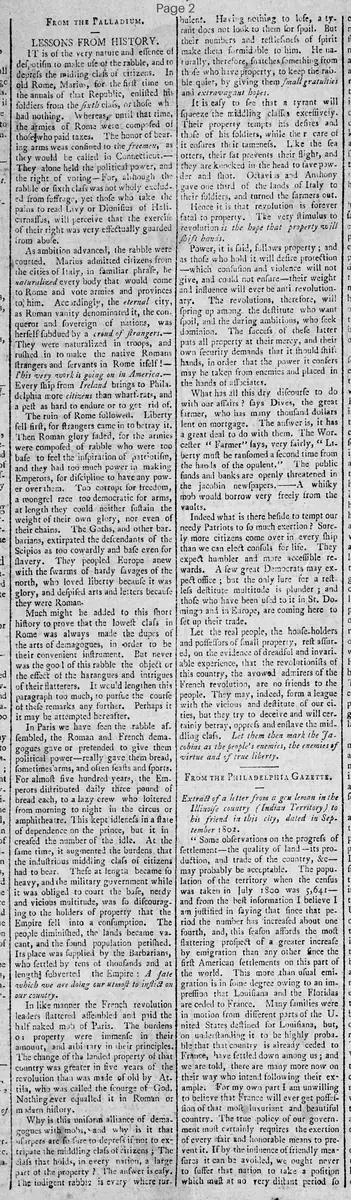
From the Palladium.
LESSONS FROM HISTORY.
It is of the very nature and essence of despotism to make use of the rabble, and to depress the middling class of citizens. In old Rome, Marius, for the first time on the annals of that Republic, enlisted his soldiers from the sixth class, or those who had nothing. Whereas, until that time, the armies of Rome were composed of those who paid taxes. The honor of bearing arms was confined to the freemen, as they would be called in Connecticut. They alone held the political power, and the right of voting -- For, although the rabble or sixth class was not wholly excluded from suffrage, yet those who take the pains to read Livy or Dionysius of Halicarnassus, will perceive that the exercise of their right was very effectually guarded from abuse.
As ambition advanced, the rabble were courted. Marius admitted citizens from the cities of Italy, in familiar phrase, he naturalized every body that would come to Rome and vote armies and provinces to him. Accordingly, the eternal city, as Roman vanity denominated it, the conqueror and sovereign of nations, was herself subdued by a crowd of strangers. They were naturalized in troops, and rushed in to make the native Romans strangers and servants in Rome itself!
This very work is going on in America. Every Ship from Ireland brings to Philadelphia more citizens than wharf-rats, and a pest as hard to endure or to get rid of. The ruin of Rome followed. Liberty fell first, for strangers came in to betray it. Then Roman glory faded, for the armies were composed of rabble who were too base to feel the inspiration of patriotism, and they had too much power in making Emperors, for discipline to have any power over them. Too corrupt for freedom, a mongrel race too democratic for arms, at length they could neither sustain the weight of their own glory, nor even of their chains. The Goths, and other barbarians, extirpated the descendants of the Scipios as too cowardly and base even for slavery. They peopled Europe anew with the swarms of hardy savages of the north, who loved liberty because it was glory, and despised arts and letters because they were Roman.
Much might be added to this short history to prove that the lowest class in Rome was always made the dupes of the arts of demagogues, in order to be their convenient instrument. But never was the good of this rabble the object or the effect of the harangues and intrigues of their flatterers. It would lengthen this paragraph too much, to pursue the course of these remarks any further. Perhaps it may be attempted hereafter.
In Paris we have seen the rabble assembled, the Roman and French demagogues gave or pretended to give them political power -- really gave them bread, sometimes arms, and often feasts and sports. For almost five hundred years, the Emperors distributed daily three pounds of bread each, to a lazy crew who loitered from morning to night in the circus or amphitheatre. This kept idleness in a state of dependence on the prince, but it increased the number of the idle. At the same time, it augmented the burdens that the industrious middling class of citizens had to bear. These at length became so heavy, and the military government while it was obliged to court the base, needy and vicious multitude, was so discouraging to the holders of property that the Empire fell into a consumption. The people diminished, the lands became vacant, and the sound population perished. Its place was supplied by the Barbarians, who settled by tens of thousands and at length subverted the Empire: A fate which we are doing our utmost to inflict on our country.
In like manner the French revolution leaders flattered assembled and paid the half naked mob of Paris. The burdens on property were immense in their amount, and arbitrary in their principles. The change of the landed property of that country was greater in five years of the revolution than was made of old by Attila, who was called the scourge of God. Nothing ever equalled it in Roman or modern history.
Why is this uniform alliance of demagogues with mobs, and why is it that usurpers are so fond to depress if not to exterminate the middling class of citizens; The class that holds, in every nation, a large part of the property? The answer is easy. The indigent rabble is every where purchasable. Having nothing to lose, a tyrant does not look to them for spoil. But their numbers and restlessness of spirit make them formidable to him. He naturally, therefore, snatches something from those who have property, to keep the rabble quiet, by giving them small gratuities and extravagant hopes.
It is easy to see that a tyrant will squeeze the middling class excessively. Their property tempts his desires and those of his soldiers, while the care of it ensures their tameness. Like the eagles, their fat prevents their flight, and they are knocked in the head to save powder and shot. Octavius and Anthony gave one third of the lands of Italy to their soldiers, and turned the farmers out. Hence it is that revolution is forever fatal to property. The very stimulus to revolution is the hope that property will shift hands.
Power, it is said, follows property; and as those who hold it will desire protection -- which confusion and violence will not give, and could not ensure -- their weight and influence will ever be anti-revolutionary. The revolutions, therefore, will spring up among the destitute who want spoil, and the daring ambitious, who seek dominion. The success of these latter puts all property at their mercy, and their own security demands that it should shift hands, in order that the power it confers may be taken from enemies and placed in the hands of associates.
What has all this dry discourse to do with our affairs? says Dives, the great farmer, who has many thousand dollars lent on mortgage. The answer is, it has a great deal to do with them. The Worcester "Farmer" says, very fairly, "Liberty must be ransomed a second time from the hands of the opulent," The public funds and banks are openly threatened in the jacobin newspapers. ---- A whisky mob would borrow very freely from the vaults.
Indeed what is there beside to tempt our needy Patriots to so much exertion? Surely more citizens come over in every ship than we can elect consuls for life. They expect humbler and more accessible rewards. A few great Democrats may expect office; but the only lure for a restless destitute multitude is plunder; and those who have been used to it in St. Domingo and in Europe, are coming here to set up their trade.
Let the real people, the house-holders and possessors of small property, rest assured, on the evidence of dreadful and invariable experience, that the revolutionists of this country, the avowed admirers of the French revolution, are no friends to the people. They may, indeed, form a league with the vicious and destitute of our cities, but they try to deceive and will certainly betray, oppress and enslave the middling class. Let them then mark the Jacobins as the people's enemies, the enemies of virtue and of true liberty.
LESSONS FROM HISTORY.
It is of the very nature and essence of despotism to make use of the rabble, and to depress the middling class of citizens. In old Rome, Marius, for the first time on the annals of that Republic, enlisted his soldiers from the sixth class, or those who had nothing. Whereas, until that time, the armies of Rome were composed of those who paid taxes. The honor of bearing arms was confined to the freemen, as they would be called in Connecticut. They alone held the political power, and the right of voting -- For, although the rabble or sixth class was not wholly excluded from suffrage, yet those who take the pains to read Livy or Dionysius of Halicarnassus, will perceive that the exercise of their right was very effectually guarded from abuse.
As ambition advanced, the rabble were courted. Marius admitted citizens from the cities of Italy, in familiar phrase, he naturalized every body that would come to Rome and vote armies and provinces to him. Accordingly, the eternal city, as Roman vanity denominated it, the conqueror and sovereign of nations, was herself subdued by a crowd of strangers. They were naturalized in troops, and rushed in to make the native Romans strangers and servants in Rome itself!
This very work is going on in America. Every Ship from Ireland brings to Philadelphia more citizens than wharf-rats, and a pest as hard to endure or to get rid of. The ruin of Rome followed. Liberty fell first, for strangers came in to betray it. Then Roman glory faded, for the armies were composed of rabble who were too base to feel the inspiration of patriotism, and they had too much power in making Emperors, for discipline to have any power over them. Too corrupt for freedom, a mongrel race too democratic for arms, at length they could neither sustain the weight of their own glory, nor even of their chains. The Goths, and other barbarians, extirpated the descendants of the Scipios as too cowardly and base even for slavery. They peopled Europe anew with the swarms of hardy savages of the north, who loved liberty because it was glory, and despised arts and letters because they were Roman.
Much might be added to this short history to prove that the lowest class in Rome was always made the dupes of the arts of demagogues, in order to be their convenient instrument. But never was the good of this rabble the object or the effect of the harangues and intrigues of their flatterers. It would lengthen this paragraph too much, to pursue the course of these remarks any further. Perhaps it may be attempted hereafter.
In Paris we have seen the rabble assembled, the Roman and French demagogues gave or pretended to give them political power -- really gave them bread, sometimes arms, and often feasts and sports. For almost five hundred years, the Emperors distributed daily three pounds of bread each, to a lazy crew who loitered from morning to night in the circus or amphitheatre. This kept idleness in a state of dependence on the prince, but it increased the number of the idle. At the same time, it augmented the burdens that the industrious middling class of citizens had to bear. These at length became so heavy, and the military government while it was obliged to court the base, needy and vicious multitude, was so discouraging to the holders of property that the Empire fell into a consumption. The people diminished, the lands became vacant, and the sound population perished. Its place was supplied by the Barbarians, who settled by tens of thousands and at length subverted the Empire: A fate which we are doing our utmost to inflict on our country.
In like manner the French revolution leaders flattered assembled and paid the half naked mob of Paris. The burdens on property were immense in their amount, and arbitrary in their principles. The change of the landed property of that country was greater in five years of the revolution than was made of old by Attila, who was called the scourge of God. Nothing ever equalled it in Roman or modern history.
Why is this uniform alliance of demagogues with mobs, and why is it that usurpers are so fond to depress if not to exterminate the middling class of citizens; The class that holds, in every nation, a large part of the property? The answer is easy. The indigent rabble is every where purchasable. Having nothing to lose, a tyrant does not look to them for spoil. But their numbers and restlessness of spirit make them formidable to him. He naturally, therefore, snatches something from those who have property, to keep the rabble quiet, by giving them small gratuities and extravagant hopes.
It is easy to see that a tyrant will squeeze the middling class excessively. Their property tempts his desires and those of his soldiers, while the care of it ensures their tameness. Like the eagles, their fat prevents their flight, and they are knocked in the head to save powder and shot. Octavius and Anthony gave one third of the lands of Italy to their soldiers, and turned the farmers out. Hence it is that revolution is forever fatal to property. The very stimulus to revolution is the hope that property will shift hands.
Power, it is said, follows property; and as those who hold it will desire protection -- which confusion and violence will not give, and could not ensure -- their weight and influence will ever be anti-revolutionary. The revolutions, therefore, will spring up among the destitute who want spoil, and the daring ambitious, who seek dominion. The success of these latter puts all property at their mercy, and their own security demands that it should shift hands, in order that the power it confers may be taken from enemies and placed in the hands of associates.
What has all this dry discourse to do with our affairs? says Dives, the great farmer, who has many thousand dollars lent on mortgage. The answer is, it has a great deal to do with them. The Worcester "Farmer" says, very fairly, "Liberty must be ransomed a second time from the hands of the opulent," The public funds and banks are openly threatened in the jacobin newspapers. ---- A whisky mob would borrow very freely from the vaults.
Indeed what is there beside to tempt our needy Patriots to so much exertion? Surely more citizens come over in every ship than we can elect consuls for life. They expect humbler and more accessible rewards. A few great Democrats may expect office; but the only lure for a restless destitute multitude is plunder; and those who have been used to it in St. Domingo and in Europe, are coming here to set up their trade.
Let the real people, the house-holders and possessors of small property, rest assured, on the evidence of dreadful and invariable experience, that the revolutionists of this country, the avowed admirers of the French revolution, are no friends to the people. They may, indeed, form a league with the vicious and destitute of our cities, but they try to deceive and will certainly betray, oppress and enslave the middling class. Let them then mark the Jacobins as the people's enemies, the enemies of virtue and of true liberty.
What sub-type of article is it?
Immigration
Partisan Politics
Economic Policy
What keywords are associated?
Rabble Politics
Immigration Dangers
Middling Class
Property Rights
Jacobin Threats
French Revolution
Roman History
Demagogues
What entities or persons were involved?
Marius
Livy
Dionysius Of Halicarnassus
Jacobins
French Revolution Leaders
Worcester Farmer
Dives
Editorial Details
Primary Topic
Historical Warnings Against Rabble, Immigration, And Revolution Threatening Middling Class And Liberty
Stance / Tone
Strongly Anti Jacobin And Anti Immigration, Pro Middling Class And Property Rights
Key Figures
Marius
Livy
Dionysius Of Halicarnassus
Jacobins
French Revolution Leaders
Worcester Farmer
Dives
Key Arguments
Despotism Uses Rabble To Depress Middling Class
Roman Armies Once Composed Of Taxpayers, Later Rabble Led To Ruin
Irish Immigrants To America Threaten Liberty Like Strangers In Rome
French Revolution Burdened Property And Empowered Mob
Demagogues Ally With Mobs To Plunder Property Holders
Revolutions Fatal To Property, Shift It To Associates
Jacobins Threaten Banks And Funds, Aim To Plunder