Thank you for visiting SNEWPapers!
Sign up free
Edgefield Advertiser
Edgefield, Edgefield County, South Carolina
What is this article about?
The packet ship Montezuma, en route from Philadelphia to Liverpool, rescues 16 crew members from the sinking French brig St. Bernard de Fecherep in rough Atlantic seas on April 25, led by Captain Lowber after passenger Mrs. Ciprial spots the wreck; providential calm aids the operation.
Merged-components note: Continuous narrative story on the rescue incident at sea.
Clipping
OCR Quality
Full Text
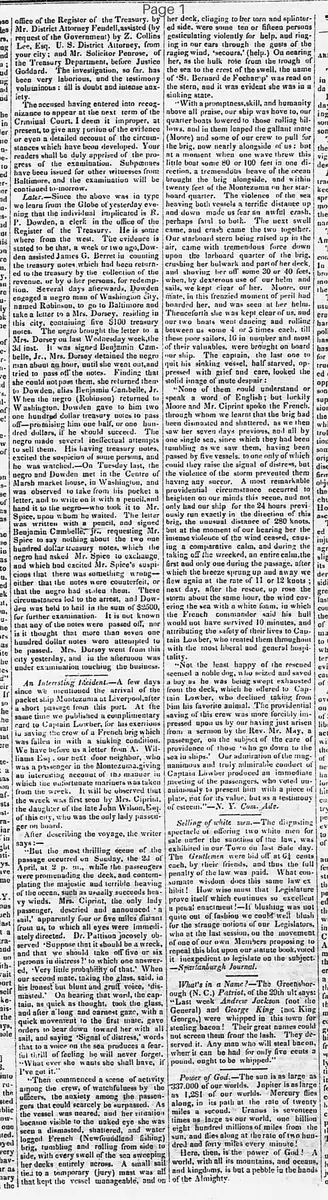
We have before us a letter from A. Williams Esq., our next door neighbor, who was a passenger in the Montezuma, giving an interesting account of the manner in which the unfortunate mariners were taken from the wreck. It will be observed that the wreck was first seen by Mrs. Ciprial, the daughter of the late John Wilson, Esq. of this city, who was the only lady passenger on board.
After describing the voyage, the writer says:--
…But the most thrilling scene of the passage occurred on Sunday, the 25th of April, at 2 p.m., when the passengers were promenading the deck, and contemplating the majestic and terrible heaving of the ocean, such as usually succeeds heavy winds.
Mrs. Ciprial, the only lady passenger, descried and announced a sail, apparently four or five miles distant from us, to which all eyes were immediately directed. Dr. Pattison jocosely observed "Suppose that it should be a wreck, and that we should take off five or six persons in distress?" to which one answered, "Very little probability of that." When our second mate, taking the glass, said, in his honest but blunt and gruff voice, "dismasted." On hearing that word, the captain, as quick as thought, took the glass, and after a long and earnest gaze, with a quick movement to the first mate, gave orders to bear down toward her with all sail, and saying "Signal of distress," words that to a voice on the sea produces a fearful thrill of feeling he will never forget. "What ever she wants she shall have, if I've got it."
Then commenced a scene of activity among the crew, of watchfulness by the officers, the anxiety among the passengers that could scarcely be surpassed.--As the vessel was neared, and her situation became visible to the naked eye she was seen a dismasted, shattered, and water logged French (Newfoundland fishing) brig, tumbling and rolling from side to side, with every swell of the sea sweeping her decks entirely across. A small sail tied to a temporary (jury) mast was all that kept the vessel manageable, and on her deck, clinging to her torn and splintered side, were some ten or fifteen persons gesticulating violently for help, and ringing in our ears through the gusts of the raging wind, "secours." (help.) On nearing her, as the bulk rose from the trough of the sea to the crest of the swell, the name of "St. Bernard de Fecherep" was read on the stern, and it was evident she was in a sinking state.
With a promptness, skill, and humanity above all praise, our ship was hove to, our quarter boats lowered to those rolling billows, and in them leaped the gallant mate (Moore) and some of our crew to pull for the brig, now nearly alongside of us: but at a moment when one wave threw this little boat some 80 or 100 feet in one direction, a tremendous heave of the ocean brought the brig alongside, and within twenty feet of the Montezuma on her starboard quarter. The violence of the sea heaving both vessels a terrific distance up and down made us fear an awful crash, perhaps fatal to both. The next swell came, and crash came the two together. Our starboard stern being raised up in the air, came with tremendous force down upon the larboard quarter of the brig, crushing her bulwark and part of her deck, and shoving her off some 30 or 40 feet. when, by dexterous use of our helm and sails, we kept clear of her. Moore, our mate, in this frenzied moment of peril had boarded her, and was seen at her helm.
Thenceforth she was kept clear of us, and our two boats went dancing and rolling between us some 4 or 5 times each, till these poor sailors, 16 in number and most of their valuables, were brought on board our ship. The captain, the last one to quit his sinking vessel, half starved, oppressed with grief and care, looked the stolid image of mute despair:
"None of them could understand or speak a word of English; but luckily Moore and Mr. Ciprial spoke the French, through whom we learnt that the brig had been dismasted and shattered, as we then saw her seven days previous, and all by one single sea, since which they had been rumbling as we saw them, having been passed by five vessels, to one only of which could they raise the signal of distress, but the violence of the storm prevented them having any succor. A most remarkable providential circumstance occurred to heighten on our minds this scene, and not only had our ship for the 24 hours previously run exactly in the direction of this brig, the unusual distance of 280 knots, but at the moment of our hearing her the intense violence of the wind ceased, causing a comparative calm, and during the taking of the wrecked, an entire calm, the first and only one during the passage, after which the breeze sprung up and away we flew again at the rate of 11 or 12 knots; next day, after the rescue, up rose the storm about the same hour, the wind covering the sea with a white foam, in which the French commander said his boat would not have survived 10 minutes, and attributing the safety of their lives to Captain Lowber, who treated them throughout with the most liberal and generous hospitality.
Not the least happy of the rescued seemed a noble dog, who seized and saved a boy as he was being swept exhausted from the deck, which he offered to Captain Lowber, who declined taking from him his favorite animal. The providential saving of this crew was more forcibly impressed upon us by our having just arisen from a sermon by the Rev. Mr. May, a passenger, on the subject of the care of providence of those who go down to the sea in ships." Our admiration of the magnanimous and truly admirable conduct of Captain Lowber produced an immediate meeting of the passengers, who voted unanimously to present him with a piece of plate, not for its value, but as a testimony of esteem."--N. Y. Com. Adv.
What sub-type of article is it?
What themes does it cover?
What keywords are associated?
What entities or persons were involved?
Where did it happen?
Story Details
Key Persons
Location
Atlantic Ocean
Event Date
April 25
Story Details
Passenger Mrs. Ciprial spots a dismasted French brig St. Bernard de Fecherep in sinking condition; Captain Lowber orders rescue, leading to a perilous operation in rough seas where boats ferry 16 crew members aboard the Montezuma amid providential calm; passengers present captain with plate in admiration.