Thank you for visiting SNEWPapers!
Sign up free
Story
April 29, 1879
Alexandria Gazette
Alexandria, Alexandria County, District Of Columbia
What is this article about?
On April 29, 1879, in Washington D.C., Congress adjourned after announcing the death of Rep. Rush Clark. Discussions focused on President Hayes' veto of the army appropriation bill, with Democrats debating whether to sustain it or back down, amid predictions of party disunity and political consequences.
Clipping
OCR Quality
92%
Excellent
Full Text
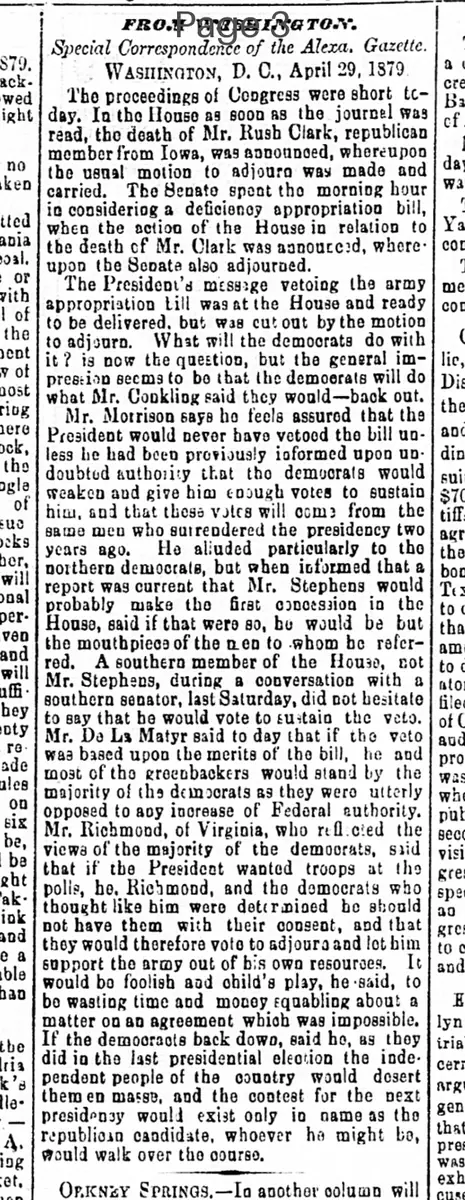
Special Correspondence of the Alex. Gazette.
WASHINGTON, D. C., April 29, 1879
The proceedings of Congress were short to-day. In the House as soon as the journal was read, the death of Mr. Rush Clark, republican member from Iowa, was announced, whereupon the usual motion to adjourn was made and carried. The Senate spent the morning hour in considering a deficiency appropriation bill, when the action of the House in relation to the death of Mr. Clark was announced, whereupon the Senate also adjourned.
The President's message vetoing the army appropriation bill was at the House and ready to be delivered, but was cut out by the motion to adjourn. What will the democrats do with it? is now the question, but the general impression seems to be that the democrats will do what Mr. Conkling said they would—back out. Mr. Morrison says he feels assured that the President would never have vetoed the bill unless he had been previously informed upon undoubted authority that the democrats would weaken and give him enough votes to sustain him, and that these votes will come from the same men who surrendered the presidency two years ago. He alluded particularly to the northern democrats, but when informed that a report was current that Mr. Stephens would probably make the first concession in the House, said if that were so, he would be but the mouthpiece of the men to whom he referred. A southern member of the House, not Mr. Stephens, during a conversation with a southern senator, last Saturday, did not hesitate to say that he would vote to sustain the veto. Mr. Dailey Matvr said to-day that if the veto was based upon the merits of the bill, he and most of the greenbackers would stand by the majority of the democrats as they were utterly opposed to any increase of Federal authority. Mr. Richmond, of Virginia, who reflected the views of the majority of the democrats, said that if the President wanted troops at the polls, he, Richmond, and the democrats who thought like him were determined he should not have them with their consent, and that they would therefore vote to adjourn and let him support the army out of his own resources. It would be foolish and child's play, he said, to be wasting time and money squabbling about a matter on an agreement which was impossible. If the democrats back down, said he, as they did in the last presidential election the independent people of the country would desert them en masse, and the contest for the next presidency would exist only in name as the republican candidate, whoever he might be would walk over the course.
WASHINGTON, D. C., April 29, 1879
The proceedings of Congress were short to-day. In the House as soon as the journal was read, the death of Mr. Rush Clark, republican member from Iowa, was announced, whereupon the usual motion to adjourn was made and carried. The Senate spent the morning hour in considering a deficiency appropriation bill, when the action of the House in relation to the death of Mr. Clark was announced, whereupon the Senate also adjourned.
The President's message vetoing the army appropriation bill was at the House and ready to be delivered, but was cut out by the motion to adjourn. What will the democrats do with it? is now the question, but the general impression seems to be that the democrats will do what Mr. Conkling said they would—back out. Mr. Morrison says he feels assured that the President would never have vetoed the bill unless he had been previously informed upon undoubted authority that the democrats would weaken and give him enough votes to sustain him, and that these votes will come from the same men who surrendered the presidency two years ago. He alluded particularly to the northern democrats, but when informed that a report was current that Mr. Stephens would probably make the first concession in the House, said if that were so, he would be but the mouthpiece of the men to whom he referred. A southern member of the House, not Mr. Stephens, during a conversation with a southern senator, last Saturday, did not hesitate to say that he would vote to sustain the veto. Mr. Dailey Matvr said to-day that if the veto was based upon the merits of the bill, he and most of the greenbackers would stand by the majority of the democrats as they were utterly opposed to any increase of Federal authority. Mr. Richmond, of Virginia, who reflected the views of the majority of the democrats, said that if the President wanted troops at the polls, he, Richmond, and the democrats who thought like him were determined he should not have them with their consent, and that they would therefore vote to adjourn and let him support the army out of his own resources. It would be foolish and child's play, he said, to be wasting time and money squabbling about a matter on an agreement which was impossible. If the democrats back down, said he, as they did in the last presidential election the independent people of the country would desert them en masse, and the contest for the next presidency would exist only in name as the republican candidate, whoever he might be would walk over the course.
What sub-type of article is it?
Historical Event
What themes does it cover?
Betrayal
Justice
What keywords are associated?
Congressional Proceedings
Presidential Veto
Army Appropriation Bill
Democratic Party
Republican Party
Political Maneuvering
What entities or persons were involved?
Rush Clark
Mr. Conkling
Mr. Morrison
Mr. Stephens
Mr. Dailey Matvr
Mr. Richmond
Where did it happen?
Washington, D. C.
Story Details
Key Persons
Rush Clark
Mr. Conkling
Mr. Morrison
Mr. Stephens
Mr. Dailey Matvr
Mr. Richmond
Location
Washington, D. C.
Event Date
April 29, 1879
Story Details
Congress adjourns after announcing Rep. Rush Clark's death; President's veto of army bill prompts Democratic debate on sustaining it versus backing down, with predictions of party betrayal and political fallout.