Thank you for visiting SNEWPapers!
Sign up free
The Union Times
New Haven, New Haven County, Connecticut
What is this article about?
Article by William S. Gordon, Jr., explains the Connecticut Labor Relations Act's protections for employees' rights to unionize without discrimination by employers, including specific prohibitions and an illustrative example of unfair firing.
Merged-components note: merged main story from page 1 with continuation on page 3
Clippings
1 of 2
OCR Quality
Full Text
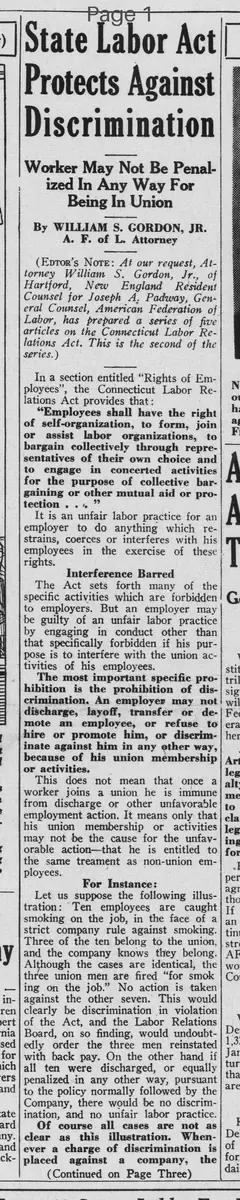
Worker May Not Be Penalized In Any Way For Being In Union
By WILLIAM S. GORDON, JR.
A. F. of L. Attorney
(Editor’s Note: At our request, Attorney William S. Gordon, Jr., of Hartford, New England Resident Counsel for Joseph A. Padway, General Counsel, American Federation of Labor, has prepared a series of five articles on the Connecticut Labor Relations Act. This is the second of the series.)
In a section entitled "Rights of Employees", the Connecticut Labor Relations Act provides that:
"Employees shall have the right of self-organization, to form, join or assist labor organizations, to bargain collectively through representatives of their own choice and to engage in concerted activities for the purpose of collective bargaining or other mutual aid or protection . . ."
It is an unfair labor practice for an employer to do anything which restrains, coerces or interferes with his employees in the exercise of these rights.
Interference Barred
The Act sets forth many of the specific activities which are forbidden to employers. But an employer may be guilty of an unfair labor practice by engaging in conduct other than that specifically forbidden if his purpose is to interfere with the union activities of his employees.
The most important specific prohibition is the prohibition of discrimination. An employer may not discharge, layoff, transfer or demote an employee, or refuse to hire or promote him, or discriminate against him in any other way, because of his union membership or activities.
This does not mean that once a worker joins a union he is immune from discharge or other unfavorable employment action. It means only that his union membership or activities may not be the cause for the unfavorable action-that he is entitled to the same treatment as non-union employees.
For Instance:
Let us suppose the following illustration: Ten employees are caught smoking on the job, in the face of a strict company rule against smoking. Three of the ten belong to the union, and the company knows they belong. Although the cases are identical, the three union men are fired "for smoking on the job." No action is taken against the other seven. This would clearly be discrimination in violation of the Act, and the Labor Relations Board, on so finding, would undoubtedly order the three men reinstated with back pay. On the other hand if all ten were discharged, or equally penalized in any other way, pursuant to the policy normally followed by the Company, there would be no discrimination, and no unfair labor practice.
Of course all cases are not as clear as this illustration. Whenever a charge of discrimination is placed against a company,
Board must decide on all the facts whether the reasons given by the company for its action are the real reasons or whether they are merely a pretext to conceal actual discrimination. The test is whether the real purpose of the action is to discourage membership in a union or to encourage membership in a company union.
It should be noted that the Labor Relations Act does not prevent discharges under a closed shop or other contract provision making union membership a condition of employment. The discharges in' such cases, however, must be pursuant to a valid contract with a union representing a majority of the employees in the bargaining unit.
Other unfair labor practices by employers will be discussed in next week's article.
What sub-type of article is it?
What themes does it cover?
What keywords are associated?
What entities or persons were involved?
Where did it happen?
Story Details
Key Persons
Location
Connecticut
Story Details
The Connecticut Labor Relations Act grants employees rights to form and join unions without employer interference or discrimination. Employers cannot penalize workers for union activities, as illustrated by a hypothetical where union members are unfairly fired for smoking while non-union are not. The Board assesses if actions are pretexts to discourage union membership.